Ministry of Land, Infrastructure and Transport Enhances Basic Functions of Rest Areas
Expands Regional Open-Type Rest Areas
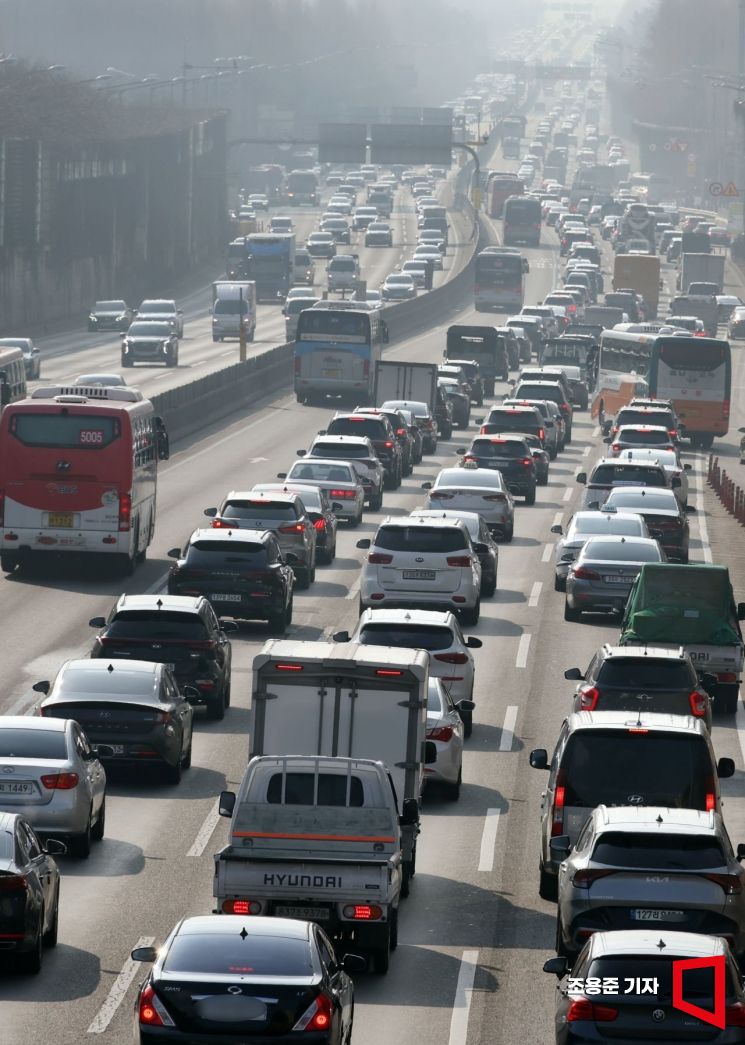 On the 8th, one day before the Lunar New Year holiday, the full-scale homecoming battle began, causing traffic congestion on the southbound lanes of the Seoul-Gyeongbu Expressway heading toward Busan. Photo by Jo Yongjun jun21@
The Ministry of Land, Infrastructure and Transport and Korea Expressway Corporation announced on the 1st that they will implement the 'Expressway Rest Area Service Improvement Plan' for May, when highway traffic is heavy, including guidance on parking spaces and increased frequency of restroom cleaning. Currently, a total of 236 rest areas are operating nationwide on expressways. Among them, 100 rest areas (42.4%) are over 20 years old and have become outdated, and user satisfaction surveys (2023) showed low satisfaction in terms of parking convenience, facility usage convenience, and pedestrian environment.
Accordingly, the plan includes expanding parking space width within rest areas (from 2.5m to 2.7m), providing pedestrian-only pathways, installing speed-reducing crosswalks, separating large and small vehicles, and continuously expanding pre-notification displays of available parking spaces. Currently, these have been introduced at 68 locations, with 9 additional locations to be installed within this year, and by 2030, all rest areas managed by the Expressway Corporation will have these facilities installed.
Before entering drowsy driving rest areas, information on parking congestion will be provided in advance. Currently, it is difficult to check parking availability beforehand, which sometimes leads to drivers not entering or stopping near the entrance to check for parking spaces, posing accident risks. Going forward, pre-notification is expected to reduce accident risks and improve user convenience.
In addition, regular inspections of aging facilities at rest areas will be strengthened, and during periods with many visitors such as weekends and holidays, the frequency of restroom cleaning will be increased to maintain safe and clean rest facilities. Restroom cleaning will be expanded from an average of three times a day to four or more times a day during busy periods like weekends and holidays. To ensure convenience during late-night hours, unmanned automated robot restaurants such as robot chefs and robot cafes will also be increased.
Furthermore, through the expansion of open-type rest areas, rest areas with enjoyable activities in cooperation with local communities will be created. Rest areas, which were previously inaccessible from outside and only available to expressway drivers, will be opened to local communities to become cultural and tourism resources shared with the region. Until last year, there were 3 such locations (Deokpyeong, Jeongeup, Jinju), and this year, 5 additional locations (Icheon, Nongong, Gangcheonsan, Chupungnyeong, Chunhyang) will be added.
Efforts will also be made to promote pedestrian pathways and shuttle bus connections so that visitors can park their vehicles at rest areas and use nearby tourist attractions and shopping malls. Additionally, to support regional economic revitalization, businesses selling products made from local specialties will receive consulting support, and the first year’s rent will be waived as part of regional specialized projects.
© The Asia Business Daily(www.asiae.co.kr). All rights reserved.
![Clutching a Stolen Dior Bag, Saying "I Hate Being Poor but Real"... The Grotesque Con of a "Human Knockoff" [Slate]](https://cwcontent.asiae.co.kr/asiaresize/183/2026021902243444107_1771435474.jpg)
















