Trump Pressures Defense Spending in Interview with Times
To NATO Countries: "If You Don't Pay, Handle It Yourself"
"Considering Over 10% Tariffs on All Imports"
As South Korea and the United States enter negotiations over the costs South Korea will bear for the stationing of U.S. troops in Korea, former U.S. President and presidential candidate Donald Trump suggested that the U.S. might withdraw its troops from South Korea if Seoul does not increase its financial contribution, reported the American news magazine Time on the 30th (local time).
In an interview with Time published that day, Trump said, "We have 40,000 troops (the actual number is 28,500) in a dangerous position. This makes no sense. Why are we defending someone else? We are talking about a very wealthy country (South Korea) now."
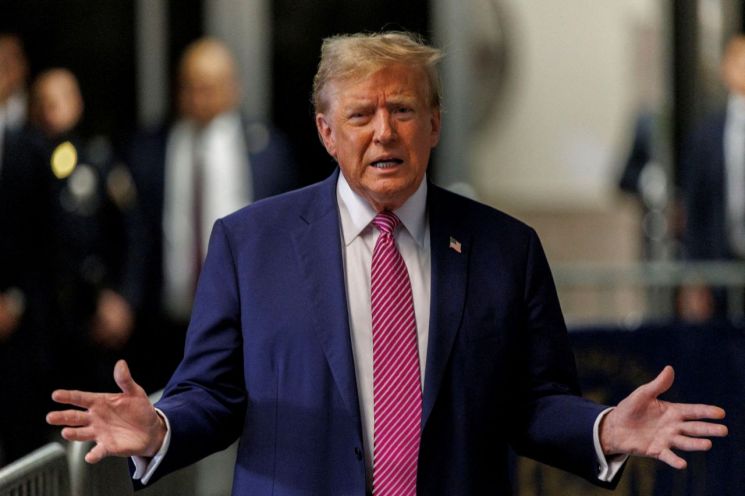
Time interpreted this statement as Trump hinting at the possibility of withdrawing U.S. troops from South Korea.
In the interview, he said, "I told them it’s time for them to step up and pay their share. They have now become a very wealthy country." He added that during his term, South Korea agreed to pay billions of dollars but has not done so due to the change in administration. He also said, "From what I heard, they (South Korea) were able to renegotiate with the Biden administration and effectively lowered the (cost-sharing) amount back to almost nothing compared to before."
During his first term in 2019, Trump pressured South Korea to increase its defense cost-sharing payments, demanding nearly six times the previous year's amount. It is also known that during his tenure, he threatened to withdraw U.S. troops if $5 billion (approximately 6.9 trillion won) was not received from South Korea for stationing costs. At that time, reports emerged that the U.S. Department of Defense had presented options regarding the reduction of U.S. troops in Korea to the White House.
In response, the U.S. Congress included provisions in the 2019 National Defense Authorization Act preventing the president from unilaterally reducing the current number of U.S. troops stationed in South Korea.
South Korea and the U.S. failed to reach an agreement on defense cost-sharing during the Trump administration due to his abrupt demands for increased payments, but negotiations were concluded after the Biden administration took office. This led to a gap of about a year and a half without an agreement at that time.
The two countries regularly conclude the Special Measures Agreement (SMA) on defense cost-sharing, which determines the costs South Korea must bear for the stationing of U.S. troops. The current agreement expires at the end of next year. Even if a new agreement is reached, there are speculations that if Trump wins the presidential election and a second Trump administration begins next year, the U.S. side may demand new negotiations.
Trump is known for opposing so-called "free riding" on security and viewing alliances as transactional relationships. In the interview with Time, he also said about NATO countries, "If you don’t pay, you’re on your own." During a campaign rally in February, he said to NATO allies who do not spend 2% of their GDP on defense, "I will not protect you. I will encourage them (Russia) to do whatever they want."
Regarding support for Ukraine, Trump said, "We won’t provide it until Europe starts to contribute equally," adding, "Europe is more affected. Why should we pay when Europe doesn’t? There’s an ocean between us (Europe and the U.S.)." Time reported that both the U.S. and European Union (EU) countries have each provided over $100 billion in aid to Ukraine.
However, Trump confirmed that "If Iran attacks Israel, we will be there," affirming that the U.S. will defend Israel. At the same time, he reiterated his position that Israel should quickly end the war in the Gaza Strip.
Regarding economic policy, Trump said he is considering imposing a so-called universal tariff of over 10% on all imported goods. He also mentioned considering a 100% tariff on certain Chinese products.
© The Asia Business Daily(www.asiae.co.kr). All rights reserved.
![Clutching a Stolen Dior Bag, Saying "I Hate Being Poor but Real"... The Grotesque Con of a "Human Knockoff" [Slate]](https://cwcontent.asiae.co.kr/asiaresize/183/2026021902243444107_1771435474.jpg)
















