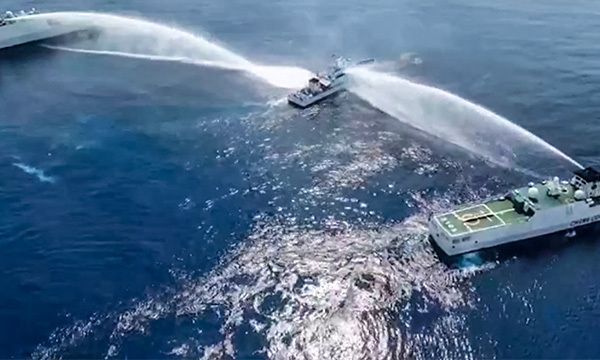
 On the 30th (local time), near the Scarborough Shoal (Chinese name Huangyan Dao) in the South China Sea, a disputed territory between the Philippines and China, the Philippine Coast Guard patrol vessel Bagacay was attacked with water cannons by Chinese Coast Guard ships positioned on both sides. (Photo by Philippine Coast Guard)
On the 30th (local time), a Chinese Coast Guard vessel attacked a Philippine Coast Guard vessel with water cannons near Scarborough Shoal (Chinese name Huangyan Dao), a disputed area in the South China Sea, resulting in partial damage to one vessel.
According to AFP and other foreign media, the attacked Philippine vessels included one belonging to the Bureau of Fisheries and Aquatic Resources (BFAR) and one Coast Guard vessel. They perform missions such as supplying food and fuel to Philippine fishing boats operating in the area and patrolling the surroundings.
The Philippine side explained that 10 Chinese vessels, including four Chinese Coast Guard ships, appeared and interfered with the Philippine vessels, attacking them with water cannons. The Coast Guard vessel, which was attacked with water cannons from both sides, suffered damage to its railings and roof.
Jay Tarriela, spokesperson for the Philippine Coast Guard, said in a statement, "This is evidence showing how powerful the water cannons used by the Chinese Coast Guard are while harassing Philippine boats."
Gan Wei, spokesperson for the Chinese Coast Guard, stated on the official social media account that afternoon, "Philippine Coast Guard vessels 4410 and 3004 government vessels stubbornly intruded into the waters near China's Huangyan Dao despite repeated Chinese recommendations and warnings."
He added, "We took necessary measures such as tracking, pressuring, water cannon warnings, blocking, and control to expel the illegally intruding Philippine vessels."
Lin Zhen, spokesperson for the Chinese Ministry of Foreign Affairs, also said at a briefing that day, "China advises the Philippines to immediately stop its intrusion and provocative actions and not to challenge China's firm determination to safeguard its sovereignty."
Scarborough Shoal, where the incident occurred, is about 240 km from Luzon Island in the Philippines and about 900 km from Hainan Province in China. China claims about 90% of the area within a U-shaped line of nine dashes in the South China Sea as its territorial waters.
The Philippines opposed China's claim and filed a lawsuit with the Permanent Court of Arbitration (PCA), which ruled in 2016 that China's claim had no basis under international law. However, China has ignored this and continues to assert its sovereignty.
As tensions between China and the Philippines over sovereignty in the South China Sea escalate, cyberattacks targeting the Philippines by China are also increasing.
The Philippine media Manila Times cited a report from the U.S. IT security company Resecurity, stating that cyberattacks targeting the Philippines surged by 325% in the first quarter compared to the same period last year.
During this period, 80% of the cyberattacks on the Philippines targeted government agencies, and the remaining 20% targeted educational institutions. Resecurity explained that these attacks appear to be carried out by government-backed hackers from China or North Korea.
© The Asia Business Daily(www.asiae.co.kr). All rights reserved.