145 Billion KRW Scale Over Two Rounds in March and April
8.125 Trillion KRW High-Risk Loans Last Year, Potential for Additional Defaults
Securing Capital Buffers to Prepare for Worsening Defaults
Hi Investment & Securities, a subsidiary of DGB Financial Group, is continuously issuing subordinated bonds to secure capital buffer capacity due to defaults in real estate project financing (PF). Following the issuance of subordinated bonds worth 100 billion KRW in early March, the company recently issued an additional 45 billion KRW worth of subordinated bonds ahead of announcing its first-quarter financial results.
According to the investment banking (IB) industry on the 2nd, Hi Investment & Securities issued subordinated bonds worth 45 billion KRW on the 30th of last month. The maturity is 6 years, and the interest rate was set at 7%. It is known that several institutional investors, including insurance companies, subscribed to the subordinated bonds. Hi Investment & Securities had also issued subordinated bonds worth 100 billion KRW on March 8. At that time, the bonds had the same issuance conditions as the April bonds, with a 6-year maturity and a 7% interest rate. Accordingly, Hi Investment & Securities has issued a total of 145 billion KRW in subordinated bonds over two occasions in the past two months.
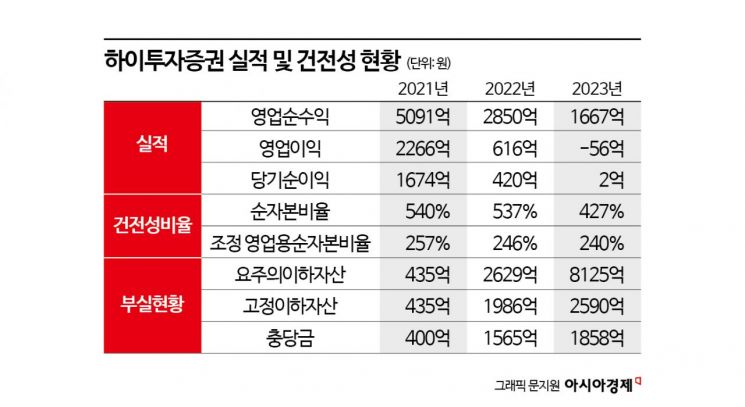
The reason Hi Investment & Securities has been issuing subordinated bonds consecutively is to raise the capital adequacy ratio (NCR ratio), which has declined due to PF losses or provisions. Subordinated bonds can be recognized as 100% capital if the remaining maturity is more than 5 years. From the moment the remaining maturity falls below 5 years, the capital recognition ratio is reduced by 20% annually. If the remaining maturity is between 4 and 5 years, 80% of the issuance amount is recognized; between 3 and 4 years, 60%; between 2 and 3 years, 40%; between 1 and 2 years, 20%; and less than 1 year, 0%.
Hi Investment & Securities recorded an operating loss of 5.6 billion KRW last year. Profitability deteriorated as it set aside provisions worth 159.5 billion KRW against losses, including 132.4 billion KRW in PF-related provisions. Net income also dropped to 200 million KRW, down 41.8 billion KRW compared to 2022. The PF-related exposure (risk exposure) amounted to a total of 918.9 billion KRW as of the end of last year, combining contingent liabilities and loans. Among these, bridge loans in an unstarted state accounted for 58% of the total. Additionally, subordinated and junior bonds, which rank lower in repayment priority, make up 75%, indicating a high proportion of bonds with a high risk of default.
As of the end of last year, 'substandard and below' assets, including watchlist, fixed, doubtful recovery, and estimated loss assets, surged to 812.5 billion KRW. Watchlist loans generally refer to assets that are delinquent for more than one month but less than three months, just before becoming non-performing. The proportion of net watchlist and below assets to total equity capital also skyrocketed from 7.7% at the end of 2022 to 46.7%. If a borrower classified under watchlist loans delays payment further and becomes delinquent for more than three months, the asset is reclassified as a fixed or below asset (NPL, non-performing loan).
A significant portion of the bonds classified as watchlist loans at the end of last year is likely to have been reclassified as non-performing loans in the first quarter of this year. An IB industry official said, "Hi Investment & Securities has relatively high loans and contingent liabilities for local projects with high risk among its total PF assets, and within these, bridge loans and subordinated/junior bonds with high risk have a large proportion," adding, "As watchlist loans increasingly become non-performing, the burden of loan losses is likely to continue rising."
© The Asia Business Daily(www.asiae.co.kr). All rights reserved.
![Clutching a Stolen Dior Bag, Saying "I Hate Being Poor but Real"... The Grotesque Con of a "Human Knockoff" [Slate]](https://cwcontent.asiae.co.kr/asiaresize/183/2026021902243444107_1771435474.jpg)
















