Emergency Economic Ministers' Meeting and Price-Related Ministers' Meeting on the 1st
Announcement of 'Measures to Improve the Distribution Structure of Agricultural and Marine Products'
The government is set to implement institutional improvements to introduce competition into wholesale markets for agricultural and marine products. It has decided to begin evaluating existing wholesale market corporations to allow new corporations to enter the market. The government will also review whether the fees charged by wholesale market corporations for distributing agricultural and marine products are appropriate. The goal is to reduce agricultural product distribution costs by more than 10% by improving the distribution structure of wholesale markets, which has recently been identified as one of the causes of high prices for agricultural and marine products.
On the 1st, the government announced the "Agricultural and Marine Products Distribution Structure Improvement Plan (Measures)" at the Emergency Economic Ministers' Meeting and Price-Related Ministers' Meeting. This came after complex wholesale market distribution processes and excessive distribution margins were pointed out as causes of high prices. As a result, government ministries including the Ministry of Agriculture, Food and Rural Affairs, Ministry of Oceans and Fisheries, Ministry of Trade, Industry and Energy, Fair Trade Commission, and National Tax Service formed a "Pan-Government Task Force for Agricultural and Marine Products Distribution Structure Improvement" and conducted a comprehensive review of the distribution status of agricultural and marine products.
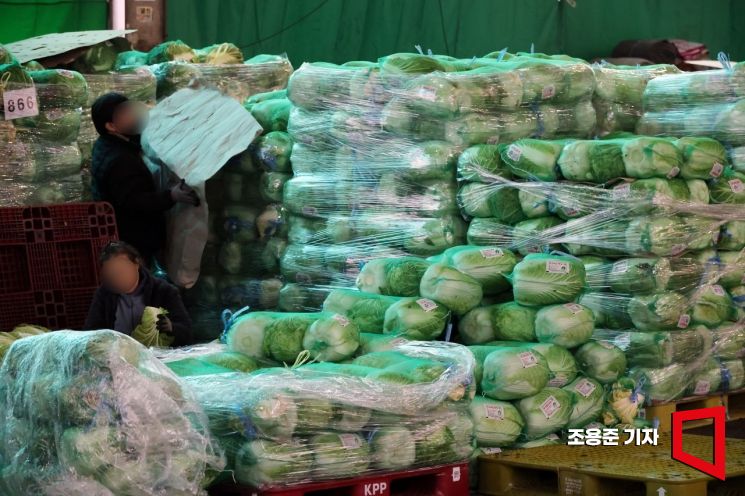 Visitors to Garak Market in Songpa-gu, Seoul, where prices of agricultural and marine products such as apples and cabbage are soaring, are sparse, showing a quiet scene. Photo by Jo Yongjun jun21@
First, to promote competition in wholesale markets, the government will push for new wholesale market corporations to enter the market. When the corporation designation period (5 to 10 years) expires, re-designation will be decided through evaluation, and new corporation designations will be pursued through a public contest system. Even during the designation period, underperforming wholesale market corporations will be subject to mandatory cancellation of designation to facilitate smooth entry and exit of wholesale market corporations. The government will also directly establish designation authority, which had previously been left to local governments' discretion, and will make it mandatory for local governments to designate new wholesale market corporations.
The government will also review whether the fees charged by wholesale market corporations are excessive. Currently, the consignment fee is up to 7%, and the government will gather opinions from professional accounting firms and experts to review this, focusing on the nine central wholesale market corporations. To enable prediction of shipment volumes and adjustment of quantities brought into the market, the application of the Garak Market electronic delivery note will be expanded from the current 6 items to 16 items within this year. By 2027, it will be expanded to cover all 193 traded items at Garak Market. Unlike the existing paper delivery notes, which only allow confirmation of item and quantity information after goods have been brought into the market, electronic delivery notes allow input of item and quantity information at the shipment stage, enabling prediction of wholesale market intake volumes.
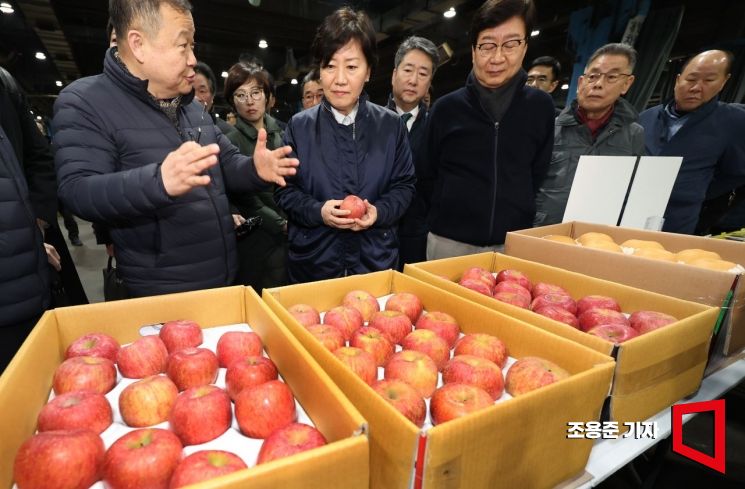 Song Mi-ryeong, Minister of Agriculture, Food and Rural Affairs, inspecting the supply and demand status of agricultural products at Garak Agricultural and Marine Products Wholesale Market in Songpa-gu, Seoul. Photo by Jo Yong-jun jun21@
The government will also promote the activation of online wholesale markets for agricultural and marine products. Wholesale markets have fundamental limitations such as restricted competition, since only transactions between corporations and intermediate wholesalers within the designated area are allowed, and high logistics costs due to the simultaneous movement of commerce and logistics. Accordingly, the government plans to revitalize the online wholesale market launched on November 30 last year. To attract a variety of sellers and buyers, the number of traded items will be expanded to 193 by 2027, matching the level of Garak Market. The seller membership criteria will also be relaxed from the current annual transaction scale of 5 billion KRW to 2 billion KRW.
To nurture competitive sellers, 100 key smart agricultural product production area distribution centers will be developed as core online sales entities. Additionally, a joint purchasing system will be established through NongHyup and merchant associations to help small and medium-sized marts and traditional markets, which have conducted multi-item, small-quantity transactions through wholesale markets, to scale up their transaction volumes. Infrastructure for activating the online wholesale market will also be developed. Integrated logistics functions for online wholesale market traders will be expanded in connection with facility modernization projects at Seoul Garak Market and Daegu Bukbu Market.
The government also aims to scale up production area distribution. To reduce the distribution share of wholesale markets and foster capable distribution entities that can directly trade with consumers, the construction of 100 smart Agricultural Product Processing Centers (APCs) at production bases will be advanced from the original plan of 2027 to 2026. For marine products, modernization of 100 key auction sites, including the Busan Joint Fish Market, will be promoted to integrate 214 production area auction sites nationwide. Major items such as gim (seaweed) and solar salt will be contract-cultivated through producer organizations like the Fisheries Cooperative Federation to establish a stable supply management system. Furthermore, the government will establish a competitive system in the logistics equipment market, which has been operated as a monopoly. First, the government plans to introduce a "logistics equipment usage price disclosure system" to enable farmers to compare prices and use logistics equipment at more affordable rates.
© The Asia Business Daily(www.asiae.co.kr). All rights reserved.
![Clutching a Stolen Dior Bag, Saying "I Hate Being Poor but Real"... The Grotesque Con of a "Human Knockoff" [Slate]](https://cwcontent.asiae.co.kr/asiaresize/183/2026021902243444107_1771435474.jpg)












