Japanese Companies Sequentially Announce Sales Suspension
Poor Harvest Reduces Production While Demand Soars
Spike in Concentrate Prices Leads to Limits on Countermeasures
Domestic Orange Concentrate Costs Also Double to Triple Increase
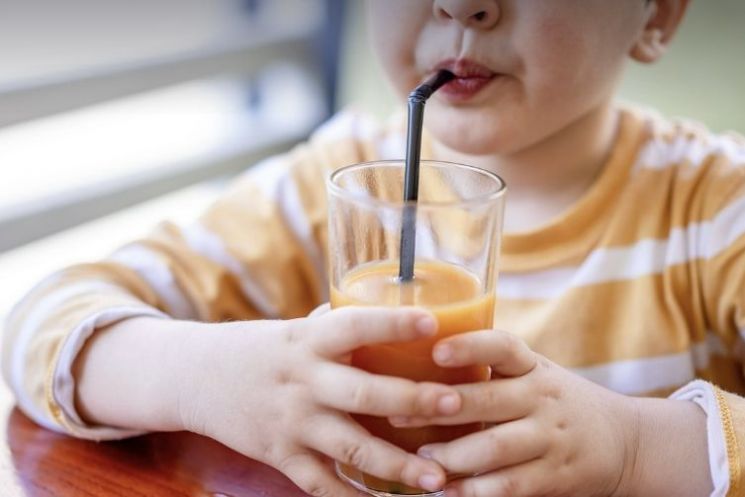
Orange juice, long recognized as a representative beverage to start the morning alongside milk, is increasingly being discontinued in Japan. As the price of orange juice concentrate has skyrocketed, companies have determined that internal cost-cutting efforts have reached their limits, leading them to raise product prices and halt sales. The domestic food industry is facing similar difficulties due to the surge in concentrate prices.
On the 25th, Japan's Moriyama Dairy announced in a "Notice of Price Revision for Some Beverage Products" that prices would change starting from shipments on June 1. Seven products, including orange, peach, and grape juices, will see an average price increase of 9.3%, or 10 yen (88 won). Among these, the Sunkist 100% 200ml product will be raised from 120 yen (1,055 won) to 130 yen (1,143 won), and sales will be discontinued once the raw materials are depleted.
Moriyama Dairy explained, "The juice and vegetable juice raw materials for Sunkist 100% fruit juice beverages have seen reduced production due to insufficient rainfall at the source regions and increased domestic demand, causing prices to rise. Packaging material costs and logistics expenses are also increasing, and these trends are expected to continue." They added, "Although we have pursued cost reductions through internal efforts, the situation has exceeded what the company can manage, leading to the price increase," and asked for understanding.
Yukijirushi Megmilk has also stopped selling the 1000ml and 450ml sizes of 'Dole Orange 100%' from this month, except for the 200ml size. Asahi Soft Drinks has halted sales of the 'Bireley's Orange' 1.5L PET bottle since December last year and has yet to set a date for resuming sales.
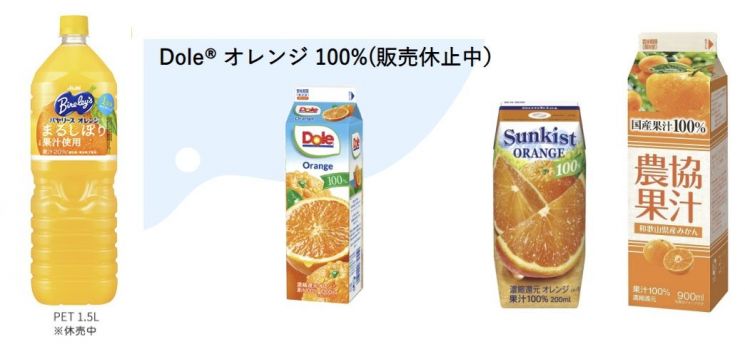 From the left, Bayaris Orange by Asahi Beverage, Yukijirushi Dol Orange 100%, Sunkist 100% by Moriyama Dairy, all discontinued products. The first on the right is the 'Nonghyup Fruit Juice' product made by the Japan Agricultural Cooperative using domestic oranges.
The Japan Agricultural Economic Newspaper reported, "Due to poor harvests in Brazil, a major import source, import volumes decreased in 2021, and since then, heavy rains and pests have caused shortages of orange concentrate." According to trade statistics released by the Ministry of Finance on the 26th, the import price of orange concentrate in March rose 69% year-on-year to 620 yen (5,450 won) per liter, doubling in five years. The weak yen and increased demand as the COVID-19 situation eases have also fueled price increases.
Amid worsening shortages of imported concentrate, there has been a movement to actively use domestically produced juice. 'Kyodo Milk Industry,' a subsidiary of the Japan Agricultural Cooperatives (JA ZEN-NOH), has revived the beverage 'Nokyo Juice,' made exclusively from domestic juice, and started sales in April after 14 years. This product uses tangerines from Wakayama Prefecture, famous for its tangerines.
The domestic food industry is facing similar circumstances. According to the New York Mercantile Exchange, the price of orange juice concentrate rose from $1.23 per pound in 2021 to $1.75 in 2022, and $3.01 in 2023, currently trading around $3.55. This represents a threefold increase over three years and about double in two years. Industry insiders are lamenting, saying "the more we sell, the more we lose" or "we have now reached our limit."
© The Asia Business Daily(www.asiae.co.kr). All rights reserved.
![Clutching a Stolen Dior Bag, Saying "I Hate Being Poor but Real"... The Grotesque Con of a "Human Knockoff" [Slate]](https://cwcontent.asiae.co.kr/asiaresize/183/2026021902243444107_1771435474.jpg)

















