‘Bohwagak 1938’ Reopening Exhibition
Exhibition of Bohwagak Blueprints and Kansong Artifact Purchase Records
Gansong Museum of Art, Korea's first private art museum, has completed a 1 year and 7 months restoration and renovation of Bohwagak and will hold a reopening exhibition highlighting the museum's past and present.
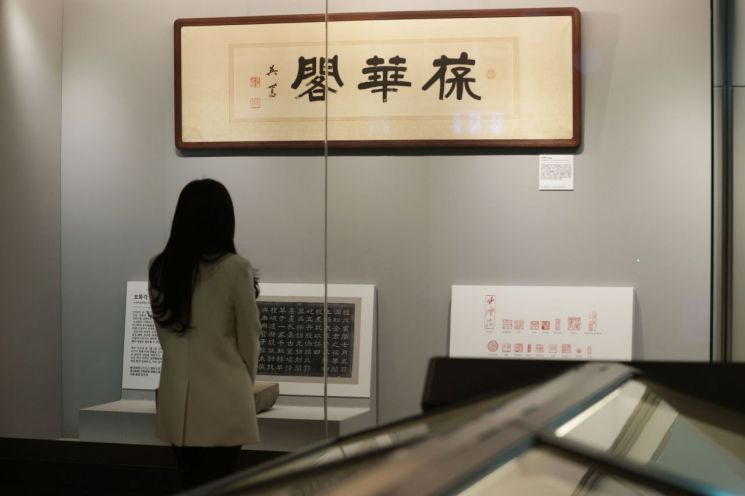 On the afternoon of the 29th, attendees are viewing the Bohwagak signboard and other items at the press preview event of the "Bohwagak 1938, Gansong Art Museum Reopening Exhibition" held at the Gansong Art Museum in Seongbuk-gu, Seoul. [Image source=Yonhap News]
Founded in 1938 by Gansong Jeon Hyeongpil (1906?1962) within the Bukdanjang (北壇莊) area in Seongbuk-gu, Seoul, Bohwagak (?華閣) was Korea's first modern private art museum and the origin of the Gansong Museum of Art. The museum has held exhibitions twice a year every spring and autumn, but due to the need for restoration, maintenance began in September 2022.
The Gansong Museum of Art preserved the original exterior of the Bohwagak building, which is designated as a Registered Cultural Heritage, while focusing on improving the internal exhibition environment. A total of 2.3 billion KRW from national and city funds was invested. The internal temperature and humidity control, heating and cooling facilities, exhibition hall windows, and lighting systems were all replaced. An elevator was installed, and Braille signage was added to enhance visitor convenience.
Through the reopening exhibition titled "Bohwagak 1938: Gansong Museum of Art Reopening Exhibition," opening on the 1st of next month, the museum will unveil newly discovered materials and 36 previously unpublished calligraphy and painting artifacts found during the restoration process. Kim Youngwook, head of the exhibition education team at Gansong Museum, explained, "This exhibition shows the establishment process of Korea's first private art museum, Gansong Museum of Art, and the early Gansong collection."
Notably, the exhibition features the "Diary Ledger," a meticulous handwritten record by Gansong Jeon Hyeongpil from 1936 to 1938, documenting the acquisition of cultural assets including calligraphy and antiques. It contains detailed records of artifact purchases as well as construction, design fees, labor costs, and material prices incurred during the establishment of Bohwagak.
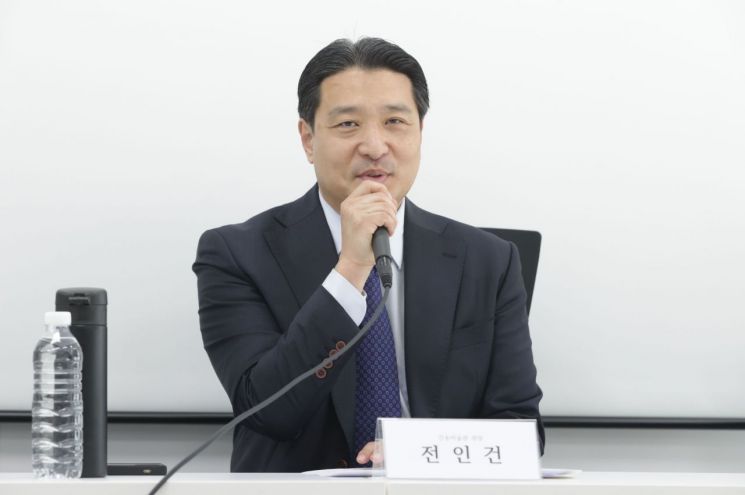 Jeon In-geon, director of the Kansong Art Museum, is explaining the restoration and repair process of 'Bohwagak' at the press preview event of the 'Bohwagak 1938, Kansong Art Museum Reopening Exhibition' held on the afternoon of the 29th at the Kansong Art Museum in Seongbuk-gu, Seoul.
 [Image source=Yonhap News]
At a press conference on the 29th, Jeon Ingeon, director of Gansong Museum of Art, stated, "The contents recorded in the Diary Ledger cover almost all expenses made by Gansong from 1936 to 1938. It even details the number of gardeners employed, and provides comprehensive records of the purchase timing, sources, costs, and management of various calligraphy and antiques, making it a valuable resource to understand the scale and formation process of the early Gansong collection."
Through the records in the Diary Ledger, it was confirmed that Gansong acquired numerous Joseon Dynasty calligraphy and painting works by Chusa Kim Jeonghui and Gyeomjae Jeong Seon. Kim Youngwook analyzed, "Based on the ledger's list, categorizing purchases by artist over three years shows 40 items by Kim Jeonghui, 26 by Jeong Seon, 20 by Kim Hongdo, and 12 by Sim Sa-jeong. This appears to be a phenomenon stemming from the 19th-century trend of collecting works by Kim Jeonghui and the Chusa school."
Additionally, the original design blueprints of Bukdanjang and Bohwagak, discovered during the renovation along with the Diary Ledger, will be publicly exhibited for the first time.
On the first floor of Bohwagak, the design blueprints of Bukdanjang and Bohwagak by Park Gilryong (1898?1943), Korea's first-generation modern architect, will be displayed. In 1934, Gansong established Bukdanjang in the Seongbuk-gu area of Seoul and commissioned Park Gilryong, who was actively working at the time, to oversee the design and supervision of Bohwagak's construction in 1938.
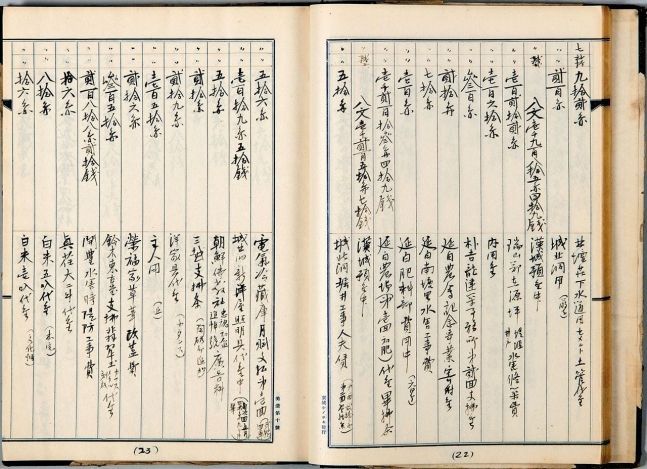 'Diary Ledger' recording deposits and withdrawals by Jeon Hyeongpil of Gansong from 1936 to 1938. The deposit and withdrawal details were recorded without omission from January to December every year.
 [Photo by Gansong Art and Culture Foundation]
Also exhibited alongside the blueprints is a sketch drawn by Gansong after seeing the display cases in the Osaka Museum of Art in Japan. When establishing Bohwagak, Gansong commissioned the Yamanaka Shokai in Osaka, Japan, to produce display cases based on this sketch. Some of the display cases made at that time are still used in this exhibition.
Calligraphy works by renowned contemporary calligraphers such as An Jongwon (1874?1951) and Lee Hanbok (1897?1944), who congratulated the opening of Bukdanjang, as well as the Bohwagak signboard written by Gansong's mentor, Wichang Oh Sechang (1864?1953), are also exhibited together.
On the second floor, visitors can see calligraphy and painting artifacts discovered during the restoration. These include "Baekimdang Pungsokhwa Album" by Baek Eunbae (1820?1901), a royal court painter during the reigns of King Cheoljong and King Gojong, and "Chuhyeop Gochon" by Sim San No Suhyeon (1899?1978), an award-winning piece at the 9th Joseon Art Exhibition in 1930. Also on display for the first time are butterfly paintings by Nam Gye-woo (1811?1888), a late Joseon painter known as "Nam Butterfly" for his detailed butterfly depictions, and his disciple Go Jinseung (1822??), also a notable butterfly painter called "Gojeop (高蝶)." Notably, Go Jinseung's butterfly paintings were previously only documented in records and have now been physically discovered for the first time.
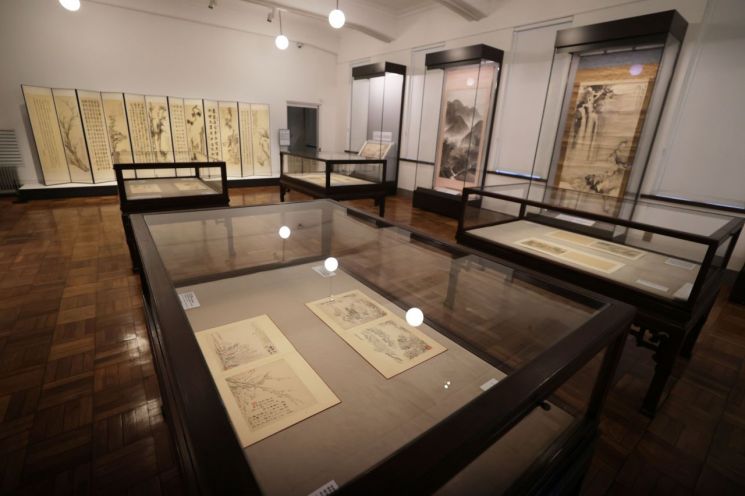 On the afternoon of the 29th, a press preview event for the "Bohwagak 1938, Gansong Art Museum Reopening Exhibition" is being held at the Gansong Art Museum in Seongbuk-gu, Seoul. [Image source=Yonhap News]
Korea's first landscape paintings depicting the United States will also be presented to the public. The "Misamugyeon Hwacho Cheongun Japwha Hapbyeok," containing eight works by Kang Jinhee, a Korean Empire diplomatic officer in Washington in 1888, and Peng Guangye (1844??), a Qing Dynasty diplomatic officer, will be exhibited in full for the first time. Among them, Kang Jinhee's "Hwacha Bunbyeoldo" is Korea's first landscape painting of the United States, depicting scenes such as a train passing near Washington DC in a literati painting style. Considering that Korea's first railway opened in 1899, this painting can be seen as a remarkable depiction of new technology and scenery.
Starting with the reopening exhibition, the Gansong Museum of Art plans to continue operating regular exhibitions in spring and autumn. The exhibition period, previously two weeks, will be extended to one and a half months.
Jeon Ingeon, director of Gansong Museum of Art, said, "While it is meaningful to exhibit representative works by Danwon Kim Hongdo and Hyewon Shin Yunbok, the museum originally started as a research-centered institution, and we will continue the tradition of discovering new meanings through research and presenting them."
The Gansong Museum of Art is scheduled to open a branch in Daegu in early September. The opening exhibition will introduce representative national treasures and treasures from the Gansong Museum's collection.
The reopening exhibition runs until June 16. Admission is limited to 100 people per hour through Interpark reservations, and admission is free.
© The Asia Business Daily(www.asiae.co.kr). All rights reserved.
![Clutching a Stolen Dior Bag, Saying "I Hate Being Poor but Real"... The Grotesque Con of a "Human Knockoff" [Slate]](https://cwcontent.asiae.co.kr/asiaresize/183/2026021902243444107_1771435474.jpg)


















