Two-thirds of 150 Currencies Weaken Against Dollar
Strong Due to US Fed Rate Cut Delay
NYT "Concerns Over Serious Global Economic Consequences"
The New York Times (NYT) reported on the 29th (local time) that most major currencies have depreciated against the dollar this year.
According to the NYT, about two-thirds of approximately 150 currencies tracked by Bloomberg are showing weakness against the dollar.
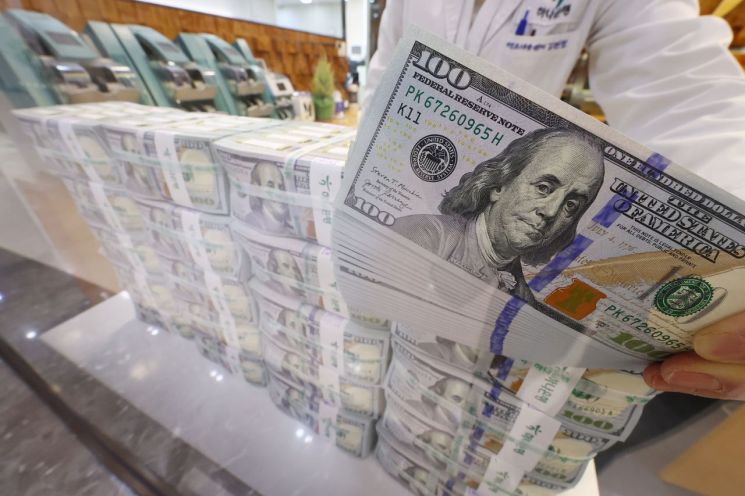
Analysis of FactSet data shows that among major countries, the currency that depreciated the most against the US dollar over the past year was Japan, falling by 10%. This was followed by Argentina (7.7%), South Korea (6.5%), and Brazil (5.0%). The European Union (EU) saw a 3% decline, and China fell by 2.1%, according to the NYT.
The recent dollar strength stems from the Federal Reserve's (Fed) delayed timing in lowering the benchmark interest rate. The US benchmark interest rate is at its highest level in 20 years. The NYT explained, "The high US interest rates mean that US assets offer better returns than other assets worldwide, and investors need dollars to purchase US assets."
The dollar index, which measures the overall strength of the US currency against six major currencies, recently surpassed 106, hovering around levels seen in the early 2000s. In particular, the yen's value hit its lowest level against the US dollar in 34 years. Jesse Rogers, an economist at Moody's Analytics, said, "There has never been a time when the Fed was more truly the central bank of the world."
The NYT explained that the effects of dollar strength are rapid and widespread. The dollar accounts for 90% of foreign exchange transactions, and when the dollar strengthens, inflation worsens in countries other than the US. Prices of major commodities priced in dollars, such as oil, soar, as do prices of US imports. Additionally, countries that borrow in dollars must pay higher interest. From a trade perspective, a strong dollar benefits US export companies. However, as President Joe Biden encourages domestic manufacturing, the US trade deficit increases.
Earlier this year, the US economy showed unexpectedly strong growth, easing concerns about soaring inflation. However, Kamaksha Trivedi, a Goldman Sachs analyst, expressed concern, saying, "If US economic growth slows but inflation remains high, more severe effects could occur." He added, "In this case, there are two options: lowering interest rates to stimulate the economy or maintaining high rates to support the currency value. We are currently at that crossroads."
The dollar's strength is particularly pronounced in Asia. Recently, the finance ministers of South Korea, the US, and Japan met in Washington, US, to closely discuss the development of foreign exchange markets. After the meeting, they issued a statement expressing concern over the sharp declines in the South Korean won and Japanese yen.
The South Korean won is showing its weakest performance since 2022. Lee Chang-yong, Governor of the Bank of Korea, recently stated, "The exchange rate movements are excessive."
Japan raised interest rates for the first time in 17 years, but the yen reached 160 yen per dollar for the first time since 1990. The NYT reported that if the yen continues to weaken, investors may lose confidence in the Japanese economy and move funds overseas.
If the yuan continues to weaken against the dollar, similar risks could arise in China, which has been hit by a real estate crisis and sluggish domestic demand. Chinese authorities, aiming to maintain yuan exchange rate stability, have recently allowed the yuan to weaken. Brad Setser, a US Treasury economist and senior fellow at the Council on Foreign Relations, said, "Questions will be raised about whether the Chinese economy is as strong as people think."
In Europe, officials from the European Central Bank (ECB) are signaling the possibility of cutting interest rates in June. Although inflation is improving in Europe, there are concerns that if rates are cut before the Fed, the interest rate gap between Europe and the US will widen, causing the euro to weaken further. Gabriel Makhlouf, Governor of the Central Bank of Ireland, said, "We cannot ignore what is happening in the US."
The NYT described this as "an unusually broad change that could have serious consequences for the global economy."
© The Asia Business Daily(www.asiae.co.kr). All rights reserved.
![User Who Sold Erroneously Deposited Bitcoins to Repay Debt and Fund Entertainment... What Did the Supreme Court Decide in 2021? [Legal Issue Check]](https://cwcontent.asiae.co.kr/asiaresize/183/2026020910431234020_1770601391.png)
















