Naver, Intel, and KAIST AI Joint Research Center Establishment MOU
Research Begins in July
Counterattack Launched in NVIDIA CUDA Ecosystem
South Korean internet company Naver and American semiconductor company Intel have joined hands with the domestic university KAIST to build a new artificial intelligence (AI) semiconductor ecosystem to compete against Nvidia.
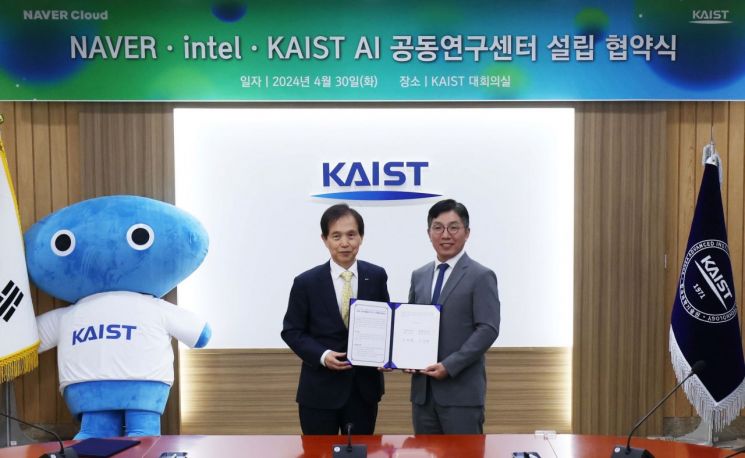 President Kwang-Hyung Lee of KAIST (left) and CEO Yuwon Kim of Naver Cloud are taking a commemorative photo after signing a business agreement to establish the 'Naver-Intel-KAIST AI Joint Research Center' at the KAIST main campus in Daejeon on the 30th. Photo by KAIST
On the 30th, KAIST (President Kwang Hyung Lee) and Naver Cloud (CEO Yoo Won Kim) signed a memorandum of understanding (MOU) to establish the ‘Naver-Intel-KAIST AI Joint Research Center (NIK AI Research Center)’ at the KAIST main campus in Daejeon. The signing ceremony was attended by President Kwang Hyung Lee, Professor Jung Ho Kim from the Department of Electrical Engineering, CEO Yoo Won Kim, AI Innovation Center Director Jung Woo Ha, and Director Dong Soo Lee in charge of Hyperscale AI, among others.
Earlier this month, Naver and Intel announced their collaboration in the AI field at ‘Intel Vision 2024’ held in Phoenix, USA, also signaling cooperation with academia. Intel’s consecutive partnerships with Naver and now KAIST indicate its recognition of South Korea’s advanced artificial intelligence (AI) achievements.
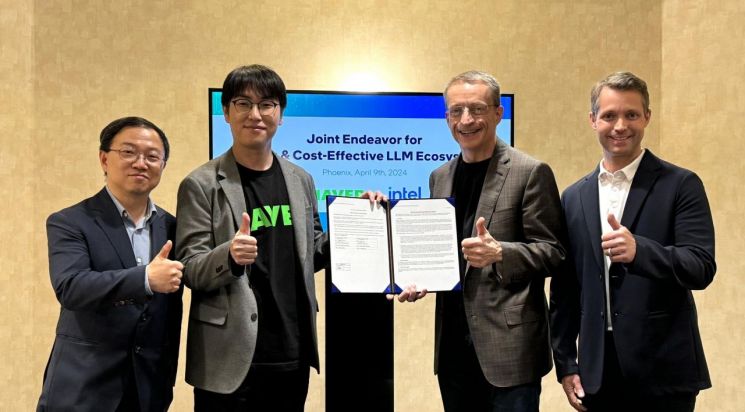 Naver Cloud and Intel announced on the 11th that they will jointly conduct research with domestic academia and startups to build an AI chip software ecosystem based on Intel's AI accelerator chip, 'Gaudi.' The photo shows Lee Dong-su, Director of Hyperscale AI Efficiency at Naver Cloud (from the left), Ha Jung-woo, Head of Naver Cloud AI Innovation Center, Pat Gelsinger, CEO of Intel, and Justin Hotard, Senior Vice President of Intel and Head of Data Center and AI Group, posing for a commemorative photo after signing the agreement. Photo by Yonhap News.
Intel stated that through collaboration with Naver and KAIST, it aims to rapidly build an open ecosystem for the Gaudi chip to counter Nvidia’s closed AI development environment centered around CUDA. The plan is to lead the anti-Nvidia camp by combining the technological capabilities of Naver and KAIST, who developed the world’s third-largest hyper-scale AI ‘HyperCLOVA,’ with Intel’s chips.
Intel, which is expanding its domain from central processing units (CPU) to semiconductor foundry, is establishing and supporting a joint research center at a domestic university for the development of open-source software for the AI semiconductor ‘Gaudi’?a first for KAIST.
A KAIST official emphasized, “Intel’s choice of Naver and KAIST as partners for open-source software development in AI and semiconductor fields holds great strategic significance.”
KAIST expressed expectations that “the combination of Naver Cloud Platform’s diverse AI service capabilities, Intel’s next-generation AI chip technology, and KAIST’s expert personnel and software research capabilities will successfully create a creative and innovative ecosystem in the AI semiconductor field, different from existing ones.”
The center will be co-led by Professor Jung Ho Kim from KAIST’s Department of Electrical Engineering and Director Dong Soo Lee from Naver Cloud. The joint research center is set to operate for three years, with the possibility of extension depending on research outcomes and needs. The center will take shape in the first half of the year and begin full-scale research from July. During the initial two years, research will mainly focus on open-source software in AI fields such as natural language processing, computer vision, and machine learning for Intel’s ‘Gaudi.’ Naver and Intel will provide ‘Gaudi2’ based on the Naver Cloud Platform to the KAIST joint research center, and KAIST researchers will annually publish research results including papers using ‘Gaudi2.’ Various facilities and equipment necessary for joint research will be shared, and personnel exchanges will also take place.
Professor Kim emphasized, “The establishment of this joint research center is very meaningful in that it allows us to secure large-scale AI data center operation experience and AI computing infrastructure necessary for future research and development.”
Director Lee said, “Naver Cloud hopes to lead various researches together with KAIST and expects the AI ecosystem centered on HyperCLOVA X to expand. Through the joint research center, we hope domestic AI research will be further activated and the diversity of the AI chip ecosystem will be secured.”
© The Asia Business Daily(www.asiae.co.kr). All rights reserved.


















