"Notify Purpose in Advance for Entry, Embassy Review Required"
Regular Briefings Ban On-Site Questions for 1 Year 7 Months
Correspondents Issue Statement... "Cancel Notification, Ambassador Apologize"
During the week, the Embassy of the Republic of Korea in China unilaterally notified Beijing correspondents of a 'prior approval system' for embassy access and reporting, sparking controversy. The correspondents strongly opposed the move, issuing a statement demanding the withdrawal of the approval system notification and the normalization of the current briefing system without on-site questioning.
On the morning of the 29th, the Embassy in China informed correspondents, "Starting May 1, if correspondents need to enter the embassy, they must apply to the embassy at least 24 hours in advance, including the time of entry, personnel, and purpose of reporting," adding, "After reviewing the application, we will inform you whether entry is possible and provide related details."
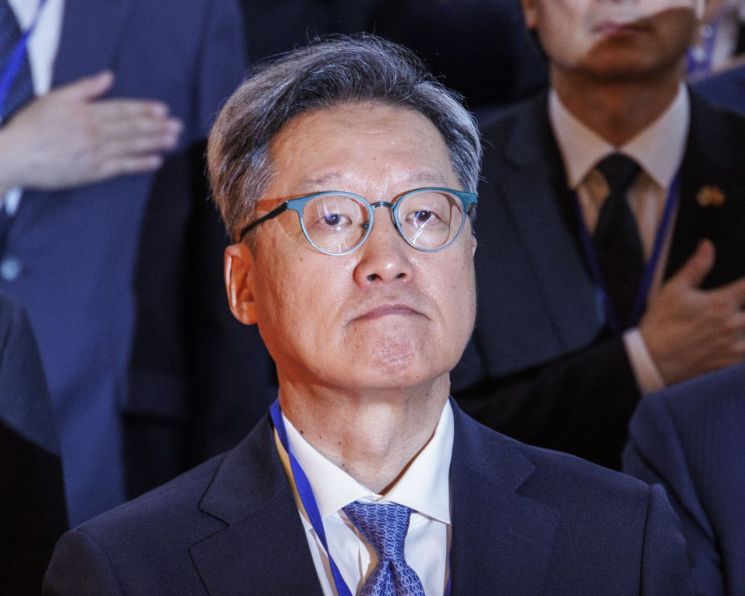
There was no consultation or discussion with the correspondents prior to this decision. However, when correspondents requested the background of the decision, the embassy belatedly explained, "Recently, a security issue occurred when a media outlet entered the embassy premises with Chinese staff without prior consultation to film."
The 'security issue' cited by the embassy referred to a recent attempt by some media to conduct on-site reporting inside the embassy courtyard with local staff (filming personnel) to directly hear the ambassador’s stance on the power abuse controversy. Until now, the embassy had not imposed separate restrictions on local staff entry during major event coverage, but it used this incident as a reason to notify all Korean correspondents in Beijing of the new policy. Most Beijing correspondents interpret the introduction of the approval system, which could be seen as prior censorship, as a personal retaliation by Ambassador Jeong Jae-ho against the coverage of the 'power abuse controversy' involving the minister.
That afternoon, the correspondents held a general meeting and passed a statement demanding the withdrawal of the 'approval system' notification, the normalization of briefings, and an apology from Ambassador Jeong, which they released the following morning on the 30th. The statement pointed out, "Considering the recent media environment where most reports are made in real time, the '24-hour prior application' is a measure that fundamentally blocks reporting," adding, "This goes beyond 'lack of communication' and constitutes an infringement on press freedom and a serious violation of the public’s right to know." It also stated, "All Beijing correspondents demand the immediate withdrawal of the access restriction notification by the Embassy of the Republic of Korea in China, the normalization of the distorted briefing system, and an apology from Ambassador Jeong."
The 'normalization of briefings' mainly calls for restoring the monthly briefing sessions for Korean correspondents, which Ambassador Jeong has not allowed questions at for 1 year and 7 months since his appointment, citing a specific media outlet’s violation of the anonymous reporting policy. Currently, the embassy only prepares answers in advance to questions submitted in writing via email.
Meanwhile, Ambassador Jeong was investigated earlier this month by the Ministry of Foreign Affairs audit team over allegations of abusive language and power abuse toward embassy staff. Ambassador Jeong denied the allegations, stating, "They are based solely on one-sided claims."
© The Asia Business Daily(www.asiae.co.kr). All rights reserved.
!["I'd Rather Live as a Glamorous Fake Than as a Poor Real Me"...A Grotesque Success Story Shaking the Korean Psyche [Slate]](https://cwcontent.asiae.co.kr/asiaresize/183/2026021902243444107_1771435474.jpg)
















