Statistics Korea, Industrial Activity Trends
Facility Investment Down 6.6%
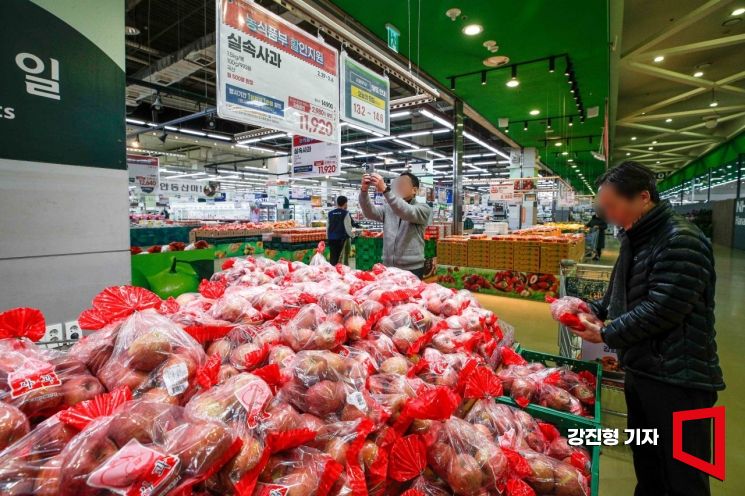 Due to the surge in agricultural product prices, especially fruits, consumer prices, which had stabilized at 2.8% in January, returned to the 3% range within a month. On the 6th, a customer visiting the Hanaro Mart Yangjae branch in Seocho-gu, Seoul, hesitated to purchase apples. Photo by Jinhyung Kang aymsdream@
Last month, industrial production and facility investment decreased compared to the previous month, but retail sales, which indicate consumption, increased. The decline in industrial production was the largest drop in 4 years and 1 month.
According to the 'March 2024 Industrial Activity Trends' released by Statistics Korea on the 30th, total industrial production in March this year decreased by 2.1% compared to the previous month.
The growth trend that continued for four months from November last year (0.3%), December (0.4%), January this year (0.3%), and February (1.1%) was broken after five months. The decrease was the largest since February 2020 (-3.2%).
All sectors, including manufacturing and mining and manufacturing industries (-3.2%), construction (-8.7%), service industries (-0.8%), and public administration (-1.6%), declined compared to the previous month. Among mining and manufacturing industries, production increased in beverages (1.4%), but decreased in metal processing (-10.6%) and electronic components (-7.8%).
Manufacturing inventory decreased by 1.2% compared to the previous month, and the average operating rate fell by 3.2 percentage points to 71.3%.
Retail sales, which show consumption trends, increased by 1.6% compared to the previous month. Sales of semi-durable goods such as clothing decreased by 2.7%, but sales of non-durable goods such as food and beverages increased by 2.4%, and sales of durable goods such as passenger cars rose by 3.0%.
Facility investment decreased by 6.6% compared to the previous month as investments in machinery such as special industrial machinery (-7.8%) and transportation equipment such as automobiles (-2.9%) all declined.
Construction performance decreased by 8.7% compared to the previous month as construction (-9.5%) and civil engineering (-6.0%) both saw reduced work results.
Domestic machinery orders increased by 2.6% in the private sector but decreased by 54.0% in the public sector. Construction orders (current) decreased in building construction such as factories and warehouses (-25.5%) but increased in civil engineering such as machinery installation (96.3%).
The coincident index cyclical component, which shows the current economic situation, was 99.6, down 0.3 points from the previous month. The leading index cyclical component, which predicts future economic phases, was 100.3, down 0.2 points from the previous month.
Gong Mi-sook, Economic Trend Statistics Officer at Statistics Korea, evaluated the simultaneous decline in the coincident and leading index cyclical components as "a temporary decline due to the base effect in an overall favorable economic situation."
© The Asia Business Daily(www.asiae.co.kr). All rights reserved.

















