96-Year-Old Mr. Meyer Receives Recognition After Retrial Due to Lack of Records
Mortar Shell Embedded in Left Thigh in 1951
A U.S. military veteran who has lived with shrapnel embedded in his leg since the Korean War received the 'Purple Heart' medal 73 years after his injury.
On the 28th (local time), Seongjoji, the U.S. Department of Defense newspaper, reported that the U.S. Army recently notified Earl Meyer (96), a Korean War veteran from Minnesota, that he had been designated as a recipient of the Purple Heart medal. The Purple Heart is awarded by the President of the United States to those who have died or been wounded while serving in the U.S. military.
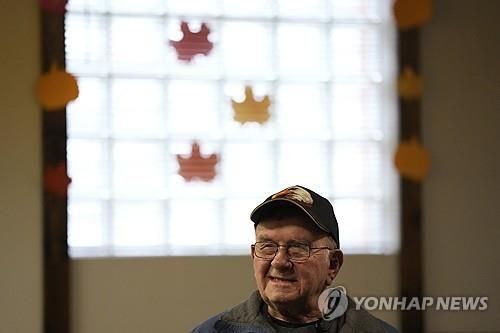 Earl Meyer (96), who was injured in the leg during the Korean War in 1951, received the 'Purple Heart' medal after 73 years.
 [Photo by AP Yonhap News]
Mr. Meyer still has shrapnel lodged in his leg, but due to repeated denials of his award, he is only now receiving the medal after 73 years. He was wounded in June 1951 during the Korean War. At that time, while advancing under heavy fire, he was hit by mortar shell fragments in his left thigh. Mr. Meyer, who was honorably discharged in 1952, had already received the Combat Infantryman Badge, awarded to soldiers who participated in frontline ground combat, and the Congressional Gold Medal, awarded to merchant marine veterans of World War II, but he faced many obstacles before receiving the Purple Heart.
Because the shrapnel was lodged too close to a nerve, some fragments could not be removed, forcing him to live with the shrapnel for his entire life after the war. However, since proper medical records were not kept at the time, it was difficult to prove that he was wounded during the war. Although Mr. Meyer was covered in blood from his leg injury, there were other comrades who were more severely wounded, so he lived with gratitude just to have survived. Time passed, and his three daughters, upon hearing their father's story, encouraged him to apply for the Purple Heart medal.
Mr. Meyer applied for the Purple Heart belatedly, but since he had not thought to keep medical records during the war and there were no records left in the military, the Army rejected his application in April last year citing "lack of proof documents." In September of last year, Mr. Meyer filed a lawsuit against the U.S. Department of Defense and the Army. His attorney pointed out that relying solely on medical records for award decisions was problematic and argued that there were past cases where Purple Hearts were awarded under similar circumstances.
When news of Mr. Meyer's lawsuit was reported by AP News and others, U.S. Senator Amy Klobuchar of Minnesota and others urged that he be awarded the medal, lending their support. Ultimately, the court requested a review from the Army, and the Army decided to award Mr. Meyer the Purple Heart. In an interview with the media, Mr. Meyer expressed his emotion, saying, "73 years... so much time has passed," and "I never thought they would give me the medal."
© The Asia Business Daily(www.asiae.co.kr). All rights reserved.
![Clutching a Stolen Dior Bag, Saying "I Hate Being Poor but Real"... The Grotesque Con of a "Human Knockoff" [Slate]](https://cwcontent.asiae.co.kr/asiaresize/183/2026021902243444107_1771435474.jpg)
















