Small and Medium Enterprises Sector "May Economy Worsens Further"
Loan Balance 1,038 Trillion Won... Expected to Increase
As the economic recession prolongs, warning signals for small and medium-sized enterprises (SMEs) are growing louder. Not only are bankruptcy filings increasing due to worsening management conditions, but the outstanding loan balance for SMEs continues to soar and is expected to surpass the highest level ever recorded. More SMEs are also showing negative outlooks for the future, indicating that it will take time to escape this crisis situation.
According to the Ministry of SMEs and Startups on the 30th, as of January this year, the outstanding loan balance for SMEs was recorded at 1,038.3 trillion won. The loan balance for SMEs began to surge after COVID-19. The loan balance, which was 748.2 trillion won in January 2020, rapidly increased to 1,004.3 trillion won in 2023, surpassing 1,000 trillion won for the first time.
 On the 8th, a store near Dongdaemun Design Plaza in Seoul is having a closing sale. Photo by Mun Ho-nam munonam@
In November last year, the loan balance reached a record high of 1,039.1 trillion won. It then fell to 1,037.6 trillion won in December but turned upward again within a month. If the current trend continues, the outstanding loan balance for SMEs is expected to exceed the all-time high.
The worsening management of SMEs this year is also evident from bankruptcy filing statistics. According to the Supreme Court, the number of corporate bankruptcy filings from January to March this year was 439, a 34.6% increase compared to the same period last year (326 cases). Compared to 2021 (204 cases) and 2022 (216 cases), when COVID-19 was rampant, the number has more than doubled. The problem is that the majority of corporations filing for bankruptcy are SMEs. It is interpreted that SMEs, which survived during the COVID-19 period through loans, are now unable to sustain interest payments, leading to a sharp increase in bankruptcies.
Experts believe that this crisis situation is based on a combination of structural problems in the business environment and external issues such as the financial environment, making it difficult to resolve in the short term. Kim Gyuseop, head of the IBK Economic Research Institute, explained, "The crisis situation of SMEs is confirmed through indicators such as high debt ratios, sales slowdown, and an increase in the proportion of marginal companies. The active soundness management by financial institutions concerned about the realization of SME soundness issues, combined with liquidity shortages due to high interest rates, is exacerbating the crisis for SMEs."
Other indicators also reveal the difficulties SMEs are currently facing. According to statistics from the Ministry of SMEs and Startups, as of January this year, the SME consumption index decreased by 3.3% compared to the same month last year, while inventories increased during the same period. The economic outlook index perceived by SMEs is also deteriorating. The SME Business Outlook Index (SBHI) for May was 79.2, showing a decline for two consecutive months after an upward trend in March. This figure represents a drop of 1.8 points compared to the previous month and 4.6 points compared to the same month last year. This survey was conducted by the Korea Federation of SMEs (Korea Federation of SMEs) from the 15th to the 22nd, targeting 3,078 SMEs. A figure below 100 indicates that more companies have a negative outlook.
Lee Dongju, vice president of the Korea Institute for Startup & Entrepreneurship Development, said, "The crisis of SMEs has the nature of a complex crisis where multiple crises overlap. To overcome the crisis, it is necessary to understand the essence of the crisis and adopt strategic thinking to overcome it before supporting SMEs."
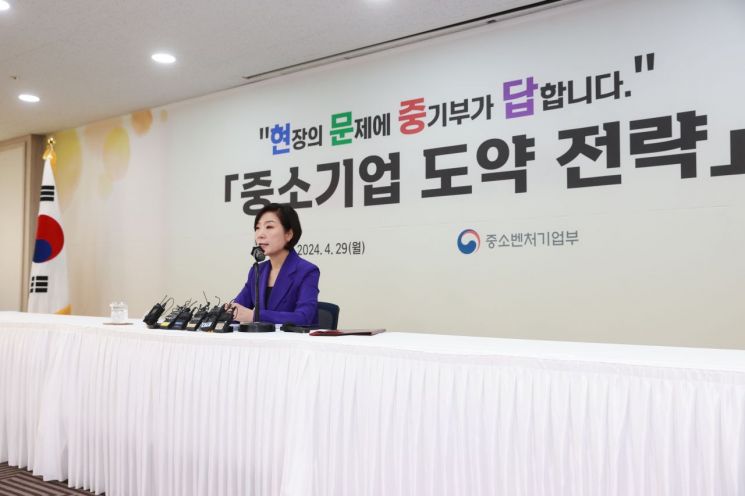 Oh Young-joo, Minister of SMEs and Startups, is announcing the 'SME Leap Strategy' on the 29th at the Korea Federation of SMEs in Yeongdeungpo-gu, Seoul. (Photo by Ministry of SMEs and Startups)
On the 29th, the Ministry of SMEs and Startups announced five major strategies and 17 implementation tasks for a new leap forward for SMEs. These include ▲enactment of the Special Act on Business Succession ▲reform of SME scope criteria ▲expansion of the payment linkage system for supply prices ▲utilization plans for foreign international students, among others. The core is to actively support ‘innovative SMEs’ with excellent sales and employment performance by promoting entry into new industries and globalization. Outdated systems and standards that do not fit market conditions will be completely reformed to promote innovation among SMEs.
In this regard, the Korea Federation of SMEs stated, "Considering economic growth and inflation, we hope that reasonable standards will be established as soon as possible," adding, "This will contribute to reducing the cost burden on SMEs and alleviating manpower shortages."
© The Asia Business Daily(www.asiae.co.kr). All rights reserved.


















