40 Million Units Production Capacity... Domestic Consumption at 22 Million Units
Economic Growth, Jobs, and Global Hegemony Competition
Excess Supply Leading to Cutthroat Competition
China is facing pressure from the United States and Europe over 'overproduction,' but it is expanding automobile production by injecting massive subsidies even into less competitive companies to boost economic growth, jobs, and strengthen its global electric vehicle dominance.
On the 28th (local time), The Wall Street Journal (WSJ), citing strategic consulting firm Automobility and the China Passenger Car Association, reported that China has the capacity to produce 40 million vehicles annually, but only about 22 million vehicles are consumed in the domestic market.
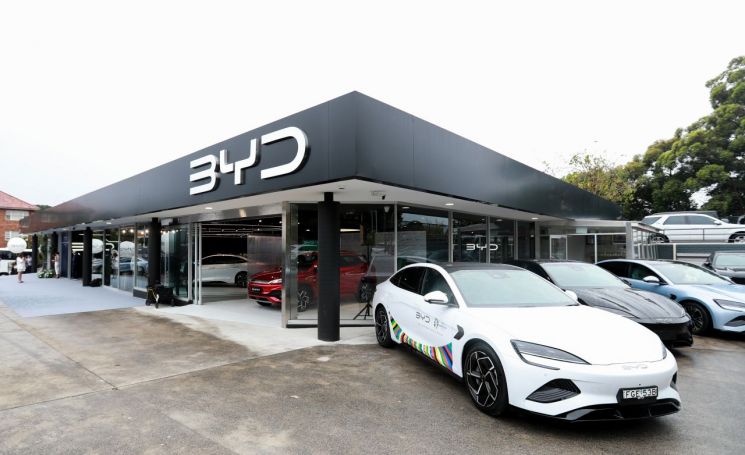
WSJ stated, "More than 100 Chinese brands produce more vehicles annually than the domestic market demand," adding, "They encourage unprofitable automakers to continue production to promote economic growth, increase jobs, and expand China's position in the global electric vehicle business."
With supply exceeding actual demand, a 'cutthroat' price competition is taking place in China's electric vehicle market. According to the South China Morning Post (SCMP), the electric vehicle price war in the Chinese market, triggered by price cuts from China's leading electric vehicle brand BYD in February this year, has continued, resulting in an average 10% drop in sales prices across 50 models from Chinese brands. BYD reduced its product prices by 5-20%.
While the oversupply of internal combustion engine vehicles is severe as Chinese consumers adopt electric vehicles, there is also an evaluation that too many companies are competing in the electric vehicle sector. Steven Dyer, director at consulting firm AlixPartners, revealed that 123 brands sold at least one electric vehicle in the Chinese market last year.
Volumes that cannot be absorbed in the domestic market are heading overseas, drawing scrutiny from various countries. China's automobile exports have increased nearly fivefold in three years, reaching about 5 million units in 2023. Three-quarters of the export volume consists of internal combustion engine vehicles, many of which are destined for Russia. However, electric vehicle exports are also increasing.
In the United States, concerns over the influx of subsidized Chinese electric vehicles have led to calls for tariff increases. The European Union (EU) Commission has been conducting an anti-subsidy investigation on Chinese electric vehicles since October last year to curb their influence.
According to Scott Kennedy, a researcher at the Center for Strategic and International Studies (CSIS), China has provided subsidies totaling $173 billion (approximately 238 trillion KRW) for new energy vehicles, including electric and hybrid cars, from 2009 to 2022. Massive capital is being invested to revive even companies that once went bankrupt.
According to the Kiel Institute for the World Economy in Germany, Chinese government support for BYD surged from 220 million euros (approximately 324.7 billion KRW) in 2020 to 2.1 billion euros (approximately 3 trillion 98.1 billion KRW) in 2022. The institute noted that BYD receives support for battery manufacturing and rebates for automobile buyers.
Dyer stated that only four brands?BYD, Tesla, Aion, and Wuling?sold more than 400,000 vehicles each in the Chinese market last year. The 400,000-unit mark is considered the breakeven point for electric vehicles based on Tesla's financial data. Most companies are practically unable to sustain their business without subsidies.
However, China's electric vehicle promotion policy is expected to continue. WSJ explained that while other parts of the Chinese economy are slowing down, President Xi Jinping emphasizes 'new qualitative productive forces' centered on advanced industries, and local governments are joining this effort. In particular, local governments focus on the automobile manufacturing industry from the perspective of job creation.
Chinese officials argue that Western criticism of their automobile industry is unfair and that Chinese cars offer innovation and good value. WSJ also reported that many automotive industry experts and foreign automaker executives share this view. Furthermore, the United States is also injecting government support into the electric vehicle industry through the Inflation Reduction Act (IRA). China has filed a complaint with the World Trade Organization (WTO) regarding this.
WSJ concluded, "What is clear is that despite a slowdown in domestic sales growth, China's automobile industry continues to show growth."
© The Asia Business Daily(www.asiae.co.kr). All rights reserved.

















