Q1 Business Performance Announcement
Operating Profit 624.7 Billion KRW... 66.6% Increase YoY
Energy and Chemical Businesses Drive Performance
SK On Expands Losses Due to Reduced Operating Rate and AMPC Downsizing
SK Innovation has succeeded in turning a profit in the first quarter, backed by solid performance in its energy and chemical businesses. Although the battery business recorded an operating loss in the 300 billion KRW range, the plan to turn profitable in the second half remains unchanged.
SK Innovation announced on the 29th that it posted sales of 18.8551 trillion KRW and an operating profit of 624.7 billion KRW in the first quarter. Compared to the same period last year, sales decreased by 287.8 billion KRW, while operating profit increased by 249.7 billion KRW.
SK Innovation explained that operating profits in the energy and chemical businesses increased compared to the previous quarter due to inventory-related gains from rising oil prices and improved refining margins. However, the battery business showed somewhat sluggish results due to decreased sales volume and price declines caused by the chasm (temporary demand stagnation).
Strong Performance in Petroleum and Chemical Businesses... Profit Expansion through Margin Improvement
The petroleum business turned profitable with an operating profit of 591.1 billion KRW, an increase of 756.3 billion KRW from the previous quarter, driven by strong refining margins and inventory-related gains from rising oil prices. The chemical business achieved an operating profit of 124.5 billion KRW, up 124.1 billion KRW from the previous quarter, influenced by margin increases from improved benzene spreads and inventory-related gains from rising naphtha prices.
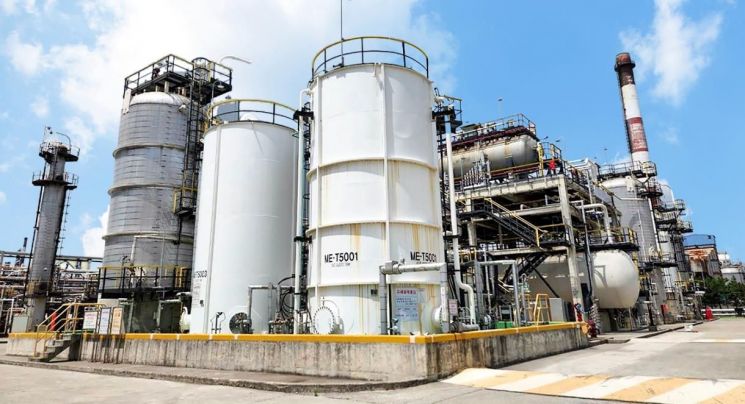
An SK Energy official said during the first-quarter earnings conference call, "The market conditions improved compared to the previous quarter due to a large-scale supply disruption in North America caused by an abnormal cold wave lasting until mid-February, and tight supply conditions continuing due to Ukraine's airstrikes on Russian refineries." He added, "Although weakness in gasoline and diesel products continues, market conditions are expected to recover with the seasonal peak entering the driving season, increased jet fuel stockpiling demand ahead of the vacation season, and expanded offshore exports centered on gasoline and diesel."
The chemical business is expected to see gradual improvement in paraxylene (PX) spreads due to increased gasoline blending demand in the second half, while polyethylene (PE) and polypropylene (PP) spreads are expected to remain stable due to the Chinese government's domestic demand activation policies.
The lubricants business recorded an operating profit of 220.4 billion KRW, up 3.4 billion KRW from the previous quarter, supported by increased sales volume from steady demand and reduced fixed costs. The petroleum development business achieved an operating profit of 154.4 billion KRW, up 47.3 billion KRW from the previous quarter, due to increased sales volume from continued production expansion in the China 17/03 block.
Battery Business Posts 331.5 Billion KRW Operating Loss: "Management Environment to Improve from Q2"
The battery business recorded sales of 1.6836 trillion KRW, down 1.0395 trillion KRW from the previous quarter. Operating losses widened from 18.6 billion KRW in the previous quarter to 331.5 billion KRW. Although productivity at overseas subsidiaries increased, this was attributed to reduced operating rates due to customer inventory adjustments and a reduction in the Advanced Manufacturing Production Tax Credit (AMPC).
Kim Kyung-hoon, Chief Financial Officer (CFO) of SK On, which is responsible for SK Innovation's battery business, said, "Although uncertainties in the management environment still exist this year, we expect the environment to improve from the second quarter onwards with increased sales volume in the U.S. and expansion of new production lines." He added, "Internally, we will flexibly operate production capacity (CAPA) according to changes in customer demand and strengthen our fundamentals during the industry slowdown."
He continued, "We intend to maintain the goal of turning profitable in the second half of this year, as mentioned in the previous earnings briefing."
SK On is the only one among the three major domestic battery companies to experience a decline (-7.3%) in global electric vehicle battery market share in January and February this year, according to estimates by SNE Research. An SK On official said, "In response to continued high interest rates and slowing growth in the eco-friendly business, we are reviewing our overall portfolio by adjusting the speed of 'Carbon to Green' initiatives." He added, "We aim to secure growth momentum through selective investment and business portfolio focus, as well as speed adjustment."
Regarding the recent downgrade of S&P credit ratings, the official explained, "This reflects preemptive concerns over deteriorating profitability in the battery business amid increased financial burdens from investments in green businesses such as the battery sector." Last month, global credit rating agency S&P Global downgraded the credit ratings of SK Innovation and its subsidiary SK Geocentric from 'BBB-' to 'BB+'.
Meanwhile, the battery business has secured additional orders worth 180 trillion KRW within two years since the launch of SK On, pushing the cumulative order backlog beyond 400 trillion KRW. The plan is to gradually increase shipments through customer inventory demand and ongoing line operation optimization.
© The Asia Business Daily(www.asiae.co.kr). All rights reserved.
![Clutching a Stolen Dior Bag, Saying "I Hate Being Poor but Real"... The Grotesque Con of a "Human Knockoff" [Slate]](https://cwcontent.asiae.co.kr/asiaresize/183/2026021902243444107_1771435474.jpg)

















