1:30 PM on the 26th at City Hall: Mayor Park Hyung-jun and CEO Park Joo-hyung
Nation's First... Exclusive Agreement with Private Company for Marine Ecology Conservation
Promotion of the 'Gijang Imrang Marine Ecological Protection Species Zal
On the 26th at 1:30 PM, Busan City signed the 'Busan Coastal Sea Ecological Forest Creation Practice Agreement' with Shinsegae at the City Hall International Protocol Room.
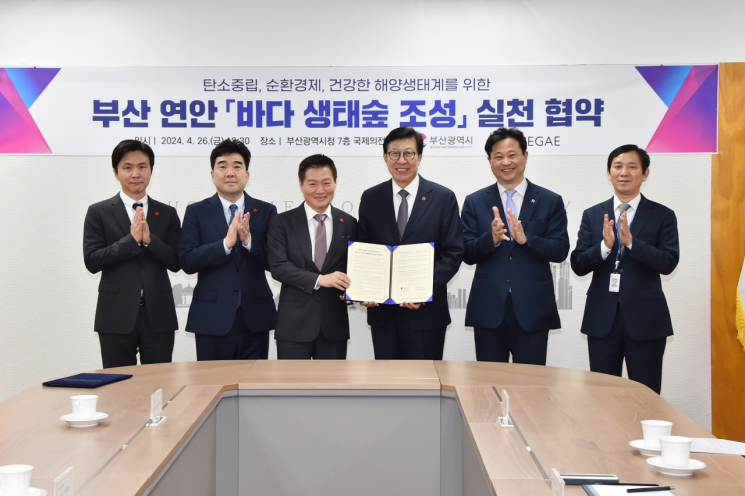 Busan City and Shinsegae, who signed the practical agreement for the creation of the 'Marine Ecological Forest' in the Busan coastal area.
At the signing ceremony, Mayor Park Hyung-jun and Shinsegae CEO Park Joo-hyung attended and personally signed the agreement, along with key officials from both organizations.
The sea ecological forest is a community formed by the flourishing of large seaweeds, similar to terrestrial forests, providing habitats, spawning grounds, nursery areas, and refuges for marine life. It plays a crucial role in maintaining a virtuous cycle of the marine ecosystem by reducing greenhouse gases and purifying pollutants such as nitrogen and phosphorus.
Recently, due to rising sea temperatures and excessive indiscriminate development, the range of seaweed die-off has expanded, causing the disappearance of sea ecological forests and threatening the survival of marine organisms.
In particular, the Busan coastal area is a convergence zone of cold and warm currents, making it sensitive to climate change. The seaweed die-off rate here is 37.21%, higher than the national average of 37.04%. To achieve sustainable fisheries in this area, efforts to restore the health of the marine ecosystem are urgently needed.
To address this, sea ecological forests tailored to the characteristics of each marine area should be created, focusing on seaweed species that can adapt to rising sea temperatures. However, since sea ecological forests are created, maintained, and managed under the leadership of the government or local governments, this poses a financial burden on local authorities.
Seaweed die-off refers to the loss of seaweed due to rising sea temperatures, dominance and death of calcareous algae causing calcium carbonate to cover rocks, transforming them into spaces where seaweed cannot inhabit, also known as marine desertification. The widespread expansion of seaweed die-off is directly linked to the risk of marine ecosystem collapse.
This agreement is significant as it forms a consensus between a private company and the public sector on the importance of sea ecological forests for future generations and promises joint efforts to overcome the climate change crisis.
Notably, this is the first nationwide exclusive agreement between a private company and the public sector related to marine ecosystem conservation and carbon neutrality practices.
Following the agreement, both parties will cooperate to discover and promote various policies for creating a healthy marine ecosystem, conduct awareness improvement education, and carry out promotional activities. The city will be responsible for policy development and administrative support, while Shinsegae will invest ESG (Environmental, Social, and Governance) funds to provide the necessary financial resources, materials, and technology for policy implementation.
The goal is to create regionally specialized sea ecological forests along the Busan coast.
Using this agreement as a starting point, the city and Shinsegae will launch the first public-private marine ecological cooperation project. By next year, Shinsegae will invest 200 million KRW of ESG funds to implement the ‘Jangpi Habitat Creation Project for Marine Ecological Protection Species at Gijang Imrang.’
‘Jangpi’ is a perennial flowering plant and a marine protected species recognized by the Intergovernmental Panel on Climate Change (IPCC) as a blue carbon sink. Through root growth, it stabilizes sediment layers and induces sediment deposition, known to reduce wave energy by an average of 36%.
This project involves transplanting the marine protected species Jangpi, which inhabits Imrang Port in Gijang, into specially created habitats. It aims to secure the safety of fishing vessels entering and leaving Imrang Port, prevent coastal erosion, promote stable living conditions for nearby residents, and contribute to biodiversity, thereby supporting the livelihoods and income of fishing village residents.
As part of climate crisis response measures, the city plans to invest a total of 51.9 billion KRW to create the ‘Imrang Carbon Neutral Ecological Sea Forest Park’ from next year until 2030. This agreement is expected to serve as a catalyst for many companies to participate in ESG activities aimed at marine ecosystem conservation and carbon neutrality.
Shinsegae CEO Park Joo-hyung said, “Climate change and carbon neutrality are the trends of our time, and I am pleased to join in opening a new marine world for the city of Busan and the future era.” He added, “We will continue to provide unwavering support and efforts for a sustainable management environment.”
Mayor Park Hyung-jun said, “I sincerely thank Shinsegae for their interest and support for the Busan sea.” He added, “Sea ecological forests are the foundation of marine life, and preserving and maintaining a healthy marine ecosystem is the destiny of our era. Our city will continue to do its best to create healthy sea ecological forests and practice the Blue Economy.”
© The Asia Business Daily(www.asiae.co.kr). All rights reserved.

















