"Jeonse Price Ratio Rises, House Prices Also Increase"
LH to Supply 5,169 General Public Sale Units This Year
"Currently, the jeonse price-to-sale price ratio (jeonse price compared to sale price) for apartments in the Seoul area is at an all-time low of around 53%. The highest jeonse price ratio was 75.1%. From now on, the jeonse price ratio can only rise."
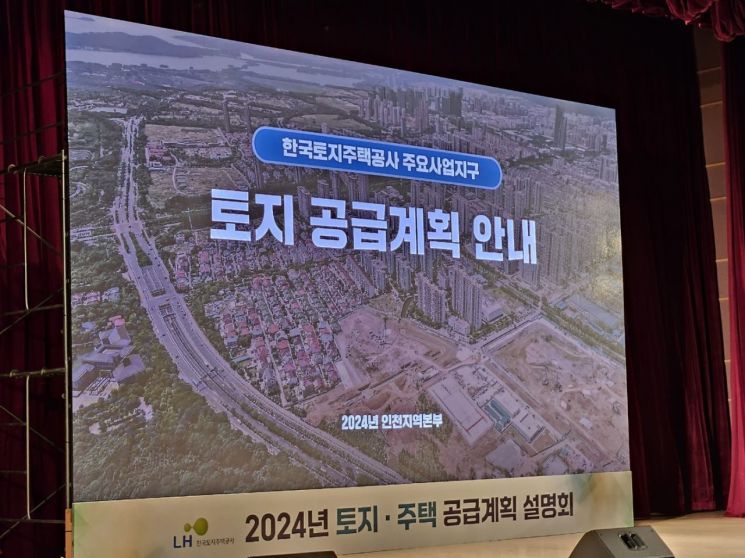 Photo of the "2024 Land and Housing Supply Plan Briefing" held by Korea Land and Housing Corporation (LH) on the 26th. Photo by Park Seung-wook
On the 26th, Jaeguk Lee, adjunct professor at the Korea Institute of Finance, predicted that apartment jeonse prices will rise this year at the '2024 Land and Housing Supply Plan Briefing' held by the Korea Land and Housing Corporation (LH) at the Bundang Ori Building in Seongnam, Gyeonggi Province, under the theme of 'Paradigm Shift in the Real Estate Market.' He stated that since current jeonse prices have hit a low point, only increases remain.
Professor Lee diagnosed that while sale prices in the real estate market are falling, jeonse prices are rising. This is due to the weak sale prices this year, which has driven demand toward jeonse. In this situation, the supply of new housing units is also decreasing, making it inevitable for jeonse prices to rise. He said, "This year, the number of apartment move-ins in Seoul is expected to be 11,000 units, which is 21,000 units less than last year's 32,000 units," adding, "As a result, the jeonse price ratio is showing an upward trend."
The continuous rise in jeonse prices can influence the increase in sale prices. If the jeonse price ratio keeps rising, sale prices and jeonse prices will become similar. When jeonse prices show signs of surpassing sale prices, buyers tend to choose purchasing over jeonse. As demand shifts to buying, housing prices rise.
Professor Lee stated that in this situation, the rising trend of jeonse prices can determine sale prices. He said, "Looking at statistics, house prices in the 1990s became the jeonse prices of the 2000s, and sale prices in the 2000s became the jeonse prices of the 2010s," adding, "When predicting the real estate market, it is important to observe how the jeonse price ratio moves."
Meanwhile, on the same day, LH introduced land and housing supply plans and the revamped subscription system from regional headquarters such as Incheon, northern Gyeonggi, and southern Gyeonggi, starting with Professor Lee's lecture. A special lecture on real estate taxation was also held afterward.
Starting from May this year, LH will supply 1,812 parcels of land totaling 4,497,000㎡. Various types of land will be supplied, including sites for multi-family housing, single-family homes, commercial and office use, and industrial distribution. The supply scale by region is 808 parcels covering 1,929,000㎡ in the metropolitan area and 1,004 parcels covering 2,568,000㎡ in other regions.
Major districts include 141 parcels covering 214,000㎡ in Hwaseong Dongtan 2 and 147 parcels covering 204,000㎡ in Incheon Yeongjong. Public sale apartments will total 5,169 units, and 132 commercial units within complexes will be supplied. Public sales consist of 2,293 general public sale units and 2,876 units in the Sinchon Hope Town.
© The Asia Business Daily(www.asiae.co.kr). All rights reserved.
![Clutching a Stolen Dior Bag, Saying "I Hate Being Poor but Real"... The Grotesque Con of a "Human Knockoff" [Slate]](https://cwcontent.asiae.co.kr/asiaresize/183/2026021902243444107_1771435474.jpg)
















