US to Cut Interest Rates Three Times This Year
South Korea Likely to Lower Rates Starting Late Q3
Possibility of Further Upward Revision in South Korea's Growth Forecast Increases
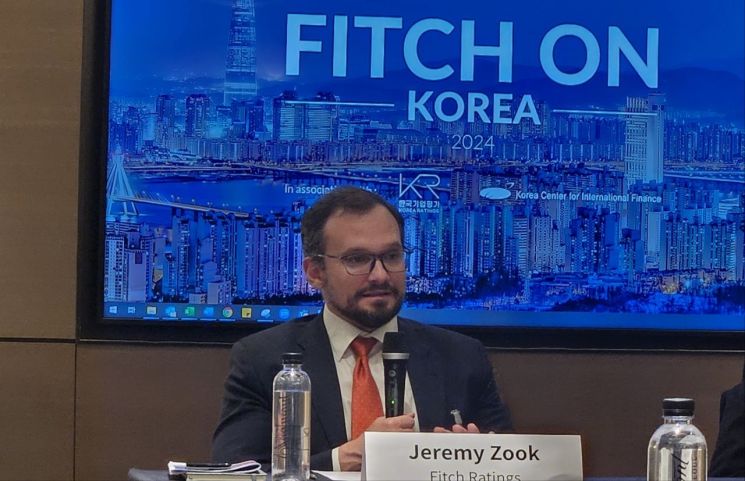 On the 26th, at the Fairmont Ambassador Hotel in Yeouido, Yeongdeungpo-gu, Seoul, Jeremy Zook is seen answering reporters' questions about the Korean economy during a press briefing following the '2024 Pitch on Korea' seminar. (Photo by Jaehyun Park)
South Korea's first-quarter growth rate indicator showed better-than-expected performance, leading to evaluations that the annual growth rate forecast may be revised upward.
Jeremy Zook, Head of Asia-Pacific Sovereign Ratings at global credit rating agency Fitch Ratings, said at the '2024 Fitch on Korea' seminar held on the 26th at the Fairmont Ambassador Hotel in Yeouido, Yeongdeungpo-gu, Seoul, "There is a possibility of upward revision of South Korea's growth rate," adding, "The figures may be adjusted in the global economic outlook in June."
Zook predicted that the Bank of Korea would cut interest rates twice in 2025, maintaining a policy rate between 2.5% and 3.5%. He expected the rate to remain around 2.5% for several years thereafter. He anticipated that the U.S. could cut rates by 25 basis points (1bp=0.01 percentage point) three times annually starting from the third quarter, and that in 2025, with inflation stabilizing more rapidly, up to five rate cuts could be possible.
There was also a forecast that the Bank of Korea might start cutting rates from the end of the third quarter. He noted, "South Korea's inflation will gradually settle around 2% in 2025," and added, "Assuming inflation slows and the U.S. Federal Reserve (Fed) cuts rates in the second half of the year, the Bank of Korea will have room to implement rate cuts from the end of the third quarter."
Regarding South Korea's first-quarter GDP growth rate of 1.3% announced on the 25th, he evaluated it as "a better figure than initially expected." Previously, Fitch had forecast South Korea's first-quarter growth rate at 0.5% quarter-on-quarter. He cited net exports as the main driver of growth. He said, "Looking at manufacturing activity, industrial productivity, and the PMI index, there has been significant improvement over the past few months," and added, "I believe the South Korean economy will benefit from this trend this year." He also diagnosed, "With increased global investment related to AI and optimistic global economic outlooks, households are increasing product consumption, which will have a positive effect on overall South Korean exports."
However, he assessed that there are no clear signs of domestic demand recovery, making its sustainability uncertain. He said, "The prolonged high-interest-rate environment is expected to cause a slight decline in domestic demand until the end of this year," and pointed out, "In construction investment, difficulties related to real estate still exist, which will constrain investment activities." He also diagnosed that consumption will continue to slow until the end of this year due to household debt repayment capacity being limited by the high-interest-rate environment.
Regarding the exchange rate, he predicted that the Korean won would shift to strength in the second half of this year. Zook said, "The delayed Fed rate cuts have affected exchange rates worldwide," and added, "As a result, the won also experienced weakness." He forecast the won-dollar exchange rate to be 1,290 won by the end of this year, stating, "Expectations for the Fed's rate cuts will lead to a shift toward strength eventually."
On concerns related to real estate project financing (PF), he evaluated, "Although risks remain due to sustained high interest rates, they are at a manageable level." Zook said, "There will be pressure on the non-financial and non-bank sectors, but the government is actively intervening with policies, and the Bank of Korea has also indicated policy intervention," adding, "I think overall stability issues will be resolved."
He assessed that household debt issues are not at a level that would affect the sovereign credit rating. He said, "Compared to OECD countries, South Korea's household debt is at the highest level," but added, "While it can be a constraint lowering economic outlooks, if the housing market achieves a soft landing, it will mitigate downside risks in terms of fiscal stability."
South Korea's Fiscal Policy...Will Determine Future Credit Ratings
He pointed out that South Korea's fiscal policy will have the greatest impact on the sovereign credit rating in the future. During the COVID-19 period, fiscal deficits increased worldwide, and South Korea's government debt also rose. Zook said, "I expect the South Korean government to implement gradual fiscal soundness measures after this year," but noted, "However, the pace may be somewhat slow due to recent general election results." Nonetheless, he believed the government's intention to reduce fiscal deficits will remain valid in the medium to long term.
He also pointed out that structural factors such as population decline and aging could affect credit rating downgrades. He said, "South Korea is in a situation where additional fiscal spending is required due to population decline and aging," adding, "If the debt ratio rises during this process, it will impact the medium- to long-term credit rating."
He mentioned that South Korea's geopolitical risks could also affect credit ratings. He said, "Conflicts with North Korea are already reflected in the credit rating, and recently their impact has been limited," but added, "The U.S.-China conflict and the outlook for the U.S. presidential election could pose challenging issues for South Korea," as the U.S. and China are major trading partners of South Korea.
Regarding South Korea's potential growth rate, he evaluated that it could face headwinds due to changes in population structure. He said, "I expect the potential growth rate to be around 2.1% until 2028," and added, "When the working-age population slows down, we need to see how the impact is offset through structural reforms and productivity improvements." However, he expressed concern, saying, "Due to the general election results, I think political conflicts will persist for a long time, making future structural reforms difficult."
© The Asia Business Daily(www.asiae.co.kr). All rights reserved.

















