Korea Corporate Governance Forum 33rd Seminar
'Is the Introduction of Management Rights Defense Mechanisms Necessary?'
"Activist Funds Are Unrelated to Hostile M&A"
Recently, amid growing demands from the business community that "management rights defense measures must be introduced for the government's value-up policy to be realized," an expert diagnosed that "hostile mergers and acquisitions (M&A) aimed at seizing management rights have never succeeded in South Korea, and rather, controlling shareholders' management rights are excessively stabilized. The call for defense mechanisms confuses the order of the problem."
On the 26th, the Korea Corporate Governance Forum held its 33rd seminar at the Korea Financial Investment Association in Yeouido, Seoul, under the theme "Is it necessary to introduce management rights defense measures?" Professor Song Ok-ryeol of Seoul National University Law School, who presented that day, evaluated the business community's claims to introduce management rights defense tools such as poison pills (subscription rights to new shares) or dual-class voting rights as "theoretically and practically contradictory."
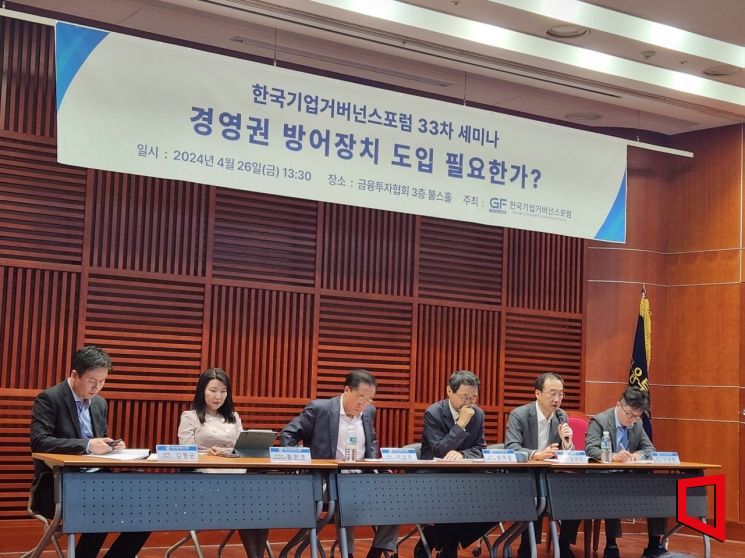 Experts attending the Korea Corporate Governance Forum seminar held at the Korea Financial Investment Association in Yeouido, Seoul, on the 26th are conducting a panel discussion. From the left, Kim Hyung-gyun, Head of Department at Cha Partners Asset Management; Hwang Hyun-young, Research Fellow at the Capital Market Research Institute; Lee Nam-woo, Chairman of the Korea Corporate Governance Forum; Song Ok-ryul, Professor at Seoul National University School of Law; Lee Chang-hwan, CEO of Align Partners Asset Management; and Kim Kyu-sik, Attorney at Fibonacci Asset Management.
 /Photo by Kim Dae-hyun kdh@
"If management rights defense is introduced without investor protection, executives' pursuit of private interests becomes easier"
Professor Song said, "In South Korea, where investor protection levels are low, the task that should precede now is to improve the capital market environment in a way that encourages efficient managers and restrains inefficient managers," adding, "If management rights defense is made easy, executives can pursue private interests through entrenchment."
He stated, "When shareholder returns increase and stock prices rise through value-up, management rights naturally stabilize," and added, "The problem in South Korea's capital market is the lack of hostile corporate acquisition attempts or active shareholder engagement. If the purpose is to defend against activism, currently discussed management rights defense measures such as poison pills cannot be effective tools."
Regarding the business community's claim that "activist funds erode the company's long-term growth and pursue short-term profits through 'hit-and-run' strategies," he dismissed it as "completely unfounded." Short-term stock price fluctuations are managed by the reputation of activist funds, and ultimately, even activist funds find it difficult to adopt strategies that damage long-term corporate value while pursuing short-term gains.
Professor Song emphasized, "Participants in South Korea's capital market tend to focus on short-term trading. Institutional investors are no exception," and added, "In fact, activist strategies cannot easily achieve their goals with just one or two shareholder proposals, requiring extensive research, so they cannot easily change target companies. Therefore, attacking activism as short-term performance-oriented is not justified."
"Claims that activism attempts hostile M&A are fighting imaginary monsters"
During the panel discussion, fierce debates continued over the demand to expand management rights defense measures. Attorney Kim Gyu-sik of Fibonacci Asset Management said, "Controlling shareholders run businesses using other general shareholders' money," and added, "In the Korea discount (undervaluation of the Korean stock market) situation, demanding expansion of management rights is inappropriate."
Lee Chang-hwan, CEO of Align Partners Asset Management, also pointed out, "Value-up means raising stock prices. The moment poison pills are introduced, executives may think they will enjoy control forever and stop caring about stock prices," adding, "Activist funds cannot replace the entire board with a 5% stake. There has practically never been a hostile M&A case in Korea; we are fighting imaginary monsters."
Examples from overseas with high levels of investor protection were also introduced. Namwoo Lee, chairman of the Korea Corporate Governance Forum and visiting professor at Yonsei University's Graduate School of International Studies, who moderated the discussion, said, "In Japan, inefficient managers have been pushed out by general shareholders and then made shareholder proposals in reverse," and explained, "It was not foreign funds seizing management rights, but independent boards formed with industry experts upgrading management."
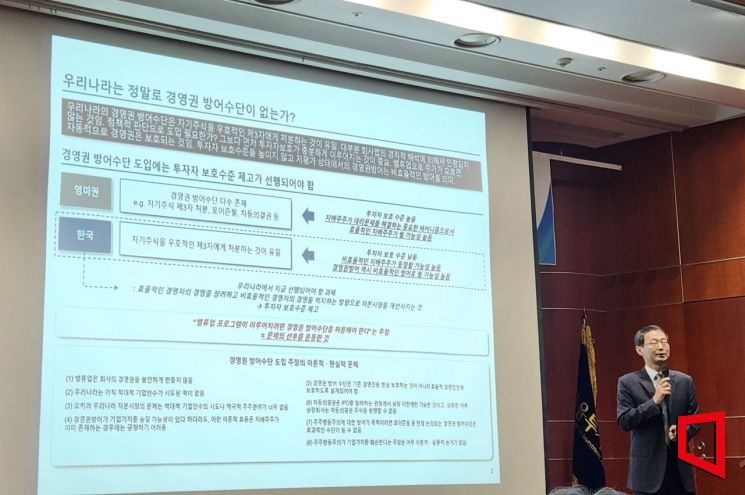 Professor Song Ok-ryeol of Seoul National University School of Law is giving a presentation at the Korea Corporate Governance Forum seminar held on the 26th at the Korea Financial Investment Association in Yeouido, Seoul.
 Photo by Kim Daehyun kdh@
Kim Hyung-gyun, head of Cha Partners Asset Management, noted, "In Japan, there have been 15 successful hostile M&A cases in the past six years, and 60 to 70 acquisitions through prior consultations annually," adding, "Japanese authorities say this indicates an improvement in Japan's M&A environment. It is seen as a direction that helps value-up."
Kim said, "In the U.S., most proposals to introduce management rights defense measures at shareholder meetings are rejected. The global standard is moving toward eliminating management rights defense measures, but South Korea is trying to go in the opposite direction," and added, "If you want defense measures, you must first manage well. It is an inappropriate claim when companies cannot increase corporate value or care about stock prices."
Points needing improvement in the current system were also presented. Hwang Hyun-young, a researcher at the Korea Capital Market Institute, said, "The current 3% voting rights system to check controlling shareholders needs to be reconsidered. Even during its introduction, there was no basis for why the '3%' standard was set," and pointed out, "Originally, it was intended to be used for appointing auditors, but now it is effectively used as a means for minority shareholders to enter the board."
Regarding concerns that "value-up raises stock prices and increases controlling shareholders' inheritance tax burden," Attorney Kim said, "South Korea is the only country in the world where management rights are inherited by a specific family," and emphasized, "The Korea Corporate Governance Forum has already proposed lowering the inheritance tax rate to 35%. However, for this, controlling shareholders must set an example. Rapid value-up to win public support is a priority."
© The Asia Business Daily(www.asiae.co.kr). All rights reserved.
![Clutching a Stolen Dior Bag, Saying "I Hate Being Poor but Real"... The Grotesque Con of a "Human Knockoff" [Slate]](https://cwcontent.asiae.co.kr/asiaresize/183/2026021902243444107_1771435474.jpg)

















