Controversy Over Lenient Punishments for Animal Abuse Perpetrators
Few Cases Result in Imprisonment... Only 5.5%
It has been nearly a year since the amendment to the Animal Protection Act, which is based on preventing animal abuse and strengthening pet management, was implemented, but the actual effect of preventing animal abuse appears to be minimal. In reality, abuse can only be proven when animals suffer injury or death, and even then, the punishments are lenient, resulting in no eradication of abuse.
 The photo is not related to any specific expressions in the article. [Image source=Getty Images Bank]
Abuse Proven Only When Animals Die or Are Injured... Difficult to Punish Abuse Itself
The Ministry of Agriculture, Food and Rural Affairs promulgated the full amendment to the Animal Protection Act in 2022 and implemented the amendment a year after its promulgation in April last year. The comprehensive amendment is characterized by elevating the prohibited acts of abuse, which were previously included in the subordinate regulations of the Animal Protection Act Enforcement Rules, to the main law, clearly specifying the conditions subject to punishment.
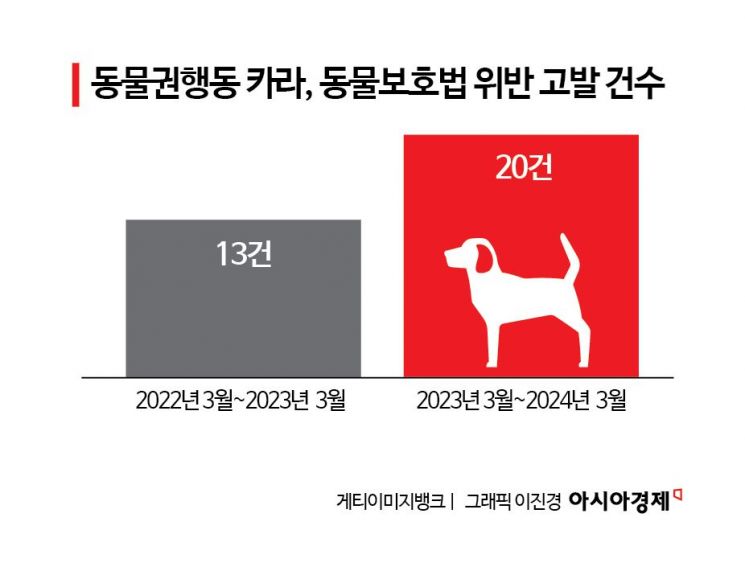
However, animal rights organizations point out that the implementation of the amendment has not had a meaningful effect on eradicating abuse crimes. According to Animal Rights Action Kara, the number of cases reported to investigative agencies by Kara for violations of the Animal Protection Act from March last year to recently is 20. During the same period last year, from March 2022 to March 2023, the number was 13, indicating that reports have actually increased since the amendment was implemented.
The biggest limitation is that the current law is more of a 'post hoc remedy' rather than prevention. If an animal does not die or get injured, it is difficult to punish the act of abuse itself. Although there are provisions to punish acts that cause pain to animals, these are limited to only four cases, such as leaving animals in extreme cold or heat or forcibly feeding them.
Han Jae-eon, a lawyer at Animal Freedom Union, said, "A few years ago, when the so-called 'sky shot,' where people threw their dogs into the air to take pictures, was popular, experts expressed concerns about mental abuse of animals. However, acts causing mental distress were not included as types of abuse and thus could not be punished. The current law has the limitation that only cases where abuse can be proven retrospectively, such as when an animal dies, can be punished."
 The so-called 'sky shot,' where pets are thrown into the air to take photos. Around 2018, the trend of posting sky shots continued mainly on social media platforms like Instagram.
 [Photo by SNS screen capture]
'Elevated cages' and 'short leashes'... Difficult to Punish Unless the Animal Is a Pet
Another problem with the current law is that neglect and abandonment can only be punished if the animal is a pet. The amended Animal Protection Act defines neglect as abuse when minimum breeding space, hygiene, and health care are neglected, but only for pets.
As a result, if the owner claims that the animal is being raised for a purpose other than companionship, even if the animal is kept on a short leash, it may not be subject to punishment. Yoon Seong-mo, an activist at Kara, said, "The most common reports received by animal organizations are cases where dogs are kept in elevated cages with holes in the floor or tied with short leashes within 2 meters. Even if animals are raised in poor conditions, if they are not pets, neglect and abandonment alone cannot be punished. It is usually resolved through local government guidance and persuasion."
Lenient Punishments... Only 5.5% Receive Imprisonment
Even when offenders are brought to trial, most receive only fines. When an animal dies due to abuse, the offender can face up to three years in prison or a fine of up to 30 million won.
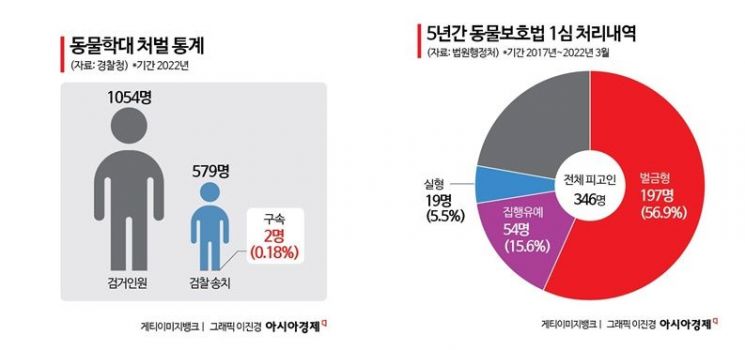
However, cases resulting in imprisonment are extremely rare. According to police statistics, among 1,054 people arrested for violating the Animal Protection Act in 2022, only two suspects (0.18%) were prosecuted while in custody. According to the court administration's records on first-instance cases of Animal Protection Act violations over the past five years, only 19 out of 346 defendants (5.5%) who underwent formal trials received imprisonment. 56.9% (197 defendants) received fines.
The Supreme Court Sentencing Commission, aware of this controversy, has decided to establish sentencing guidelines for animal abusers by 2025. This aims to create proper standards for punishment, as the severity of abuse penalties has been inconsistent.
A lawyer said, "Even for the same animal abuse crime, there have been issues with sentencing standards, where some receive fines and others imprisonment. Along with establishing sentencing guidelines, the types of animal abuse should be detailed so that offenders can be punished for abuse alone, even if the animal does not die or get injured."
© The Asia Business Daily(www.asiae.co.kr). All rights reserved.



















