Intensive Inspection Expected on Incomplete Sales
Asset Management Industry on Hong Kong ELS Incident Recurrence
"Product Structure Completely Different... Comparison Not Appropriate"
 Yeouido Financial Supervisory Service building (right) and securities buildings in Seoul. Photo by Younghan Heo younghan@
As the financial supervisory authorities prepare to investigate whether major banks have engaged in incomplete sales of covered call exchange-traded funds (ETFs), related products have disappeared from sales counters. The authorities conducted a comprehensive review of securities registration statements submitted by asset management companies and concluded that there are no issues with the products themselves. Similar to the recent controversy surrounding the 'Hong Kong equity-linked securities (ELS) incident,' the key focus is expected to be on whether incomplete sales occurred.
Financial Supervisory Service Prepares to Inspect Bank Sales... The Core Issue is Incomplete Sales
According to the financial investment industry and regulatory authorities on the 29th, the Financial Supervisory Service (FSS) has begun preparations to inspect the recent sales of covered call ETFs by major banks. During the actual inspection, it is expected that the authorities will examine whether the possibility of principal loss was sufficiently disclosed during the sales process and whether incomplete sales occurred.
A covered call is a strategy that involves buying the underlying asset while simultaneously selling a 'call option' that allows the asset to be purchased at a specific price. The premium from selling the call option is used to generate dividend funds. In the event of a stock price decline, losses are cushioned by the option premium, but the upside is limited when the stock price rises. Investors should be aware that prices may rise less flexibly in an upward market due to this limitation.
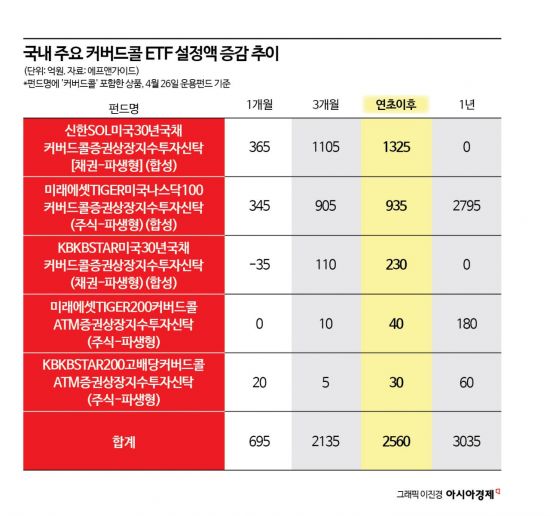
Since the beginning of the year, sales of covered call ETFs have surged, prompting financial authorities to closely monitor sales trends. According to financial information provider FnGuide, as of the 26th, there are currently 12 domestic covered call ETFs based on the total classes of managed funds. The total assets under management amount to 852.1 billion KRW, with net inflows of approximately 248 billion KRW over about four months since the start of the year. Among these, the top five funds accounted for most of the increase, with net inflows of 256 billion KRW. Over the past year, the 12 funds have seen net inflows of 289.5 billion KRW, indicating a concentration of investments this year.
The main targets of the authorities' inspection are expected to be banks that have sold large volumes of covered call ETFs. SC First Bank, which recently engaged in aggressive sales through individual branches, is likely to be included. Although KB Kookmin Bank was mentioned in some quarters, it stopped selling covered call ETFs following the enforcement of the Financial Consumer Protection Act in 2021. Hana Bank also independently filters out high-risk products, such as high-yield bonds included in trust ETFs, through its Non-Deposit Product Committee.
The FSS reviewed the securities registration statements and prospectuses submitted for domestic covered call ETFs and determined that there are no issues with the products themselves. The FSS examines all documents during the initial review process when financial investment products are first launched and continues to conduct ongoing inspections thereafter.
An FSS official stated, "We conducted a comprehensive re-examination of the securities registration statements related to covered call ETFs to verify whether risks were properly disclosed, but found no particular issues. It seems that whether incomplete sales occurred at the frontline of sales will be important, and we will continue to monitor whether there is an excessive concentration in specific products."
Asset Management Industry on Alert: "Covered Call ETFs Are Different from Hong Kong ELS"
With bank sales channels blocked, tension is rising in the asset management industry as well. An investment strategy manager at Bank A said, "Securities firms have recently sold many covered call products, and banks, which lost products to sell after the Hong Kong ELS incident, have shifted to covered call ETFs as alternative products. I understand that asset managers are now on high alert."
The market has drawn a clear line regarding concerns raised by some about the possibility of a recurrence of the recent Hong Kong ELS incident. This is due to differences in the characteristics of the closed structure of ELS and the freely redeemable nature of ETFs. ELS typically offers early redemption opportunities every six months if the underlying index maintains a certain level. If the index falls below the target, investors must wait until maturity. At maturity, if conditions such as not entering the knock-in zone are met, the principal is returned. In contrast, ETFs can be redeemed at any time, preventing simultaneous large-scale losses. Dividend events or declines in the value of the underlying index are reflected in ETF prices in real time. Investors can also easily verify this directly and make immediate investment decisions.
A representative from Asset Management Company B said, "Thanks to transparency, which has been a driving force behind the growth of the ETF market, the product structures of the closed ELS and ETFs are very different. In the case of ELS, the fact that principal is not lost unless the index falls below a certain level has led to greater consumer misunderstanding during sales. ETFs cannot be structured as principal-guaranteed products, so it is difficult to compare them directly."
He added, "However, because monthly dividends are paid, there may be some potential for misunderstanding or exaggerated advertising. But after dividends are paid, if the index falls and the value turns negative, customers can accurately check price fluctuations, allowing investors to respond more proactively."
© The Asia Business Daily(www.asiae.co.kr). All rights reserved.
![Clutching a Stolen Dior Bag, Saying "I Hate Being Poor but Real"... The Grotesque Con of a "Human Knockoff" [Slate]](https://cwcontent.asiae.co.kr/asiaresize/183/2026021902243444107_1771435474.jpg)

















