JLK announced on the 26th that it has launched Snappy (Stroke Network APPlication for You), a one-stop network service platform for stroke care aimed at securing the golden time for stroke treatment.
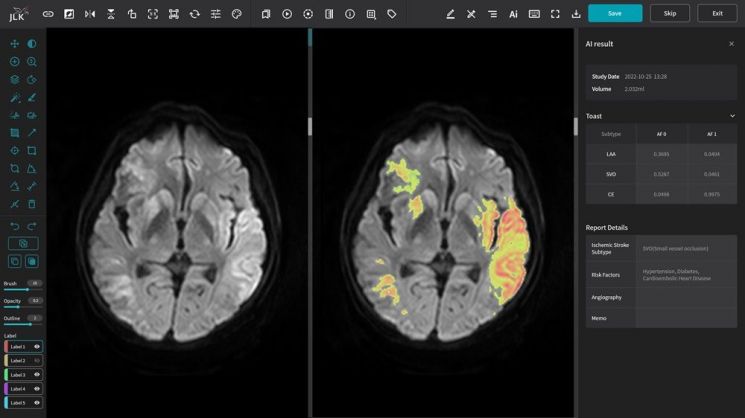
Snappy is the first medical network service developed by JLK in Korea. It is equipped with 11 full stroke artificial intelligence (AI) solutions. It can operate in both PC and mobile environments, allowing real-time sharing of patients' stroke-related clinical and imaging information along with quantitatively analyzed values interpreted by AI anytime and anywhere, which greatly aids in making rapid treatment decisions.
When medical institutions adopt Snappy, patient conditions, clinical information, and AI analysis results are shared with multiple medical staff involved in stroke care, enabling real-time exchange of opinions. This is expected to facilitate faster decision-making by medical personnel and improve the accuracy of stroke diagnosis. Additionally, enhanced communication features such as ▲dedicated chat among medical staff ▲sharing and viewing of computed tomography (CT) and magnetic resonance imaging (MRI) ▲provision of AI diagnostic results will maximize convenience in medical settings. In particular, these communication functions allow real-time interaction among stroke care medical staff, including those in emergency rooms, enabling swift diagnosis and treatment decisions, which is expected to help secure the golden time for stroke patients and improve prognosis.
JLK plans to actively utilize Snappy for its full-scale entry into the U.S. market scheduled for this year. Given the long distances between hospitals in the U.S. healthcare market, there is an expectation of high demand for responsive applications like Snappy that incorporate both AI solutions and communication functions.
Kim Dong-min, CEO of JLK, stated, “Snappy is a stroke care AI app platform that can be conveniently operated in all medical environments. With 11 stroke diagnostic AI solutions and medical staff communication features, it will play a crucial role in enhancing the speed and accuracy of stroke diagnosis.”
© The Asia Business Daily(www.asiae.co.kr). All rights reserved.

















