Proposed 30 Tasks Across 12 Key Areas to Government
Priority Active Inclusion Starting from Next Year's R&D Budget Planning
The government has unveiled a future blueprint for research and development (R&D) in small and venture businesses, focusing on innovation and challenges in strategic technology sectors, as well as innovation in governance and specialized institutions.
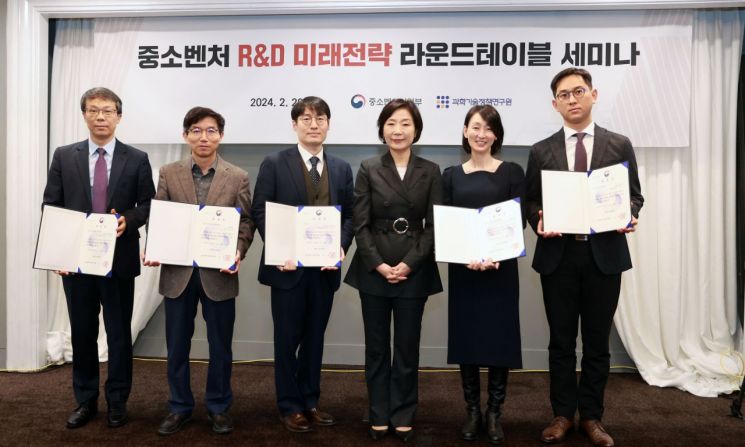 Oh Young-joo, Minister of SMEs and Startups (center), is taking a commemorative photo after receiving a certificate of appointment as an advisory committee member at the 'SME and Startup R&D Future Strategy Roundtable Seminar' held on February 29 at the Kensington Hotel in Yeongdeungpo-gu, Seoul.
 [Photo by Yonhap News]
On the 26th, the Ministry of SMEs and Startups held the ‘SME & Venture R&D Future Strategy Roundtable Performance Sharing Forum’ at the Glad Hotel in Yeouido, Seoul, announcing the future strategic direction for R&D in small and venture companies.
The forum was organized to share the results of the subcommittee discussions aimed at innovating and restructuring R&D since the launch of the R&D Future Strategy Roundtable at the end of January. The R&D Roundtable consists of three subcommittees: Strategic Technology & Global R&D, R&D Structural Reform, and AX (AI Transformation), with the Science and Technology Policy Institute (STEPI) serving as the secretariat.
From January to this month, the three subcommittees proposed a total of 30 tasks across 12 major areas to the government, covering both short- and mid-to-long-term goals. Accordingly, the Ministry of SMEs and Startups structured the policy recommendations from each subcommittee to derive the future strategic direction for SME and venture company R&D.
First, the focus will be on fostering innovative small giants and expanding innovative and challenging R&D in strategic technology fields. Additionally, support for R&D will be strengthened through joint research with world-class innovative companies and research institutions, as well as projects that have ripple effects on multiple companies. The plan also emphasizes supporting areas that can create new markets in the future, concentrating on ecosystem innovation and global network R&D support.
Cooperative R&D with research institutions will be improved to support technology development that small businesses and markets demand, and R&D support methods will diversify beyond traditional grants to include investments and loans, enhancing the efficiency of financial input. In the long term, SME R&D governance will be reorganized, and the R&D planning and management capabilities of specialized institutions such as the Small and Medium Business Technology Information Promotion Agency will be strengthened in line with national R&D innovation directions like deep tech and innovation challenges.
Minister Oh Young-joo of the Ministry of SMEs and Startups stated, “For small and venture companies to grow into strong enterprises competitive in the international community, technological capability must be supported. The importance of SME R&D as a core means for this cannot be overstated. We will actively reflect the proposed policy recommendations starting with next year’s R&D budget allocation.”
The first subcommittee of the SME & Venture R&D Future Strategy Roundtable, ‘Strategic Technology & Global R&D,’ proposed initiatives such as ‘high-risk, high-reward projects,’ ‘expanding investment in strategic technology sectors including deep tech and Scale-up TIPS,’ ‘collaboration with global companies and overseas certification bodies to link with local overseas demonstrations,’ ‘data-driven strategic inbound and outbound policies including investment by technology and global supply chains in cooperation with leading countries in carbon neutrality and AI,’ and ‘expanding global R&D networking using overseas bases.’
The second subcommittee, ‘R&D Structural Reform,’ requested redesigning SME R&D to support technology development demanded by the market, future-oriented R&D focusing on markets likely to emerge, optimizing R&D support methods from past grant-centered approaches to include investments and loans tailored to company growth stages and market demand, and establishing control functions at the inter-ministerial level to plan and execute SME R&D strategies.
The third subcommittee, ‘AX,’ called for ‘expanding investment in AI-leading startups and a public-private consortium AI platform ecosystem,’ ‘specialized strategies by industry and target such as AI service platforms for micro and small merchants,’ and ‘reducing infrastructure costs to make AI more accessible to SMEs.’
© The Asia Business Daily(www.asiae.co.kr). All rights reserved.