KRW 250,000 Support Fund Criticized Indirectly by Opposition
Presidential Office: "Balanced Recovery in Domestic Demand and Exports"
The Presidential Office stated on the 25th that the real Gross Domestic Product (GDP) for the first quarter of this year grew by 1.3% compared to the previous quarter, adding, "We believe it is very important to be cautious about policies that could stimulate inflation, so that the recovering economy does not translate into rising prices."
This was interpreted as a veiled criticism of cash support measures such as the 250,000 won per person payment demanded by Lee Jae-myung, leader of the Democratic Party of Korea, suggesting that such support could lead to inflation. Furthermore, given the strong performance in exports and domestic demand, the economy is expected to exceed the initially forecasted growth rate of 2.2% by the International Monetary Fund (IMF).
A senior official from the Presidential Office said in a meeting with reporters at the Yongsan Presidential Office that "Fortunately, the economic growth indicators this time show that both exports and domestic demand are quite stable. It is more important to maintain economic stability rather than excessively stimulate the economy."
The official explained, "Consumer prices in March rose by 3.1%. In a sense, this reflects an economic recovery. There are factors that could stimulate inflation. Therefore, it is important to carefully manage the recovery so that it does not lead to rising prices."
Regarding the opposition party's demand for an additional supplementary budget to provide nationwide livelihood recovery support payments, the official said, "Policies that stimulate domestic demand can increase inflationary pressure," but added, "This is not an evaluation of the opposition's proposal. I am answering based on a question about what is important in managing overall economic policy."
According to the Bank of Korea, the Korean economy grew by 1.3% quarter-on-quarter and 3.4% year-on-year in the first quarter of this year. Excluding the COVID-19 period of 2020-2021, this is the highest growth rate in four and a half years.
The government and the Presidential Office explained that this is a private-led growth, where the private sector fully contributed to the overall growth rate rather than fiscal stimulus.
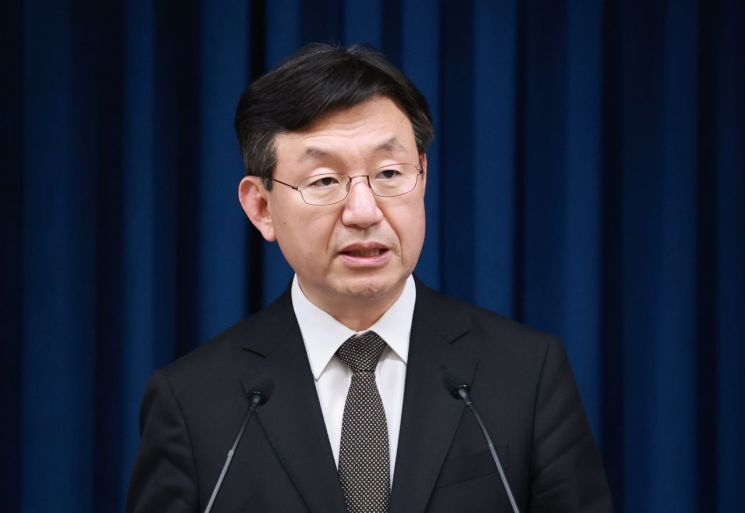
Seong Tae-yoon, Director of Policy at the Presidential Office, also mentioned at a briefing at the Yongsan Presidential Office that the entire 1.3% quarter-on-quarter economic growth was contributed by the private sector, with the government's contribution being 0 percentage points. He emphasized that of the 1.3%, 0.7 percentage points came from domestic demand and 0.6 percentage points from net exports, indicating a balanced recovery with half from exports and external factors and half from domestic demand.
Interpreting this economic trend as a positive signal, Director Seong stated that the economic growth rate this year will exceed 2.2%. He said, "Global investment banks (IBs) and domestic and international forecasting institutions have already revised upward their growth forecasts for our economy this year. As you know, in January this year, the IMF raised its forecast from 2.2% to 2.3%, JP Morgan raised it from 2.2% to 2.3% this month, and UBS raised it from 2.0% to 2.3% this month. Today, JP Morgan further revised Korea's economic growth forecast for this year from 2.3% to 2.8%."
© The Asia Business Daily(www.asiae.co.kr). All rights reserved.
![Clutching a Stolen Dior Bag, Saying "I Hate Being Poor but Real"... The Grotesque Con of a "Human Knockoff" [Slate]](https://cwcontent.asiae.co.kr/asiaresize/183/2026021902243444107_1771435474.jpg)
















