Constitutional Court: "No Recognition of Contribution to Formation of Inherited Property... No Reason to Grant Compulsory Portion Rights"
The Constitutional Court has ruled that the system of forced inheritance of a certain portion of an estate to siblings, regardless of the deceased's wishes, is unconstitutional.
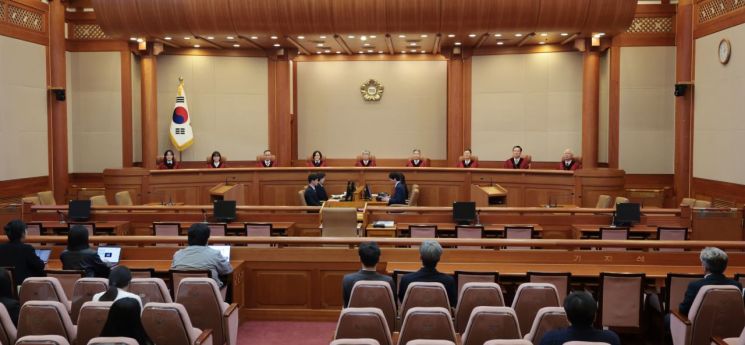 Chief Justice Lee Jong-seok of the Constitutional Court and the justices are seated on the 25th in the Grand Bench of the Constitutional Court in Jongno-gu, Seoul, for the ruling on the unconstitutionality trial of Article 1112 of the Civil Act and the inheritance portion system, as well as the constitutional complaint. [Image source=Yonhap News]
On the 25th, the Constitutional Court unanimously declared Article 1112, Clause 4 of the Civil Act unconstitutional.
The Court stated, "It is difficult to find a reasonable justification for granting siblings of the decedent a statutory reserved portion right, despite the fact that their contribution to the formation of the inheritance property or their expectation of inheritance is hardly recognized."
The reserved portion system guarantees half of the statutory inheritance share (for spouses, sons, and daughters) or one-third (for parents and siblings when there is no spouse or children) to protect the survivors' right to live.
If an heir's actual inheritance amount from the decedent's estate is less than their reserved portion, they can claim the difference from other heirs or third parties who received lifetime gifts or legacies (gifts made by will). Each heir's reserved portion is half or one-third of the statutory inheritance share they would have originally received if there were no lifetime gifts or legacies.
The basic property for calculating the reserved portion includes gifts made by the decedent within one year before death. However, property gifted to co-heirs is included in the basic property without any time limitation.
During the earlier public hearing, the petitioner challenging the constitutionality of the reserved portion system argued that the current system is a "law that fosters unfilial children" and a "law that causes disputes," and should be abolished to reflect changes in the times. On the other hand, the Ministry of Justice countered, "While some modifications and improvements are necessary, fundamental changes to the system should be carefully decided through social discussion," and argued that "problems should be addressed through legislative amendments rather than a constitutional court declaration of unconstitutionality."
© The Asia Business Daily(www.asiae.co.kr). All rights reserved.

















