The Supreme Court has ruled that it is difficult to recognize the "monthly working days of urban daily workers," which serves as the standard for calculating damages when a worker suffers an occupational injury, as exceeding 20 days. Previously, based on a 2003 Supreme Court precedent, the standard of '22 days' was commonly applied, but this standard has been changed after 21 years.
On the 25th, the Supreme Court's Second Division (Presiding Justice Lee Dong-won) overturned and remanded the appellate court's ruling that recognized 22 monthly working days in a subrogation claim lawsuit filed by the Korea Workers' Compensation and Welfare Service (KCOMWEL) against Samsung Fire & Marine Insurance, the insurer of the crane that caused the accident, after KCOMWEL paid temporary disability benefits to a daily worker who suffered an occupational injury. The court stated, "It is difficult to recognize the monthly working days of urban daily workers as exceeding 20 days."
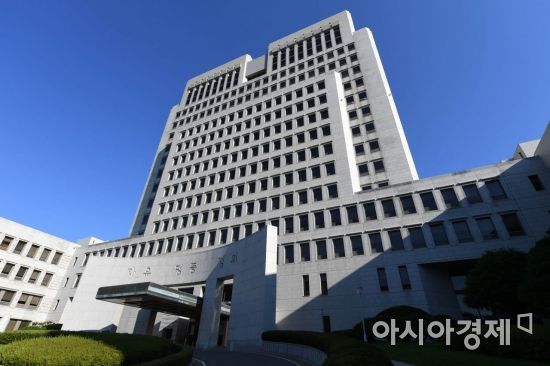
The monthly working days of urban daily workers is one of the key criteria for calculating compensation in related civil lawsuits. In 2014, an accident occurred at a construction site in Changwon, Gyeongnam, where workers fell from a crane and died or were injured. KCOMWEL recognized this accident as an occupational injury and paid temporary disability benefits to the victims, then filed a subrogation claim lawsuit against Samsung Fire & Marine Insurance, the insurer of the crane that caused the accident.
Both the first and second trials recognized liability for damages. However, the issue was how many monthly working days should be considered for daily workers when calculating the amount of compensation. The first trial recognized only '19 days,' based on the fact that the total number of working days over 51 months in the victim's employment insurance daily work records was only 179 days. In contrast, the second trial set the monthly working days at 22 days according to previous precedents.
However, in its ruling on this day, the Supreme Court stated, "The various statistical data that previously served as the basis for the Supreme Court to consider the monthly working days of urban daily workers as about 22 days have changed significantly, making it difficult to apply them as they are," and reduced the standard for monthly working days to 20 days after 21 years. This reflects social and economic changes such as the introduction of substitute holidays, an increase in annual holidays, and a gradual reduction in working hours.
A Supreme Court official said, "The reduction of the monthly working days standard from 22 to 20 days is significant and will have a great impact on actual practice," but added, "It does not mean that the monthly working days must be recognized as 20 days in all cases. If the victim actively proves otherwise, it can be recognized as exceeding 20 days, and in some cases, less than 20 days may be recognized depending on the circumstances."
He continued, "This is a declaration of a practical rule that can be applied currently, reflecting the changed times, and does not constitute a change in precedent. Therefore, it is not necessary for the full bench to discard the previous precedent and issue a ruling."
© The Asia Business Daily(www.asiae.co.kr). All rights reserved.
![Clutching a Stolen Dior Bag, Saying "I Hate Being Poor but Real"... The Grotesque Con of a "Human Knockoff" [Slate]](https://cwcontent.asiae.co.kr/asiaresize/183/2026021902243444107_1771435474.jpg)
















