US Tennessee GM Joint Venture 2nd Plant Operation
Arizona Cylindrical & ESS Plant Groundbreaking
Enhancing Investment Efficiency and Securing Competitiveness
LG Energy Solution announced on the 25th that although its sales and operating profit in the first quarter declined compared to the same period last year, it continued investments to prepare for the future, such as expanding production facilities.
LG Energy Solution explained that its first-quarter sales were KRW 6.1287 trillion and operating profit was KRW 157.3 billion, down 29.9% and 75.2% respectively compared to the same period last year. Compared to the previous quarter, they decreased by 23.4% and 53.5%, respectively.
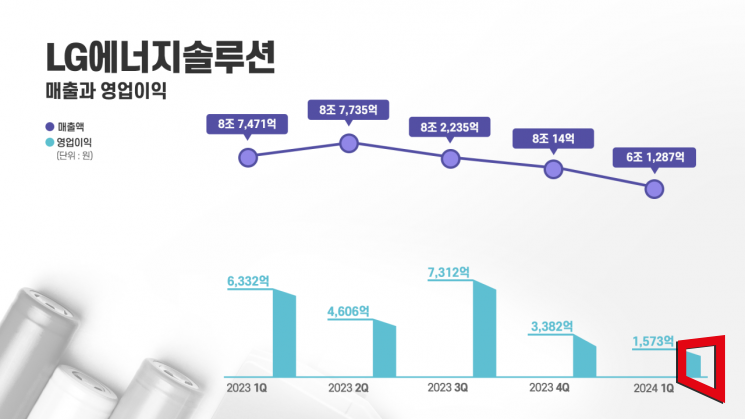
Lee Chang-sil, Vice President and CFO of LG Energy Solution, said, "While we actively responded to strategic customer demand and cylindrical batteries for electric vehicles achieved double-digit sales growth, overall sales decreased by 23% compared to the previous quarter due to factors such as weakening demand in the upstream market and price reflection of metal price declines. Profitability also declined compared to the previous quarter due to increased fixed cost burdens from production rate adjustments caused by market demand contraction and the lagging effect of raw material input caused by metal price drops."
The amount of the U.S. Inflation Reduction Act (IRA) tax credit reflected in the first-quarter operating profit was KRW 188.9 billion, which decreased compared to the previous quarter (KRW 250.1 billion) due to reduced customer demand and partial production line stoppages caused by the transition of new lines at the Michigan corporation. Excluding the tax credit, the first quarter recorded an operating loss of KRW 31.6 billion.
LG Energy Solution operated several production facilities in the first quarter. The Tennessee GM joint venture plant in the U.S. is operating normally and shipping products. LG Energy Solution plans to expand the production capacity of this plant to 50 GWh, and the batteries produced will be installed in new electric vehicles based on GM's third-generation battery platform.
The second standalone production plant in the U.S., the Arizona plant, has also begun full-scale construction. It is the first cylindrical battery plant and the first dedicated ESS (Energy Storage System) plant in the North American region. Starting in 2026, it will begin production of the 46 series, which is gaining attention as the next-generation cylindrical battery, and LFP-based ESS, solidifying technological leadership in the North American market.
Battery-related new businesses are also accelerating. In March, LG Energy Solution agreed to collaborate with Qualcomm Technologies to develop advanced BMS diagnostic solutions, and its in-house independent company Kuru installed about 200 battery swapping stations in the Seoul area. The plan is to increase this to about 1,000 nationwide by 2025. LG Energy Solution intends to secure leading 'technological leadership' in service businesses beyond battery production and sales through these new businesses.
Additionally, it strengthened supply chain competitiveness by securing 160,000 tons of LFP cathode materials from 'Sangju Liwon' in China and 85,000 tons of lithium concentrate from 'WesCEF' in Australia. It also continued efforts to alleviate short-term financial burdens and secure competitive funding by successfully issuing corporate bonds worth KRW 1.6 trillion and signing a long-term lease contract for a building in Arizona.
LG Energy Solution also announced key execution strategies to fundamentally strengthen competitiveness on the same day. First, it will enhance investment and cost efficiency. It plans to carefully review demand changes for various ongoing projects, prioritize them, and reasonably adjust the scale and speed of investment execution. It will seek ways to maximize the operating rate of each production facility to alleviate fixed cost burdens and optimize logistics and utility costs to solidify its foundational strength.
It will also secure cost competitiveness through raw material cost innovation. The company plans to reduce material costs by expanding direct sourcing areas for raw materials such as lithium and precursors, and improve profitability by expanding direct investment in global supply chains.
Based on strong partnerships with key customers, it will actively respond to customer demand. Currently, the joint venture plant with Hyundai Motor in Indonesia has started full-scale operations in the second quarter, ensuring smooth mass production, and in the second half of the year, a 45 GWh Stellantis joint venture plant in Ontario, Canada, is also scheduled to begin operations.
The company will also expand its new product lineup to lead future markets. It will start production of the next-generation cylindrical battery 46-series at the Ochang Energy Plant and begin stable mass production from the third quarter of this year. The ESS LFP batteries, which began mass production in Nanjing, China, at the end of last year, will also expand supply to the North American and European markets.
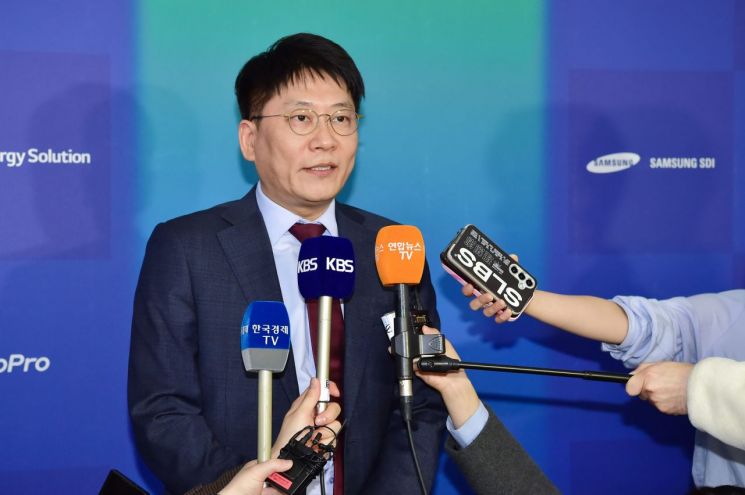
Kim Dong-myung, CEO of LG Energy Solution, stated, "Although a challenging market environment is expected throughout this year, we will fundamentally strengthen our competitiveness and steadily realize differentiated customer value to firmly prepare a foundation that can secure overwhelming technological leadership."
© The Asia Business Daily(www.asiae.co.kr). All rights reserved.
![Clutching a Stolen Dior Bag, Saying "I Hate Being Poor but Real"... The Grotesque Con of a "Human Knockoff" [Slate]](https://cwcontent.asiae.co.kr/asiaresize/183/2026021902243444107_1771435474.jpg)

















