Japanese Lawmaker's Group Visit to Yasukuni Shrine
Seo Kyung-duk: "Shrine Visit Justifies Aggressive War...
Japan's Actions Must Be Widely Publicized to Shape Global Opinion"
As Japanese ruling and opposition party lawmakers collectively visited Yasukuni Shrine, Professor Seo Kyung-duk of Sungshin Women's University announced that he reported this fact to major media outlets worldwide.
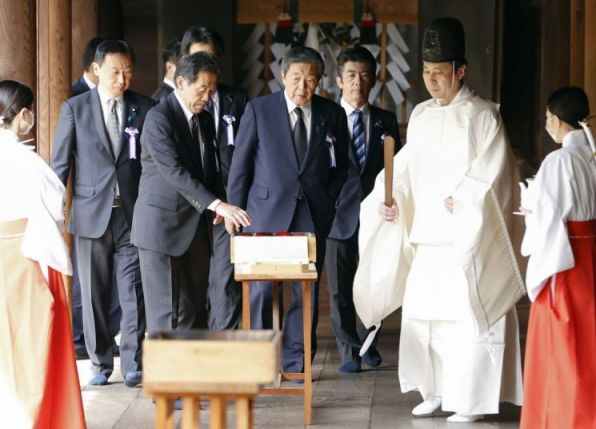
On the 25th, Professor Seo revealed that he had informed major global media about the collective visit of Japanese lawmakers to Yasukuni Shrine. He stated, "I pointed out the issues regarding Yasukuni Shrine and the visits in detail to over 50 media outlets across 20 major countries worldwide, including AP News, Reuters, CNN, BBC, The New York Times (NYT), and Xinhua News Agency."
Earlier, on the 23rd, about 90 Japanese lawmakers from both ruling and opposition parties conducted a collective visit to Yasukuni Shrine, where Class-A war criminals from the Pacific War are enshrined. Prior to that, on the 21st, Prime Minister Fumio Kishida offered tributes at Yasukuni Shrine, and Minister for Economic Revitalization Yoshitaka Shindo personally visited the shrine to pay respects.
In the denunciation email sent by Professor Seo, he stated, "Japanese politicians' continuous visits to Yasukuni Shrine are acts of denying history with the intention of 'justifying' their invasion wars," and emphasized, "For the future peace and prosperity of Northeast Asia, please widely publicize Japan's actions to the world so that global public opinion can be formed."
Meanwhile, Yasukuni Shrine, located in Chiyoda Ward, the heart of Tokyo, is Japan's largest shrine. The shrine houses memorial tablets of approximately 2,466,000 soldiers and civilians who died in major wars waged by Japan, including the First Sino-Japanese War, Russo-Japanese War, Manchurian Incident, and World War II, and deifies them through rituals. In 1978, the memorial tablets of 14 Class-A war criminals, including former Prime Minister Hideki Tojo, were enshrined at Yasukuni Shrine, making official visits by Japanese prime ministers and cabinet members a political issue. Regarding the visits, Korea and China, victims of Japanese imperialist aggression, have strongly protested, demanding that Japan not deny its war responsibility; however, official visits by Japanese cabinet members continue to this day.
© The Asia Business Daily(www.asiae.co.kr). All rights reserved.

















