Yellow Dust Blows in from the Sahara Desert
Air Quality Index Soars to Critical Levels
The live-action adaptation of the movie series 'Dune,' set against a sandy desert backdrop, unfolded in Greece. Just like South Korea, which suffers from yellow dust every spring, Greece is also struggling with sandstorms. Storms originating from the Sahara Desert in North Africa have crossed the sea and engulfed Greece.
On the 23rd (local time), Greek meteorological authorities announced that a sandstorm originating from the Sahara Desert had covered the southern region of Greece. Authorities urged citizens to be cautious when going outside. Greece has already been engulfed in yellow dust since the end of last month. The yellow dust has spread beyond Southern Europe to Switzerland and Southern France.
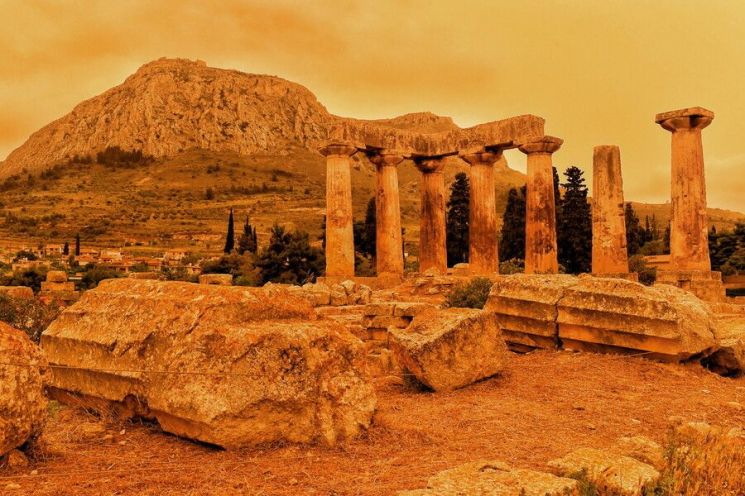 On the 23rd (local time), the area around the Apollo Temple in Greece was dyed orange due to the influence of a sandstorm. [Image source=EPA Yonhap News]
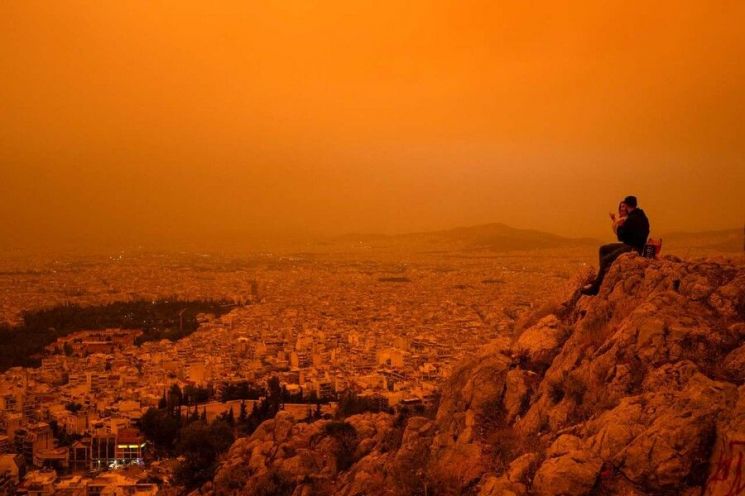
The enormous scale of the yellow dust changed the sky over Greece. The sky turned orange, and major historical sites in Athens were also affected, taking on an orange hue. Netizens who saw photos released by local citizens expressed concerned reactions such as "It looks like an alien planet," "Is this the end of the world?" and "On days like this, it seems impossible to go outside."
The sand from the Sahara Desert contains iron oxide, which gives it a reddish color. This is why the skies of European countries within the yellow dust influence zone turned orange. It is also known that air quality has significantly deteriorated as a result.
In particular, Libya, a North African country severely affected by this desert storm, recorded a regional Air Quality Index (AQI) of 128, which is considered unhealthy. Typically, an AQI of 0?50 is classified as good, 51?100 as moderate, and above 100 advises sensitive groups to refrain from outdoor activities.
Sahara sandstorms cross the Mediterranean and enter Southern Europe every spring, but this year’s storm is reported to be extremely severe. It is considered the worst storm since the desert storm recorded in 2018.
Greek authorities have recommended that citizens with underlying respiratory conditions avoid going outside. However, Libya, Greece, and other affected areas are expected to gradually recover from the sandstorm’s impact starting from the afternoon of the 24th.
© The Asia Business Daily(www.asiae.co.kr). All rights reserved.
![Clutching a Stolen Dior Bag, Saying "I Hate Being Poor but Real"... The Grotesque Con of a "Human Knockoff" [Slate]](https://cwcontent.asiae.co.kr/asiaresize/183/2026021902243444107_1771435474.jpg)












