First Observation of Nanometer Water Dynamics Using Terahertz Waves
Suppression of Motion Reduction Dynamics Published in Science Advances
The moment when tiny water molecules come to a stop has been captured.
 From the top row, left to right: First author Researcher Yang Hyosim, Professor Jeong Jiyoon (Kangwon National University), First author Researcher Ji Gangseon, Researcher Lee Hyungtaek; from the bottom row, left to right: Jeong Junwoo, Park Nojeong, Park Hyungryeol, Professor Kim Daesik.
A research team led by Professor Hyung-ryul Park from the Department of Physics at UNIST (President Yong-Hoon Lee), in collaboration with Professor Ji-yoon Jung's team at Kangwon National University, Professors Dae-sik Kim, No-jung Park, and Jun-woo Jung's teams at UNIST, Professor Kyung-wan Kim's team at Chungbuk National University, and Professor Yoon Park's team at Seoul National University, has for the first time in the world confirmed that the dynamics of water molecules trapped in a two-dimensional world inside a nano resonator are suppressed using terahertz waves.
They observed various collective motions occurring at ultrafast speeds in water molecules with high-density light amplified inside the nano resonator at the fleeting moment of a picosecond (one trillionth of a second).
Water dynamics refer to water molecules performing specific motions at certain frequencies. When dynamics are suppressed, water molecules temporarily exhibit solid-like properties. Water molecules with a thickness of nanometers (nm, one billionth of a meter) are about one millionth the wavelength of terahertz electromagnetic waves, making it impossible to measure changes in water molecules.
First author Hyo-sim Yang, a researcher at UNIST, said, "Previous characteristics of water molecules were measured electrically at very low frequencies," adding, "However, the dynamics of water molecules trapped in very narrow gaps at high frequencies such as the terahertz range had not been revealed."
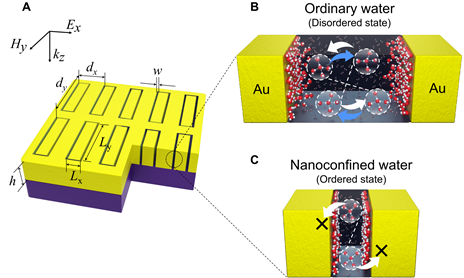
The research team fabricated nano resonators using atomic layer lithography technology to improve the focusing of terahertz waves. Conventional nano resonators could only reduce the gap width to the level of tens of nanometers. However, nano resonators made with atomic layer lithography can reduce the gap width to as narrow as 1 nm.
The fabricated resonators, based on the principle of capacitors, exhibit sensitive changes in the induced electric field inside as the gap width narrows to the nanometer scale. In other words, the sensitivity of measuring molecular motion is greatly enhanced.
According to previous studies, water trapped in nanometer gaps experiences an 'interfacial effect' where water molecules are aligned by both surfaces, suppressing their movement. Water molecules perform various collective motions at terahertz frequency ranges at picosecond speeds, and it was expected that these collective motions would be suppressed in water molecules trapped in nano gaps.
To verify this, the research team fabricated nano resonators with adjustable gap widths from 2 to 20 nm and filled the gaps with water. They confirmed the complex refractive index of water with nanometer thickness through terahertz electromagnetic wave transmission experiments. Changes in water dynamics were observed by measuring the rate at which the intensity of light decreased as it passed through the sample.
The team confirmed for the first time that water's picosecond dynamics are suppressed by the interfacial effect in gaps about 2 nm wide. They also discovered that the picosecond collective motion of water molecules decreases and dynamics are suppressed in 10 nm gaps.
Co-first author Kang-seon Ji, a researcher at UNIST, explained, "Water confined in nanometer gaps has been known to align due to the interfacial effect, showing phenomena similar to solids," adding, "Through this experiment, we revealed for the first time that, in addition to the interfacial effect, there is also an influence from the reduction of picosecond collective motions of water molecules."
Professor Hyung-ryul Park said, "This research can be utilized to observe superionic phases of two-dimensional water molecules or to study the dynamics of molecules in solvents such as DNA and RNA," adding, "It is a study that can be expanded to the mid-infrared and visible light regions by adjusting the size of the nano resonator."
This research was published online in the internationally renowned journal Science Advances. The research was supported by the Ministry of Science and ICT's National Research Foundation of Korea (NRF), the Institute for Information & Communications Technology Planning & Evaluation (IITP), Ulsan National Institute of Science and Technology, and Gangwon Technopark (GWTP).
© The Asia Business Daily(www.asiae.co.kr). All rights reserved.
![Clutching a Stolen Dior Bag, Saying "I Hate Being Poor but Real"... The Grotesque Con of a "Human Knockoff" [Slate]](https://cwcontent.asiae.co.kr/asiaresize/183/2026021902243444107_1771435474.jpg)

















