Up to 30 Million KRW Fine for Non-Compliance
Small Business Owners "No Support... Burden of Installation Costs"
Ministry of Health and Welfare to Re-discuss Details After Survey
On the morning of the 24th, in the first-floor lobby of Dongdaemun-gu Office in Seoul, an unmanned information terminal (kiosk) that looked like a game machine at first glance caught the eye. Ms. Choi Hyun-hee (56), seated in a wheelchair, pressed the triangle-shaped button at the lower right to adjust the screen height. Even while seated in the wheelchair, there was no part of the screen that Ms. Choi's hand could not reach. Ms. Choi said, “Usually, kiosk screens are installed too high, making it difficult to reach, but since the height can be adjusted, it was convenient to use.”
This machine is a specially designed “Accessibility Guaranteed Kiosk” to ensure access regardless of disability. The district office spent about 28 million KRW to install it to guide all residents to use the office without inconvenience. A Dongdaemun-gu Office official explained, “It is designed so that people who usually have difficulty using kiosks, including people with disabilities, can easily use it, and it is being used effectively.”
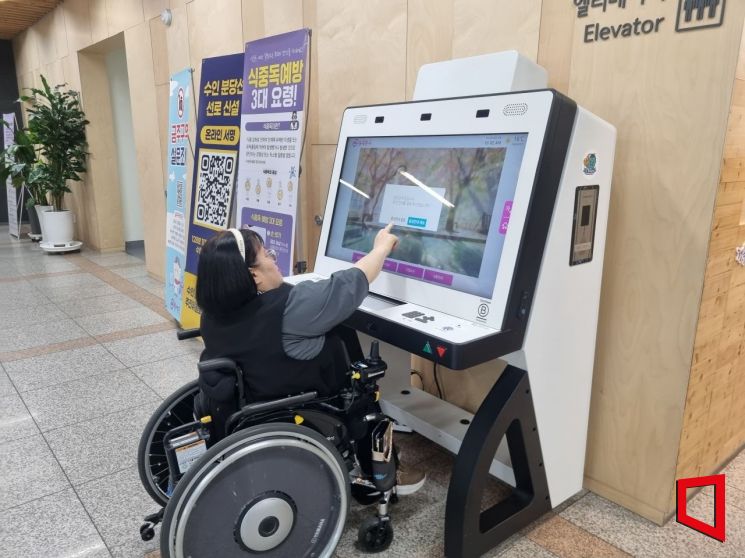 A citizen in a wheelchair is using an accessibility kiosk installed in the lobby of Dongdaemun-gu Office in Seoul.
 [Photo by Seongah Sim]
Last year, with the amendment of the “Act on Prohibition of Discrimination Against Persons with Disabilities and Remedies” (Disability Discrimination Act), the mandatory installation of “Accessibility Guaranteed Kiosks” began in phases from January 28 this year. Providers of goods and services must provide convenience so that everyone can equally access and use them regardless of disability, in accordance with the phased implementation dates. If a disabled user feels discriminated against when using a kiosk and files a complaint, a fine of up to 30 million KRW may be imposed.
There was hope that the inconvenience faced by people with disabilities in using kiosks would be somewhat alleviated with the enforcement of this amended law. However, pessimistic voices about the feasibility of the policy in the field have continued, causing difficulties in its establishment.
For businesses with fewer than 100 employees, less than nine months remain until the mandatory application date, but small business groups claim that there are only obligations without any support, making it practically difficult. A representative from the Korea Federation of Small and Medium Business said, “In a situation where an unbearable obligation is imposed, some support for replacement costs should be provided, but since it is being pushed forward without such support, it feels like the burden is being unilaterally passed on,” adding, “If implemented like this, it will inevitably be difficult to achieve the policy’s intended goals and efficiency.”
The Ministry of SMEs and Startups also expressed concern last July that kiosks intended to reduce labor costs might instead become a financial burden, and is demanding alternatives to reduce the burden on small business owners. A ministry official said, “We proposed to the Ministry of Health and Welfare to exclude small business owners from the law’s application or to extend the grace period, but it was not accepted, so discussions are at an impasse.”
The gap between the legally specified implementation date and reality was also stark. For the first phase groups such as public institutions, educational institutions, and medical institutions, the mandatory installation of accessibility guaranteed kiosks has been applied since January 28. However, only about 40 products have been officially verified by the Korea Intelligent Information Society Agency as meeting all the accessibility guaranteed kiosk conditions, which number around 50 items. Considering that approximately 180,000 kiosks were distributed in the domestic public sector (administrative agencies, hospitals, universities, etc.) as of 2021, this number is far from sufficient.
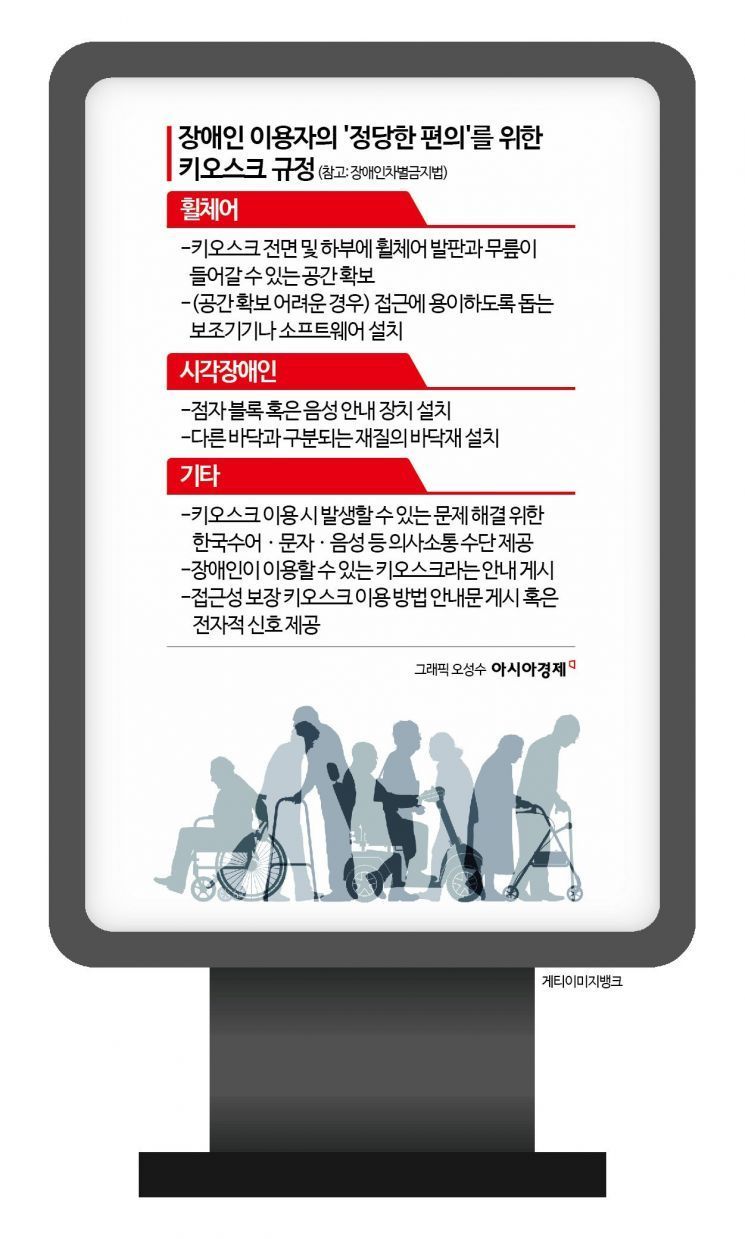
The Ministry of Health and Welfare ultimately announced that it would conduct a survey on the cost burden and status of accessibility guaranteed kiosk installations through a disability discrimination status investigation and then discuss the details again based on objective indicators. However, it is uncertain whether a comprehensive survey can be completed and re-discussion fully conducted before July 28 this year, when the law also applies to private businesses. This is because the survey alone is expected to take about eight months.
Experts point out that blind spots have occurred because the policy was implemented without careful consideration. Professor Lee Sol-ji of Dongmyung University’s Department of Social Welfare said, “Before executing the policy, many detailed aspects were not properly addressed, causing confusion among the public, so the same mistakes should not be repeated,” adding, “It is necessary to specifically select the targets who need support and improve the details by considering realistically necessary grace periods for implementing the obligations.”
© The Asia Business Daily(www.asiae.co.kr). All rights reserved.
![Clutching a Stolen Dior Bag, Saying "I Hate Being Poor but Real"... The Grotesque Con of a "Human Knockoff" [Slate]](https://cwcontent.asiae.co.kr/asiaresize/183/2026021902243444107_1771435474.jpg)

















