Less Likely to Be Entangled in Investigative Neutrality Controversies,
But Questions Arise Whether Case Allocation Is Appropriate
As 'Drug Cases' Accumulate
It was recently revealed that the ‘Yongsan Presidential Office Relocation Construction Corruption’ case, commissioned by the Board of Audit and Inspection last year, has been assigned to the Violent Crimes Division of the Seoul Central District Prosecutors’ Office (led by Chief Prosecutor Kim Yeon-sil). Since the investigation targets corruption related to the Presidential Office, it was expected to be handled by the Anti-Corruption Investigation Division, which has extensive experience in special investigations involving the power elite. However, attention is now focused on why the case was assigned to the Violent Crimes Division, which primarily handles drug-related cases.
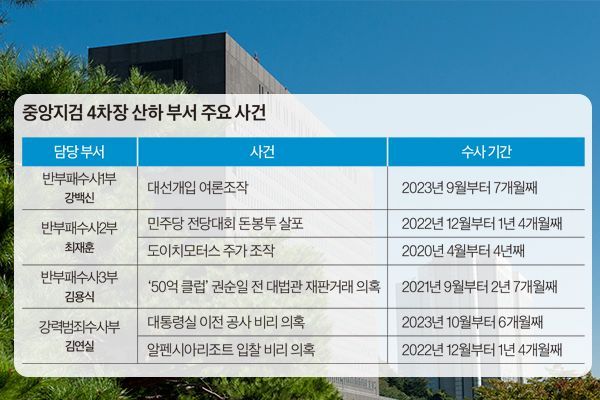
According to the legal community on the 19th, the Violent Crimes Division of the Seoul Central District Prosecutors’ Office began a full-scale investigation last November by conducting a search and seizure at company A, which installed bulletproof glass at the Yongsan Presidential Office, and its factory. This came just one month after the Board of Audit and Inspection detected signs of collusion between the Presidential Security Service officials and the bulletproof glass installation company during the relocation process of the Presidential Office, involving a private contract worth approximately 2.1 billion won, and requested an investigation by the prosecution in October of the same year.
This case is considered the prosecution’s first disciplinary action against the current administration. There is analysis that it could serve as a ‘momentum’ to change the direction of political investigations by the prosecution, which have mainly targeted opposition parties in cases such as the Democratic Party’s cash envelope scandal, the Baekhyeon-dong development preferential treatment allegations, and the Daejang-dong lobbying scandal. A lawyer who is a former chief prosecutor said, “Whether it is the Board of Audit and Inspection or the prosecution, this case could be the prelude to investigating corruption allegations against the current government,” adding, “It could remain a matter of individual corruption or deviation, but there is also a possibility it could escalate into a case involving external pressure from government officials.”
It is somewhat unusual that a corruption allegation case involving the current government, which is not a typical violent crime case, was assigned to the Violent Crimes Division. The Violent Crimes Division is a department under the 4th Deputy Chief Prosecutor of the Central District Prosecutors’ Office and can conduct ‘direct investigations,’ but it has always been a lower priority for cases involving corruption among the power elite. This has been interpreted as a consequence of the so-called ‘prolonged investigations into deep-rooted evils.’ Due to the prolonged investigations targeting the previous administration and opposition parties for several years, the Anti-Corruption Investigation Division did not have the capacity to take on this case.
Currently, the Anti-Corruption Investigation Division of the Central District Prosecutors’ Office is focusing its investigative power on political-related allegations for an extended period. The Anti-Corruption Investigation Division 1 (led by Chief Prosecutor Kang Baek-shin) has formed a special investigation team and has been investigating the election interference and public opinion manipulation case since September last year. The Anti-Corruption Investigation Division 2 (led by Chief Prosecutor Choi Jae-hoon) has been investigating the Democratic Party’s cash envelope distribution case since December 2022. The Deutsche Motors stock manipulation case is also ongoing. The Anti-Corruption Investigation Division 3 (led by Chief Prosecutor Kim Yong-sik) has been investigating the allegations related to the ‘50 Billion Club’ in Daejang-dong and the trial manipulation allegations involving former Supreme Court Justice Kwon Soon-il since September 2021.
There are some advantages to having prosecutors from the Violent Crimes Division investigate non-violent crime cases. Since the Violent Crimes Division mainly handles drug and organized crime cases and is separate from political cases, it is less likely to be embroiled in controversies over investigative neutrality. Currently, the Violent Crimes Division of the Seoul Central District Prosecutors’ Office is also investigating a case involving bid-rigging and official secrets leakage against Gangwon Province and the Gangwon Development Corporation, which informed KH Group of the minimum bid amount. There have been cases where Violent Crimes Division prosecutors were deployed to high-profile cases and achieved results. A representative example is the Sewol ferry disaster investigation led by the joint prosecution-police task force centered on Park Jae-eok, then head of the Gwangju District Prosecutors’ Office Violent Crimes Division and now head of the Daejeon District Prosecutors’ Office, in 2014.
However, some question whether it is appropriate to assign this case to the Violent Crimes Division, given that their main task is ‘drug cases,’ which are piling up. Last year, then Minister of Justice Han Dong-hoon emphasized strengthening the Violent Crimes Division to restore the diminished drug crime investigation capabilities following the adjustment of investigative authority between the prosecution and police. The Anti-Corruption and Violent Crimes Division of the Supreme Prosecutors’ Office, which had been integrated in 2018, was separated into the Anti-Corruption Division and the Drug and Organized Crime Division after five years, highlighting the fight against drug crimes.
A lawyer specializing in drug crime said, “Important drug crimes, especially those involving medical professionals, are increasing recently, and the police have been actively cracking down on drug crimes since last month,” adding, “Major drug cases investigated by the Seoul Metropolitan Police Agency tend to be concentrated at the Central District Prosecutors’ Office, and these cases are still backlogged.”
Reporter Lim Hyun-kyung, Law Times
※This article is based on content supplied by Law Times.
© The Asia Business Daily(www.asiae.co.kr). All rights reserved.

















