Intense Competition Among Speaker Candidates... Emphasis on 'Clarity' Over Neutrality
Jung Sung-ho: "Must Lay the Groundwork for the Democratic Party's Next Election Victory"
Cho Jung-sik: "A Speaker Who Works Well with Lee Jae-myung Is Needed"
The Democratic Party of Korea is fiercely competing in terms of 'clarity' for the next Speaker of the National Assembly. Although the Speaker, the head of the legislative branch, is not allowed to hold party affiliation under current law, the candidates who have thrown their hats into the ring are emphasizing 'the Democratic Party's legislative achievements' over 'mechanical neutrality.' Because of this, there are concerns that cooperation between the ruling and opposition parties may be difficult to expect in the 22nd National Assembly as well.
The Speaker of the National Assembly is taken by the party with the largest number of seats in the assembly. After an internal primary, one candidate must be selected, and currently within the Democratic Party, former Minister of Justice Choo Mi-ae, who has reached six terms, and former Secretary-General Cho Jung-sik have stepped forward. Among those with five terms, Representative Jung Sung-ho, the 'pro-Myung faction leader,' and Representative Woo Won-shik have declared their candidacies. In addition, Representative Kim Tae-nyeon and former National Intelligence Service Director Park Ji-won are also being mentioned.
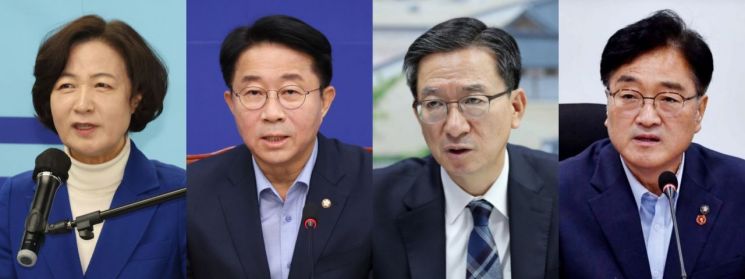 Former Minister of Justice Choo Mi-ae, former Democratic Party Secretary-General Cho Jung-sik, Representative Jung Sung-ho, and Representative Woo Won-shik, who ran as candidates for the Speaker of the 22nd National Assembly's first half term from the Democratic Party.
The candidates classified as pro-Myung faction are focusing on a 'clarity competition' rather than emphasizing inclusiveness and cooperation as the head of the legislative branch. This is interpreted as their intention to become a Speaker who supports the Democratic Party under the Lee Jae-myung regime, which pursues 'innovation' rather than mechanical neutrality.
Representative Jung Sung-ho, who has been considered relatively moderate, said on CBS Radio the day before, "You cannot do anything by mechanically maintaining neutrality," and added, "(The next Speaker) should be from the Democratic Party and subtly lay the groundwork for some kind of victory for the Democratic Party in the next election." Representative Woo Won-shik also wrote on his Facebook, "There is no neutrality in livelihood."
This clarity competition is gradually spreading as an appeal for recognition. Former Secretary-General Cho Jung-sik, who declared his candidacy for Speaker, argued in a media interview, "The Speaker should be someone who works well with Representative Lee Jae-myung and the party to properly produce results and lead the National Assembly."
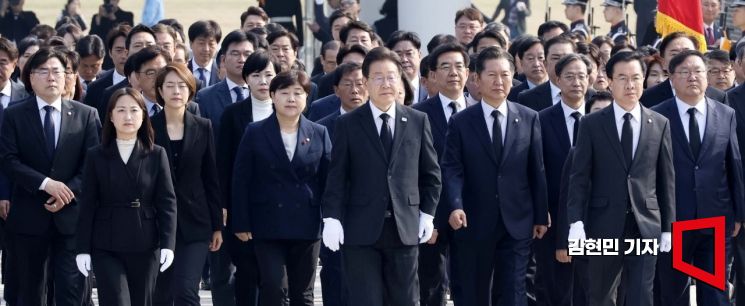 Lee Jae-myung, leader of the Democratic Party of Korea, along with the 4.10 general election district winners and Democratic Union co-leaders Yoon Young-deok and Baek Seung-ah, visited the National Cemetery in Dongjak-gu, Seoul on the 12th to pay tribute to the patriotic martyrs. Photo by Kim Hyun-min kimhyun81@
However, under the current National Assembly Act, the Speaker is prohibited from holding party affiliation from the day after being elected. The purpose is to ensure balance that encompasses both ruling and opposition parties as the head of the legislative branch and to guarantee political neutrality. Because of this, there are concerns that the candidates' clarity competition over the next Speaker position could turn the 22nd National Assembly into an arena of excessive political strife. A Democratic Party floor official said, "If the Speaker abandons even a superficial neutral position, there is concern that the legitimacy of decisions made by a Speaker from the Democratic Party might be weakened."
Meanwhile, as the competition among Democratic Party Speaker candidates overheated, the party changed the candidate recommendation party rules from the previous 'highest vote-getter wins' to 'elected by majority of the total members.' If no candidate receives a majority, a runoff vote will be held between the top two candidates. The Speaker election will be held on the first assembly day after the general election.
© The Asia Business Daily(www.asiae.co.kr). All rights reserved.
![Clutching a Stolen Dior Bag, Saying "I Hate Being Poor but Real"... The Grotesque Con of a "Human Knockoff" [Slate]](https://cwcontent.asiae.co.kr/asiaresize/183/2026021902243444107_1771435474.jpg)

















