Verification of Safety from Ground Movement to Pre-Flight and Landing Stages
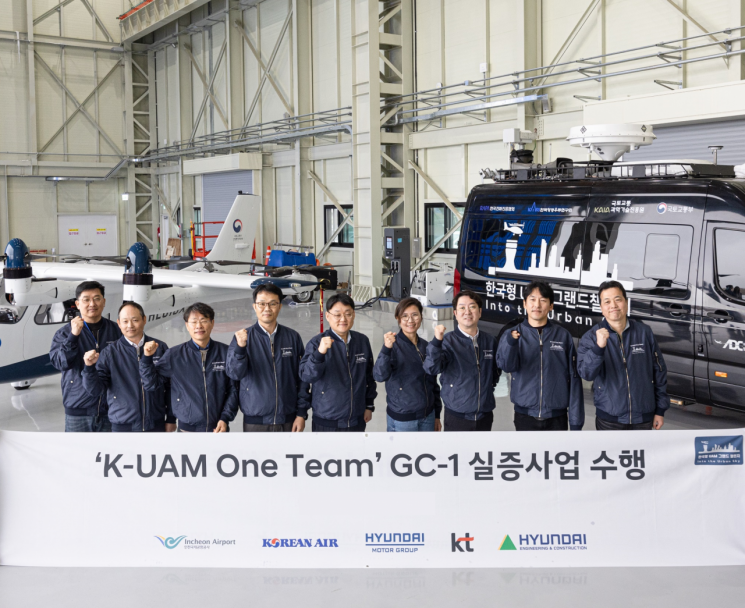
Incheon International Airport Corporation, along with major conglomerates such as Hyundai Motor Company, has become the world's first to verify the safety of all stages of Urban Air Mobility (UAM), from ground movement to flight and landing.
On the 24th, Incheon International Airport Corporation announced that the 'K-UAM One Team' consortium, consisting of the corporation, Korean Air, Hyundai Motor Company, KT, and Hyundai Construction, has completed the world's first demonstration in the integrated operation of UAM.
The 'K-UAM One Team' consortium has been participating in the 'K-UAM Grand Challenge Phase 1 Demonstration Project,' led by the Ministry of Land, Infrastructure and Transport, aiming for UAM commercialization next year and establishing Korean-style UAM operation standards. As part of this, from the 11th to the 12th of last month, integrated UAM operability was verified at the Goheung Aviation Center in Jeollanam-do.
This verification was conducted based on a total of 10 scenarios, ranging from normal operation of UAM aircraft to abnormal response and collision prevention management. A total of 30 demonstration flights were conducted, three times per scenario. During this process, the corporation was responsible for verifying technologies related to the UAM traffic management system and vertiport (UAM takeoff and landing site) operations. Additionally, the V-CDM system-based vertiport operation system and video surveillance system were also verified.
Hyundai Motor Company built a Mobility-as-a-Service (MaaS) platform connecting UAM and ground mobility, demonstrating the process of passengers using UAM moving from their departure point to their final destination by linking various mobility options. Furthermore, they secured diverse demonstration data on UAM operating environments such as weather, wind speed, and atmospheric turbidity, deriving essential conditions to be considered during aircraft development. Hyundai Motor plans to reflect the results obtained from this demonstration in future aircraft development and product strategy formulation.
Korean Air verified the stability of the UAM flight control system and traffic management system currently under development, while KT established a platform system capable of processing and sharing traffic and safety data required for flight in real time. Hyundai Construction conducted congestion and pedestrian system simulation analyses to advance the design and construction technology of vertiports, the UAM vertical takeoff and landing sites.
Based on the results of this Phase 1 verification, the 'K-UAM One Team' consortium plans to further advance the systems and processes necessary for the UAM business and continue cooperating to revitalize the domestic UAM industry and achieve early commercialization.
Lee Hak-jae, President of Incheon International Airport Corporation, stated, "Based on this verification, we will actively strive to faithfully implement the government’s K-UAM roadmap through improvements and cooperation with related organizations, and to establish an industrial ecosystem."
© The Asia Business Daily(www.asiae.co.kr). All rights reserved.
![Clutching a Stolen Dior Bag, Saying "I Hate Being Poor but Real"... The Grotesque Con of a "Human Knockoff" [Slate]](https://cwcontent.asiae.co.kr/asiaresize/183/2026021902243444107_1771435474.jpg)
















