The first domestically produced ultra-small satellite cluster, launched from the Mahia launch site in New Zealand on the morning of the 24th (local time), successfully entered orbit. The shift from operating mainly medium- and large-sized satellites to ultra-small satellite clusters is expected to enable rapid responses to disasters and security issues on the Korean Peninsula.
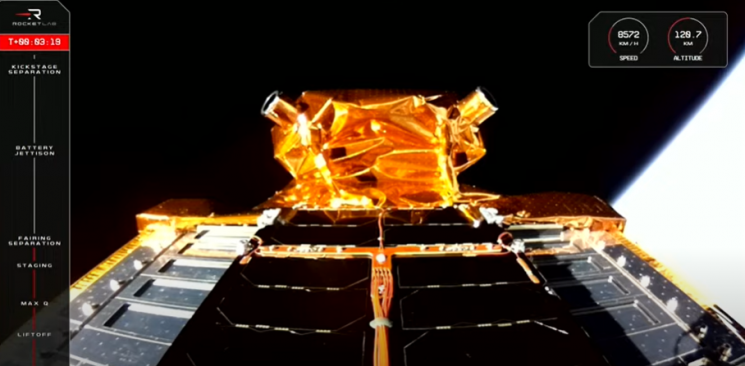 The microsatellite cluster separated from the launch vehicle after being launched from the Mahia launch site in New Zealand on the 24th. Photo by Rocket Lab (YouTube capture)
The Ministry of Science and ICT announced that "the first ultra-small satellite cluster separated from the launch vehicle about 50 minutes after launch, around 8:22 a.m." The launch vehicle ‘Electron’ from the American space company Rocket Lab, carrying the first ultra-small satellite cluster, was launched at 7:32 a.m. (local time 10:32 a.m. on the 24th), slightly later than scheduled.
The ultra-small satellite cluster was developed to conduct precise surveillance by visiting the Korean Peninsula and surrounding waters multiple times a day, responding to national security and disaster situations. Approximately 231.4 billion KRW has been invested over eight years since 2020. The Korea Advanced Institute of Science and Technology (KAIST) Satellite Research Center led the development, collaborating with satellite manufacturer Satrec Initiative of Hanwha Group and the Korea Aerospace Research Institute. Following the prototype launched this time, the remaining 10 satellites will be mass-produced using the same design.
Originally, the plan was to launch the ultra-small satellite cluster using Korea’s own launch vehicle, Nuri, but this year foreign launch vehicles were used due to no Nuri launches scheduled. Additional five satellites each are planned to be launched via Nuri in 2026 and 2027. Once all launches are completed, the cluster will monitor the Korean Peninsula in real time.
This ultra-small satellite cluster holds significant meaning for security and disaster response. The Ministry of Science and ICT expects that the imagery provided by the 11 ultra-small satellites will create a synergistic effect with existing high-resolution reconnaissance resources, greatly enhancing the 24-hour surveillance system for key targets. In cases of abnormal climate phenomena or disasters such as typhoons, floods, earthquakes, wildfires, droughts, and heavy snow, the imagery will be actively utilized to significantly improve national response capabilities during crises.
The economic impact is also substantial. The Ministry anticipates that the ultra-small satellite cluster will secure large volumes of imagery covering the Korean Peninsula and its surroundings, meeting most of the satellite imagery demands in major public sectors. This will drastically reduce unnecessary overseas image purchase costs. Additionally, capturing images of overseas regions beyond the Korean Peninsula is expected to generate revenue through sales of high-resolution images with resolutions below 1 meter.
It also contributed to establishing a mass production system for domestic space system development and fostering a private-led space industrial ecosystem. The organic collaboration among KAIST, Satrec Initiative, and the Korea Aerospace Research Institute in satellite manufacturing, launch, and control could serve as a catalyst for ushering in the new space era led by the private sector.
Promoting domestic satellite launch demand is another important achievement. Once stable domestic launch demand is created following the development of the Korean launch vehicle, it will also contribute to securing price competitiveness for domestic satellite launches.
© The Asia Business Daily(www.asiae.co.kr). All rights reserved.
![Clutching a Stolen Dior Bag, Saying "I Hate Being Poor but Real"... The Grotesque Con of a "Human Knockoff" [Slate]](https://cwcontent.asiae.co.kr/asiaresize/183/2026021902243444107_1771435474.jpg)











