Ministry of Agriculture, Food and Rural Affairs Announces Strategy for Introducing Agrivoltaics
The government has decided to extend the temporary use permit period for non-agricultural promotion area farmland from the existing 8 years to 23 years and to concentrate agrivoltaics mainly on non-prime farmland.
On the 23rd, the Ministry of Agriculture, Food and Rural Affairs announced the 'Agrivoltaics Introduction Strategy' at the first plenary meeting of the '2050 Carbon Neutral Green Growth Committee.'
Agrivoltaics is a form that combines farming and power generation, preserving farmland while providing farmers with an additional source of income. Accordingly, the Ministry of Agriculture, Food and Rural Affairs set three main strategies: ▲designating farmers as the main agents of agrivoltaic power generation projects ▲inducing concentration mainly on non-prime farmland ▲establishing a meticulous management system to prevent poor farming practices.
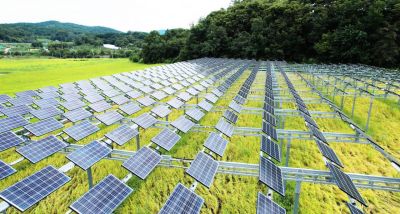
First, to minimize negative impacts on food security, the temporary use permit period for non-agricultural promotion area farmland will be extended from 8 years to 23 years, and the payment of public interest direct payments will be considered. For facilities entering renewable energy zones designated by local governments under the Rural Spatial Restructuring Act, the Ministry of Trade, Industry and Energy will consult to provide policy incentives related to power generation projects to induce concentration.
To prevent poor farming practices, a meticulous management system will also be established. Whether the applicant is a farmer and the farming plan will be verified during the power generation project approval process, and thereafter, regular checks on sincere farming activities will be conducted thoroughly. If an agrivoltaic power generation project is approved through fraudulent methods, the temporary use permit will be revoked, and fines and penalties will be imposed.
In addition, the system is designed to enable farmers to increase farm income through power generation profits. Education will be supported to enhance farmers' understanding of agrivoltaic power generation projects and to enable stable operation, including the approval procedures. To prepare for damage to agrivoltaic facilities, related insurance products will be developed in cooperation with the Ministry of Trade, Industry and Energy to support stable management for farmers.
The Ministry of Agriculture, Food and Rural Affairs plans to establish the legal basis for implementing the agrivoltaic system by 2025 and will also focus on field monitoring such as checking the status of agrivoltaic promotion. Song Mi-ryeong, Minister of Agriculture, Food and Rural Affairs, said, "Once the agrivoltaic system is implemented, it will be one way to increase farm income through additional power generation profits," adding, "Furthermore, it is expected to contribute to achieving the national greenhouse gas reduction target (NDC)."
© The Asia Business Daily(www.asiae.co.kr). All rights reserved.
![Clutching a Stolen Dior Bag, Saying "I Hate Being Poor but Real"... The Grotesque Con of a "Human Knockoff" [Slate]](https://cwcontent.asiae.co.kr/asiaresize/183/2026021902243444107_1771435474.jpg)
















