"Must Declare Reform Will Through Summit Talks"
Likely to Seek Gradual Pension Reform Centered on Population Reform
If Delayed, Reform Will Become Difficult Due to Black Holes Like the Presidential Election
The responsibility for reforming the National Pension has once again shifted to the National Assembly. Attention is focused on whether a consensus can be reached on pension reform. In political circles, if President Yoon Seok-yeol and Lee Jae-myung, leader of the Democratic Party of Korea, confirm their 'will to reform' through meetings such as the summit talks, time is not seen as an issue.
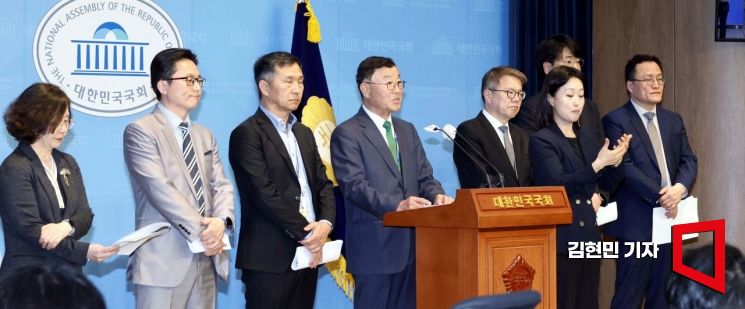 Kim Sang-gyun, Chairman of the National Assembly Pension Special Committee's Public Deliberation Committee, is disclosing the survey results on the national pension reform plan conducted with a citizen delegation (500 people) at the National Assembly Communication Hall on the 22nd. Photo by Kim Hyun-min kimhyun81@
'Pay More, Receive More' Income Guarantee Plan Supported by 56%
On the 23rd, the National Assembly's Special Committee on Pension Reform (Chairman Joo Ho-young) is coordinating the reporting schedule following the final conclusion drawn by the Public Deliberation Committee under its jurisdiction. The committee's secretary plans to hold a full meeting of the Pension Special Committee either late this week or early next week to receive a report on the Public Deliberation Committee's meeting results. A committee official said, "We plan to hold a meeting as early as this week or by early next week at the latest."
Kim Sang-gyun, chairman of the Public Deliberation Committee, announced the results of a public opinion survey conducted in the form of a questionnaire based on the judgments made by 492 citizen deliberators after learning and discussing the pension system. The current system is designed with a contribution rate (amount paid) of 9% and an income replacement rate (amount received) of 40%. The citizen deliberators agreed 56.0% with the so-called 'Pay More, Receive More' income guarantee plan, which proposes increasing the contribution rate to 13% and raising the income replacement rate to 50%. Meanwhile, 42.6% supported the so-called 'Pay More, Receive the Same' financial stability plan, which increases the contribution rate to 12% while maintaining the income replacement rate at 40%.
Possibility of Discussion Stalling... Attention on 'Ruling and Opposition Summit Talks'
Considering that the ruling party has emphasized the financial stability plan while the opposition has stressed the income guarantee plan, it seems the opposition's position has been accepted. However, the opposition does not insist on sticking solely to the income guarantee plan. Kim Seong-joo, the Democratic Party's secretary of the Pension Special Committee, said, "It is not a matter of choosing between the financial stability plan and the income guarantee plan," adding, "We will seek a balance during the National Assembly's discussion process." However, whether the ruling party will participate in reform discussions remains a key issue, especially after their defeat in the general election and the lack of active support for financial stability in the public opinion survey. If discussions are not concluded in the 21st National Assembly, the pension reform debate is likely to stall.
The key issue is how much political will the ruling and opposition parties will show toward reform plans that include increasing pension burdens on workers and companies (raising contribution rates). In this regard, the ruling and opposition summit talks are drawing attention. A political insider said, "If President Yoon and Leader Lee agree on the necessity of pension reform through talks and express hope for good results from the National Assembly's Pension Special Committee, it will generate momentum." Joo Ho-young, a member of the People Power Party and chairman of the Pension Special Committee, expressed his determination in a phone call, saying, "I will do my best to reach a bipartisan agreement."
The ruling and opposition parties' discussions are expected to focus on fundamental reforms involving raising contribution rates and adjusting income replacement rates. Kim said on social media, "Focusing first on fundamental reforms to create a reform plan is the task of the remaining 21st National Assembly," adding, "Fundamental reforms can buy time for structural reforms." He also said, "The government, ruling party, and opposition all agree on a phased approach strategy." Regarding raising the mandatory enrollment age limit, he said, "Companies have so far only had to support 50% of contributions until age 60, but now they have to bear the burden for four more years, so there may be opposition," adding, "This will be a key issue."
© The Asia Business Daily(www.asiae.co.kr). All rights reserved.
![Clutching a Stolen Dior Bag, Saying "I Hate Being Poor but Real"... The Grotesque Con of a "Human Knockoff" [Slate]](https://cwcontent.asiae.co.kr/asiaresize/183/2026021902243444107_1771435474.jpg)

















