"Export Controls in Action... Surpassing China with Innovation"
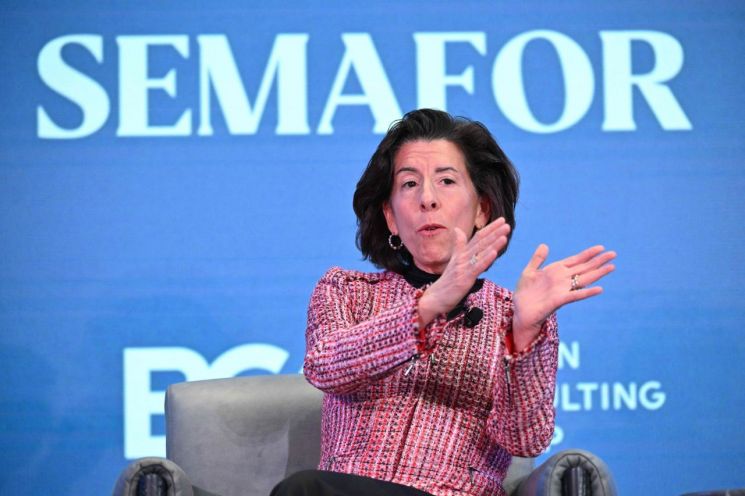
U.S. Commerce Secretary Gina Raimondo stated that Huawei's latest smartphone demonstrates that China's advanced semiconductor technology still lags behind, indicating that U.S. semiconductor restrictions on China are having an effect.
In an interview with CBS News' 60 Minutes on the 21st (local time), Secretary Raimondo said that the technological gap between the U.S. and China shows that the Biden administration has succeeded in imposing export controls on China.
The Biden administration has imposed strong semiconductor sanctions on China and others to protect national security. A representative target of these sanctions is the Chinese telecommunications equipment manufacturer Huawei. Once the world's number one smartphone manufacturer by shipment volume, Huawei was placed on the U.S. sanctions list against China in 2019, making it impossible to obtain the latest chips and thus hindering the release of high-performance 5G smartphones. However, when Secretary Raimondo visited China last August, Huawei launched the 5G smartphone 'Mate 60 Pro.' Despite U.S. export restrictions on advanced semiconductors to China, the phone was equipped with a 7nm (nanometer) chip made with its own technology, earning it recognition as a symbol of the revival of Chinese technology. Huawei also released its latest smartphone, the 'Pura 70,' on the 18th. This raised doubts about the effectiveness of U.S. sanctions.
Referring to Huawei's smartphone, Secretary Raimondo said, "That chip is several years behind the U.S. Export controls are working," adding, "We have the most sophisticated semiconductors in the world, but China does not." She further stated, "We have innovated ahead of China."
When asked whether "we" included Taiwan, she answered, "Yes." According to CBS, 90% of advanced U.S. chips are produced in Taiwan. Secretary Raimondo expressed concern that China's threat to invade Taiwan could cut off access to advanced semiconductors produced there, saying, "It makes us vulnerable."
Last year, the U.S. enlisted allies such as Japan and the Netherlands to join sanctions aimed at curbing China's advancement in advanced semiconductor technology. Recently, it has also urged countries like South Korea and Germany to participate. Additionally, to boost domestic semiconductor manufacturing, the U.S. has allocated large subsidies, providing billions of dollars to companies such as Intel, TSMC, and Samsung Electronics.
Secretary Raimondo expressed her intention to further strengthen semiconductor sanctions against China, stating, "China looks for ways to evade our sanctions every day. We need to respond more aggressively."
She also commented on the effectiveness of semiconductor sanctions against Russia. Citing reports that chips from refrigerators and dishwashers are being extracted for use in military equipment in Russia, she evaluated the regulations as effective. She said, "It is clear that U.S. export controls have impaired Russia's warfighting capabilities and made things more difficult for them."
© The Asia Business Daily(www.asiae.co.kr). All rights reserved.
![Clutching a Stolen Dior Bag, Saying "I Hate Being Poor but Real"... The Grotesque Con of a "Human Knockoff" [Slate]](https://cwcontent.asiae.co.kr/asiaresize/183/2026021902243444107_1771435474.jpg)
















