60th Venice Biennale Golden Lion Award
Australian Indigenous Artist and Maori Women Artists Group Win
The world's largest contemporary art festival with a 129-year history, the 60th Venice Biennale, saw the highest honor, the 'Golden Lion Award,' swept by Indigenous artists from the Southern Hemisphere.
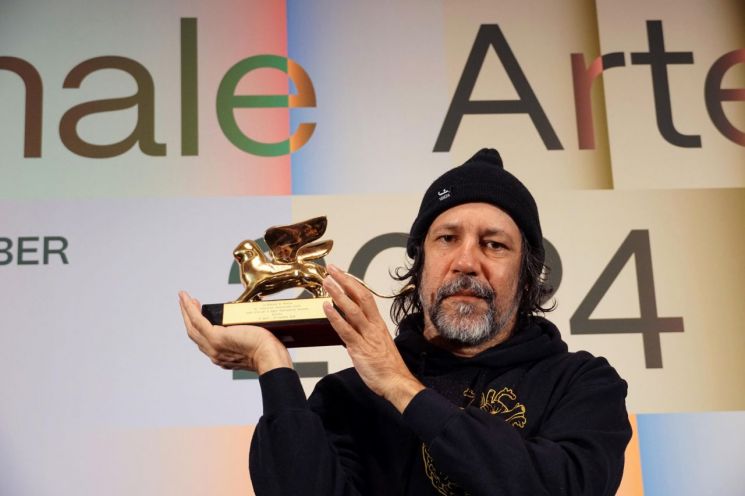 Archie Moore (54), an Indigenous Australian writer who led the Australian Pavilion.
 [Image source=EPA Yonhap News]
On the 20th (local time), the Venice Biennale organizing committee held an award ceremony combined with the official opening ceremony in Venice, Italy, announcing that the Golden Lion for Best National Participation was awarded to the Australian Pavilion led by Archie Moore (54), an Indigenous Australian artist, and the Golden Lion for Best Artist was awarded to the 'Mata Aho Collective,' a group of M?ori women artists from New Zealand. Both awardees share the commonality of being Indigenous peoples from the Southern Hemisphere. They also share the thematic focus on the 'Global South' identity in their works, responding to the colonial powers and Western mainstream 'Global North,' reflecting their historical and political marginalization.
Archie Moore, representing the Australian Pavilion, created the winning work "Kith and Kin," in which he traced back his own family history and the undervalued history of Indigenous peoples over more than four years to create a family tree. On walls and ceilings made of blackboards, the artist recorded a genealogy of 3,484 Indigenous people spanning 65,000 years and 2,400 generations. Some parts were left blank, representing those who died from disease, were killed, or erased from public records. Additionally, Moore displayed reports and national archives containing coroner investigation records of Indigenous deaths by the Australian government at the center of the exhibition space.
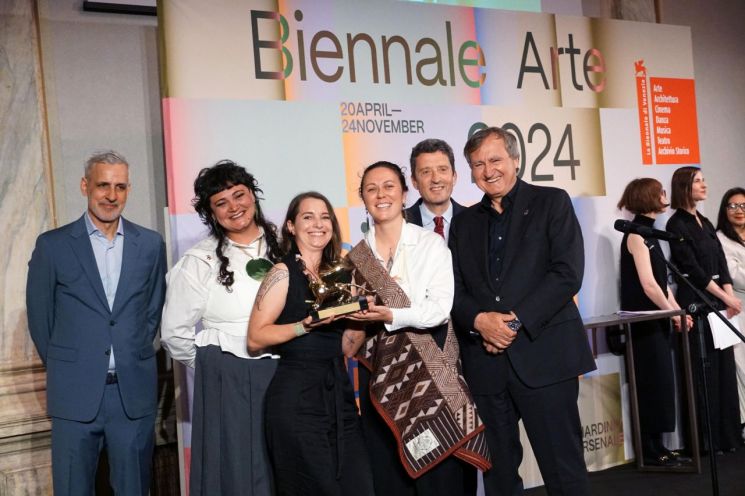 The Mataho Collective, which won the top Golden Lion award for best artist, is a group consisting of four Maori women writers from New Zealand (Bridget Lewetti, Erena Baker, Sarah Hudson, Terry Te Tau).
 [Image source=EPA Yonhap News]
The Mata Aho Collective, recipients of the Golden Lion for Best Artist, is a group of four M?ori women artists from New Zealand (Bridget Reweti, Erena Baker, Sarah Hudson, and Terri Te Tau). They presented a large fluorescent textile installation titled "Takapau" at the entrance of the Arsenale exhibition hall. The Takapau is a traditional woven item used by M?ori women during childbirth or ceremonies. By creating a large-scale version that enveloped the ceiling, the work multifacetedly represented the labor-intensive lives of women passed down through matrilineal traditions, while the lighting cast shadow patterns on the ceiling and floor. The jury praised it as "cosmic and providing a sense of sanctuary."
The Silver Lion Award for promising young artists went to Karima Adebibe Ashadu, a Nigerian-born British artist, for her video "Machine Boys" and sculpture "Wreath," which explore themes of gender and migration.
Korea, boasting an unprecedented scale with participation from masters such as Koo Jeong A, Kim Yoon Shin, and Lee Kang Seung, unfortunately did not receive any awards. However, parallel and satellite exhibitions held throughout Venice during the Biennale period were praised for showcasing the diversity of Korean art.
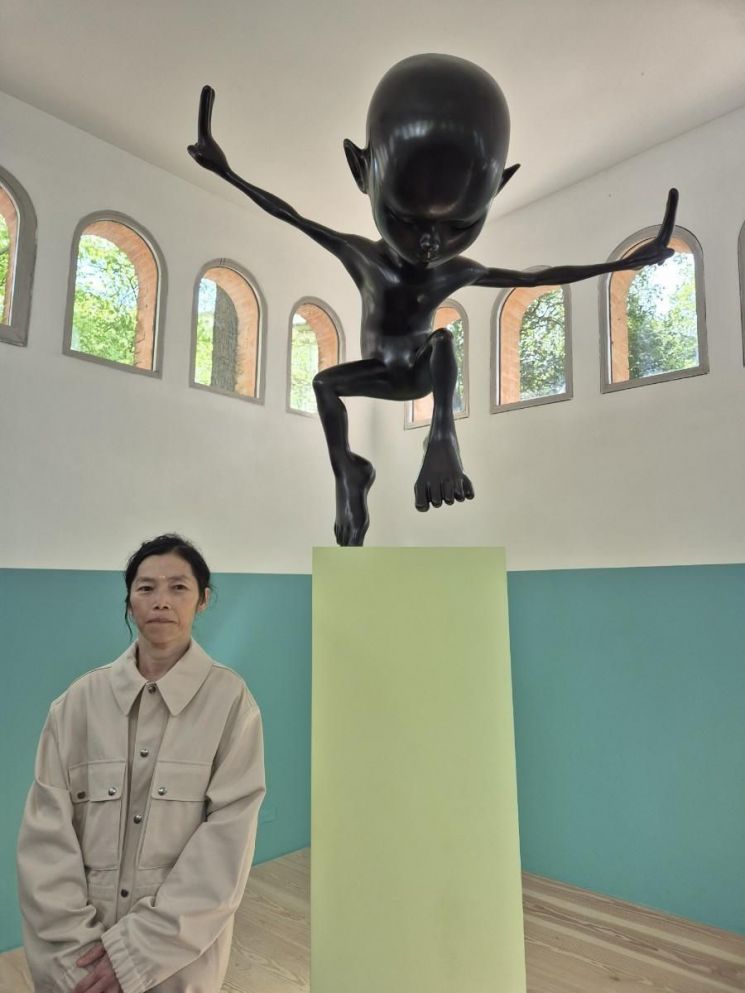 On the 17th (local time), the 60th Venice Biennale Korea Pavilion exhibition "Odorama City" opened, featuring artist Gu Jeong-a's work "KANGSE Spst" and artist Gu Jeong-a.
 [Image source=Yonhap News]
In particular, the special exhibition "Every Island is a Mountain," held ahead of the 30th anniversary of the Korean Pavilion next year, received acclaim as a meaningful project illuminating the past, present, and future of Korean art in one place.
This year’s main Biennale exhibition featured protagonists such as Indigenous peoples whose lives were taken under Western colonial powers, immigrants and refugees displaced from their homelands, and queer and women artists excluded from mainstream narratives and historical records. Under the theme "Foreigners Everywhere," the exhibition included 331 artists from 88 countries, presenting works that signify encountering foreigners wherever one goes and recognizing that deep inside, we too are foreigners.
Artistic Director Adriano Pedrosa explained, "We aimed to expand the meaning of foreigners by focusing on the works of foreign, immigrant, displaced, refugee artists, as well as queer artists persecuted and marginalized for their sexual identity, self-taught artists, folk artists, and those on the fringes of the art world, including Indigenous artists still treated as foreigners in their homelands."
The Golden Lion for Lifetime Achievement was awarded to Brazilian artist Anna Maria Maiolino from Calabria Scalea and Turkish artist Nil Yalter, born in Egypt and living in Paris.
The Venice Biennale exhibition runs until November 24.
© The Asia Business Daily(www.asiae.co.kr). All rights reserved.

![Clutching a Stolen Dior Bag, Saying "I Hate Being Poor but Real"... The Grotesque Con of a "Human Knockoff" [Slate]](https://cwcontent.asiae.co.kr/asiaresize/183/2026021902243444107_1771435474.jpg)

















