Kim Prices Soar to 'Gold Value' Amid Japan and China Sweep
Noodle Shop Faces Ingredient Worries Due to Kim Price Surge
"Can't Raise Noodle Prices Much Just Because Kim Prices Went Up"
Yu (68), who runs a small noodle shop with her husband in Chuncheon-si, Gangwon Province, recently started topping noodles with Gim only during the morning hours. From lunchtime onwards, noodles are served without Gim toppings. This drastic measure was taken by Yu to save on ingredient costs amid soaring Gim prices.
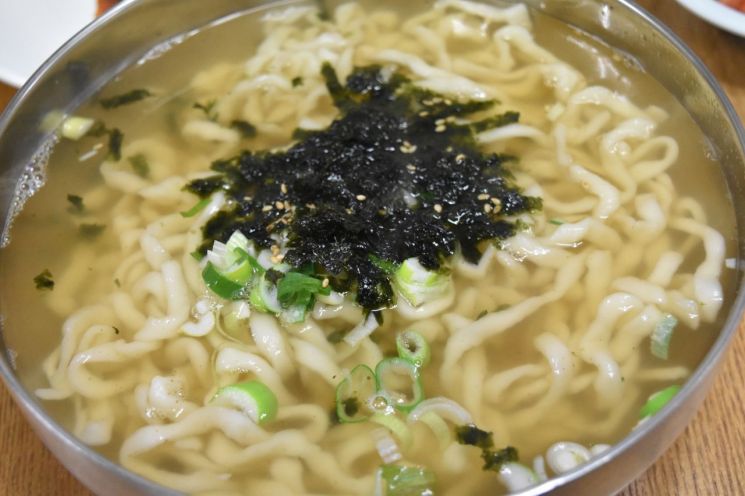
Until last year, Yu spent about 150,000 won monthly on 2 kg of Gim powder and 28 packs of 5g lunchbox Gim sheets (based on 16 sheets per pack), but this year the cost has nearly doubled to 300,000 won.
Yu sighed, "I raised the price of noodles, which had been 5,000 won for 13 years, by 1,000 won, but since customers are also struggling, I couldn't raise the noodle price much to match the increase in Gim prices. Still, I feel so sorry to the customers that I don't know what to do."
Recently, with inflation, Gim prices have surged about 1.5 times compared to the previous year, causing small business owners to struggle with rising ingredient costs. The explosive popularity of Korean Gim in countries like China and Japan has led to supply failing to meet demand. Following increases in vegetable and oil prices, Gim prices have also soared, causing small business owners to face a so-called "triple inflation burden."
According to the Korea Agro-Fisheries & Food Trade Corporation (aT) Agricultural Products Distribution Information System on the 22nd, the wholesale price of one pack (100 sheets) of dried Gim recorded 10,440 won as of the 17th, a 57.8% increase compared to 6,618 won in the same month last year. In April 2022, the price was around 5,800 won per pack, nearly doubling in two years. Gim powder, which could be purchased for around 13,000 won per kilogram at ingredient marts, has surged to 29,000 won this month. The 5g lunchbox Gim sheets (16 sheets per pack), which could be bought for 3,000 to 4,000 won last year, have skyrocketed to over 8,000 won within a year.
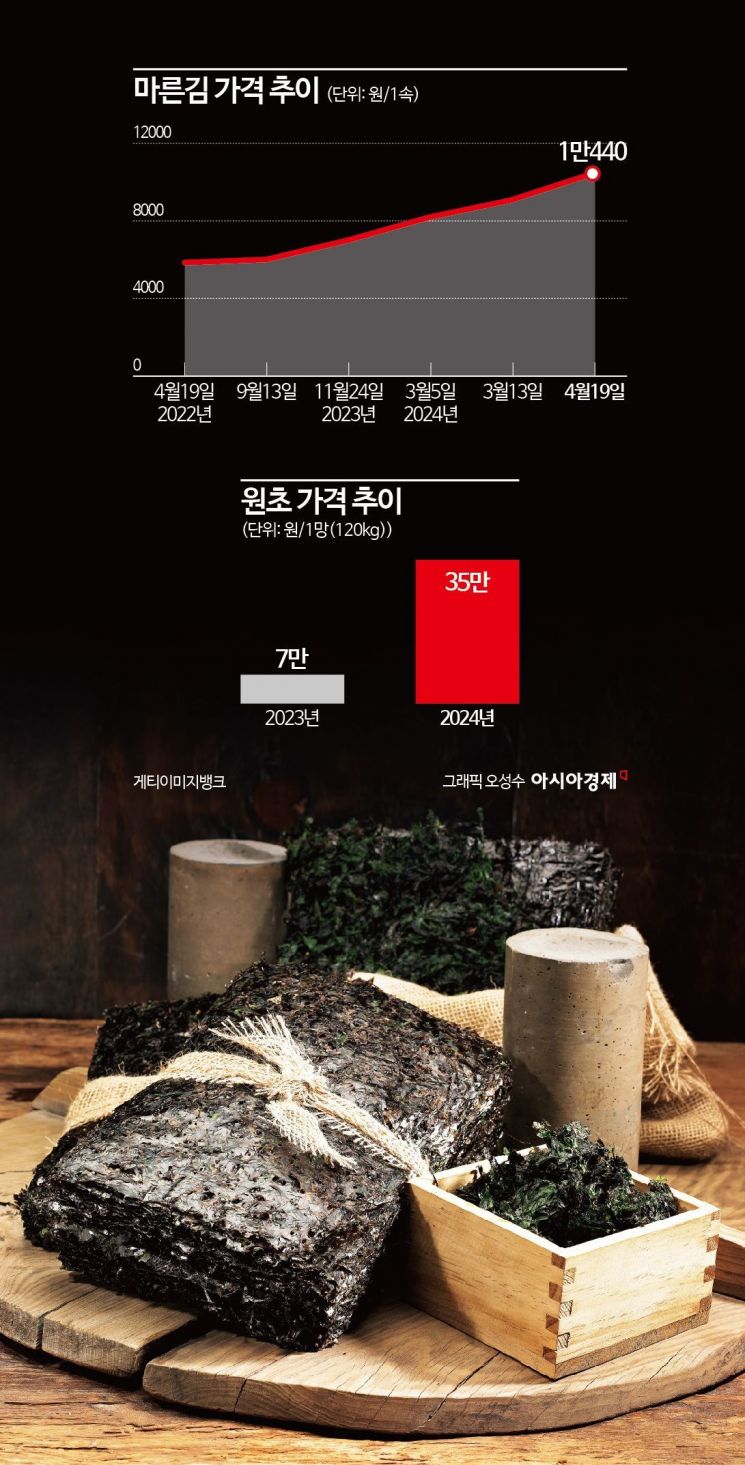
The seasoned Gim manufacturing industry cites the sharp rise in the price of raw seaweed, the primary material for Gim, as the cause of product price increases. Raw seaweed refers to unprocessed water seaweed harvested from the sea. Until last year, the price was around 70,000 won per net (120 kg). One net of raw seaweed can produce 35 packs (3,500 sheets) of dried Gim. However, industry insiders explain that recently, Chinese and Japanese traders have been sweeping up dried Gim processed from raw seaweed, pushing the price of one net of raw seaweed up to 350,000 won.
An official from a Gim manufacturing company said, "Seasoned Gim manufacturers buy dried Gim made from raw seaweed from primary factories and then process it further to distribute finished products. Although raw seaweed prices have increased fivefold due to Chinese and Japanese buyers competing to purchase dried Gim, companies have not been able to raise product prices accordingly." He added, "We need to observe future supply trends, but there is a possibility that Gim prices will continue to rise."
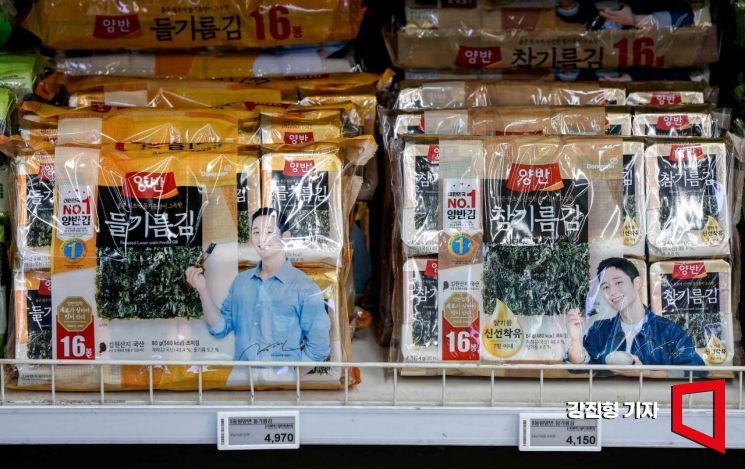 Dongwon Yangban Perilla Oil Seaweed and Sesame Oil Seaweed displayed at a large supermarket in Seoul. Photo by Jinhyung Kang aymsdream@
As Gim prices skyrocket, small business owners are striving to save every penny on ingredient costs. On an online community where small business owners gather, posts asking about cheaper suppliers or how to store Gim stockpiled in preparation for price hikes are flooding in. One small business owner said, "Prices change weekly, so I try to find the cheapest place to buy and stock up a little. I'm trying to stockpile several months' worth, but with summer coming, I'm worried if storing it at room temperature is okay."
The Ministry of Oceans and Fisheries has also taken measures to curb the fluctuating Gim prices. Since last month, dried Gim has been added to the half-price discount event for seafood products. This event offers up to 50% discount benefits on domestic seafood purchases at 26 online malls and 18 marts, held for about two weeks each month.
Additionally, the ministry has allocated an extra 4 billion won in private purchase support budgets for Gim and is recruiting applicants for the program. The purchase support involves the government lending funds to seafood processing companies to buy stock and partially controlling the timing of product release to regulate prices. Furthermore, to increase Gim supply, the ministry plans to develop an additional 2,000 hectares of new aquaculture farms starting July this year.
A Ministry of Oceans and Fisheries official explained, "We are currently recruiting companies for a project that provides about 4 billion won in loans to private companies for raw seaweed purchases. We also plan to expand production areas by 2,000 hectares so that supply can begin around October."
© The Asia Business Daily(www.asiae.co.kr). All rights reserved.
![Clutching a Stolen Dior Bag, Saying "I Hate Being Poor but Real"... The Grotesque Con of a "Human Knockoff" [Slate]](https://cwcontent.asiae.co.kr/asiaresize/183/2026021902243444107_1771435474.jpg)


















