"Not Due to Climate Anomalies, Could Reach 100 Trillion"
Two Cicada Species Massively Born This Year Occur Simultaneously
"Using Pesticides Causes Adverse Effects"
A massive swarm of cicadas, the largest in 221 years, is predicted to appear in the United States. The scale is estimated to be in the trillions. Starting from the end of this month, they will cover the Midwest and Southeast regions of the U.S.
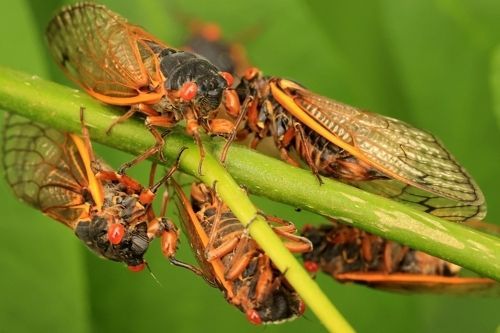 The "Brood X" cicada swarm that appears every 17 years in the United States.
 [Photo by AFP Yonhap News]
On the 20th (local time), local media such as The Washington Post (WP) and the Associated Press (AP) reported, citing entomologists, that two groups of periodical cicadas will emerge and be active together until this summer.
John Cooley, an entomologist at the University of Connecticut, described it as a "Cicada-geddon," a combination of cicada and Armageddon. He also analyzed that the total number of individuals could reach hundreds of trillions, possibly even 1,000 trillion.
The appearance of this massive cicada swarm is not an abnormal phenomenon caused by climate change. This year is when two species of periodical cicadas, which emerge en masse once every several years, appear simultaneously. Periodical cicadas are numbered in Roman numerals; cicadas belonging to the Great Southern Brood (Brood XIX) emerge every 13 years, and those belonging to the Northern Illinois Brood (Brood XIII) emerge every 17 years. Since 13 and 17 have a least common multiple of 221, they become active simultaneously every 221 years. The last simultaneous emergence was in 1803, during President Thomas Jefferson’s administration.
The emergence areas range from Illinois, Wisconsin, Louisiana, and Maryland next to Washington DC, down to Georgia. It is expected that about one million cicadas per acre (approximately 4047 square meters) will cover these regions on average.
The emergence timing is also analyzed to be advancing. Cicadas come to the surface when the ground temperature warms to 17.8 degrees Celsius, and due to climate change, their appearance is becoming increasingly earlier.
Cicadas are harmless to humans and do not transmit diseases or pests to crops. They also serve as food for wild animals. However, the problem is the noise. Periodical cicadas, which emerge in specific cycles, produce much louder sounds. Cooley said, "The noise from the cicada swarm can reach 110 decibels," adding, "It’s like putting your head next to a jet engine. It would be painful."
The New York Times stated, "In the Midwest and Southeast of the U.S., people may hear buzzing sounds for up to six weeks," and added, "The best thing humans can do is to leave the insects alone." Cooley said, "Since cicadas are part of the forest ecosystem, there is no need to kill them with pesticides," and warned, "Pesticides could kill other creatures besides cicadas, causing adverse effects."
© The Asia Business Daily(www.asiae.co.kr). All rights reserved.
![Clutching a Stolen Dior Bag, Saying "I Hate Being Poor but Real"... The Grotesque Con of a "Human Knockoff" [Slate]](https://cwcontent.asiae.co.kr/asiaresize/183/2026021902243444107_1771435474.jpg)











