Press Conference in Washington D.C., USA
"Value-up Progressing Smoothly... Will Persuade the National Assembly"
Regarding Public Utility Fee Hikes, "Thinking Conservatively"
Choi Sang-mok, Deputy Prime Minister for Economic Affairs and Minister of Strategy and Finance, stated on the 19th (local time), "We will seek the opposition party's cooperation to smoothly implement the corporate value-up program," adding, "We will introduce corporate tax credits for companies that increase shareholder returns such as dividends or share buybacks, and impose separate taxation on dividend income for shareholders of companies that expand dividends."
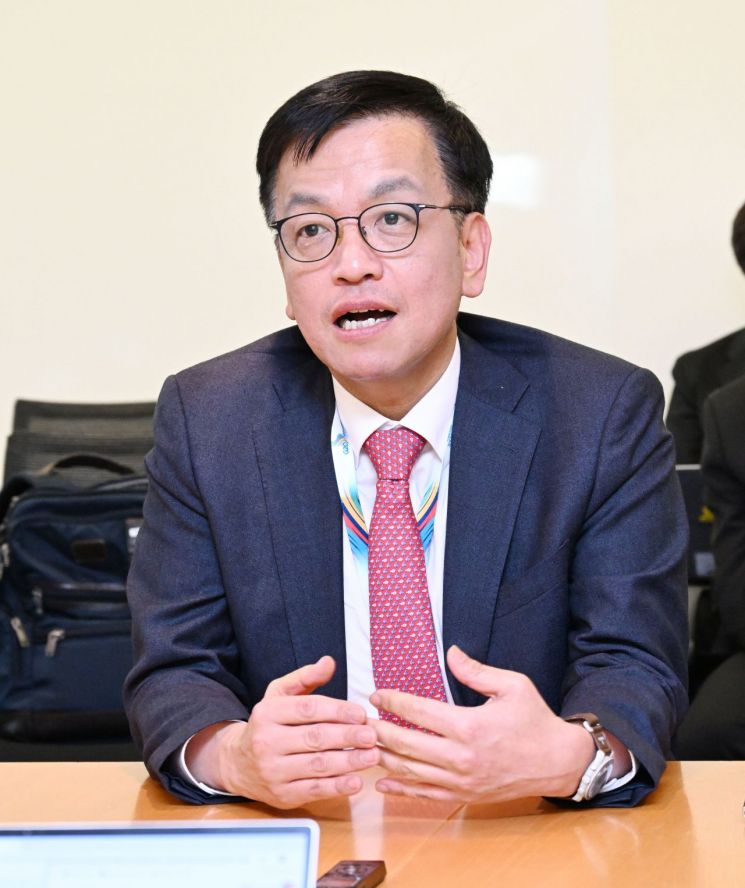 Choi Sang-mok, Deputy Prime Minister for Economic Affairs and Minister of Strategy and Finance, who is visiting Washington, USA to attend the G20 Finance Ministers and Central Bank Governors Meeting, is holding a press conference on the 19th (local time).
Choi, who visited Washington D.C., USA, to attend the G20 Finance Ministers and Central Bank Governors Meeting, held a press conference on the same day and made these remarks.
He expressed his intention to seek the opposition party's cooperation by specifically outlining the detailed direction of tax incentives to support the 'corporate value-up program.' Choi emphasized, "Since there are 14 million stock investors, we will persuade the National Assembly to find a consensus between the ruling and opposition parties."
The core of the corporate value-up program, proposed as a solution to the Korea discount (undervaluation of the Korean stock market), is tax incentives to induce voluntary shareholder return efforts such as dividend expansion by companies. The Ministry of Strategy and Finance disclosed in March that it plans to ease corporate tax burdens on a certain portion of increased shareholder returns and reduce dividend income tax burdens for shareholders of companies that expand dividends. However, it has explained that the specific methods of easing corporate tax burdens and the detailed contents of dividend income tax reduction have not yet been finalized.
On this day, Choi announced, "We will design the corporate tax credit and separate taxation on dividend income so that the tax relief benefits increase proportionally to the increase in companies' shareholder return efforts." This is interpreted as designing incentives to encourage corporate participation in value-up while preventing controversy over 'tax cuts for the wealthy.'
The dividend income increase tax system introduced in 2014 with the same purpose disappeared after three years amid criticism of tax cuts for the wealthy. At that time, the system allowed separate taxation at a 25% rate for shareholders holding high-dividend stocks who were subject to comprehensive financial income taxation (over 20 million KRW). For small shareholders, the withholding tax rate on dividend income was lowered from 14% to 9%, offering a greater reduction. This time as well, the tax rate will be lowered so that small shareholders can benefit from the value-up, and tax benefits will be applied proportionally to the increase in dividend income by companies. Choi also revealed plans to persuade the National Assembly as much as possible to include specific details such as tax credit rates in the tax law amendment bill by July to enable legislative revision.
Budget Review from Zero Base Again This Year... From Departmental Review to Project-Based Review
He also expressed his determination to rigorously sort out fiscal projects to implement major policy tasks announced at public discussion forums as much as possible. Choi said, "This year, we will review projects from a rigorous zero base," adding, "We will give significant incentives to departments that eliminate many ineffective projects." He further explained, "Previously, budgets were reviewed by departments, but this year, budgets will be examined by projects."
He explained that when promoting new projects, the focus will be on whether each department has cooperated to eliminate unnecessary existing projects as much as possible. He added, "The more ineffective projects are cleared out, the more incentives (to undertake new projects) can be obtained." He emphasized the need for close cooperation among departments, especially since budgets will be reviewed by major projects. This is interpreted as a directive to cut down overlapping and scattered similar projects across multiple departments as much as possible.
The Ministry of Strategy and Finance announced in March the 'Guidelines for Budget Formulation and Fund Operation Plan Preparation,' stating plans to carry out strong expenditure structure innovation again this year. It plans to restructure by reducing all discretionary expenditures except national tasks by more than 10%, and to reform rigid expenditures by identifying projects causing leakage due to moral hazard and changing support criteria. This shows the government's willingness to restructure not only discretionary expenditures, which can be adjusted in scale according to policy intentions, but also rigid expenditure projects. The 'zero-base evaluation,' which re-examines the effectiveness of all fiscal projects from scratch, will also continue.
Choi said, "The tasks revealed by the President at the public discussion forums are promises to the people," adding, "By reviewing fiscal expenditure restructuring from a zero base and eliminating as many projects with questionable effectiveness as possible to maintain fiscal sustainability, we can implement the policies announced at the public discussion forums as smoothly as possible." He reaffirmed his commitment to implement issues requiring opposition cooperation, such as the abolition of the financial investment income tax.
Regarding public utility fee increases, he said he is "thinking conservatively" considering the price trends in the second half of the year. Choi stated, "It is difficult to comment because it depends on the impact of public utility fees on prices, the financial structure of public institutions, and global price trends." He added, "Although geopolitical instability such as oil prices has increased, the forecast that consumer prices will stabilize downward to the mid-2% range in the second half remains valid, so various efforts are underway."
On the establishment of a special account for low birth rates, he drew a line, saying, "It is not yet at the stage of review." Regarding the low birth rate issue, he mentioned, "I am also a member of the Low Birth Rate and Aging Society Committee, and since the Ministry of Strategy and Finance is the fiscal authority, I believe it is important to take a multifaceted approach in cooperation with the relevant authorities." He added, "It is important to remove low-effectiveness low birth rate policies based on scientific data and to promote highly effective measures."
© The Asia Business Daily(www.asiae.co.kr). All rights reserved.
![Clutching a Stolen Dior Bag, Saying "I Hate Being Poor but Real"... The Grotesque Con of a "Human Knockoff" [Slate]](https://cwcontent.asiae.co.kr/asiaresize/183/2026021902243444107_1771435474.jpg)
















