7.6% Increase Year-on-Year in Q1 to 480,000 TEU
YGPA's 'One Carrier One Route Campaign' Effect
Yeosu Gwangyang Port Authority (President Park Seong-hyun, YGPA) announced that the cumulative provisional container throughput at Gwangyang Port for the first quarter of this year rose by 7.6% compared to the first quarter of last year, reaching 480,000 TEU (1 TEU equals one container box).
In January this year, Gwangyang Port's container throughput increased by 10.3% compared to the previous year. However, in February, operations were halted due to the Korean Lunar New Year holiday and the Chinese Spring Festival holiday, resulting in a modest increase rate of 0.2%. In March, production and operations resumed, recording an 11.5% increase compared to the previous year, continuing the upward trend.
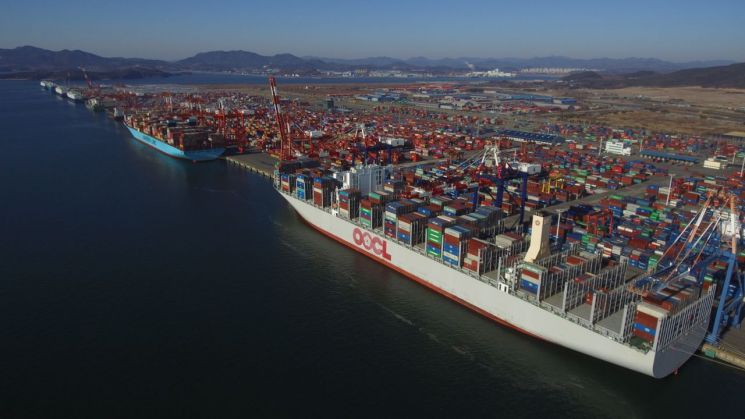
Since President Park Seong-hyun took office in 2021, the authority has been promoting “on-the-ground marketing” and the “one shipping company, one plus service attraction campaign,” focusing all organizational capabilities. As a result, in 2023, it successfully attracted eight new services including those from Europe and Latin America.
In particular, thanks to the attraction of new deep-sea services, transshipment volume increased by about 50% compared to the first quarter of last year, reversing the declining trend in Gwangyang Port’s throughput caused by the COVID-19 pandemic and the shipping and logistics crisis.
Import and export volumes also increased by 2.2%, and despite economic policies focusing on boosting domestic demand in China, Gwangyang Port’s largest trading partner, growth was driven by the United States and Southeast Asia regions.
President Park Seong-hyun stated, “The authority must stand at the center of the industrial structure transformation in the Gwangyang Bay area, represented by petrochemicals and steel.” He added, “In addition to the existing cargo portfolio of petrochemicals, steel, automobiles, and containers, we will actively create eco-friendly convergence cargo such as secondary batteries and new materials, laying the foundation for Gwangyang Bay, which has led South Korea’s economy for the past 50 years, to lead innovation for the next 100 years.”
Meanwhile, the authority is proceeding with the sale of 610,000㎡ of the first phase site of the Yulchon Convergence Logistics Complex, which will serve as the foundation for creating eco-friendly convergence cargo, and is accepting business proposals until April 26 of this year.
© The Asia Business Daily(www.asiae.co.kr). All rights reserved.

















