EU May Cut Interest Rates More Proactively Than the US
To Lower Rates... Need Confidence in Price and Exchange Rate Stability
As monetary policies around the world show signs of decoupling, there is a possibility that South Korea's monetary policy will follow a trend similar to that of Europe. While the United States is experiencing a "lone boom" contrary to the global economic trend, South Korea and major European countries continue to face sluggish domestic demand. Experts say that for South Korea to proactively cut interest rates, it ultimately needs confidence in inflation control and exchange rate stability.
Lee Chang-yong, Governor of the Bank of Korea, said at a press conference following the Monetary Policy Committee meeting on the 12th, “Monetary policy decoupling is progressing globally,” adding, “Since the U.S. has already given a pivot signal, (South Korea) may cut rates either before or after the U.S.”
So far, countries have aligned their monetary policies with the U.S. to avoid capital outflows caused by widening interest rate differentials. However, this year, except for the U.S., many countries have shown sluggish economic trends or sufficiently eased inflation, leading them to make more proactive pivots (monetary policy shifts) than the U.S.
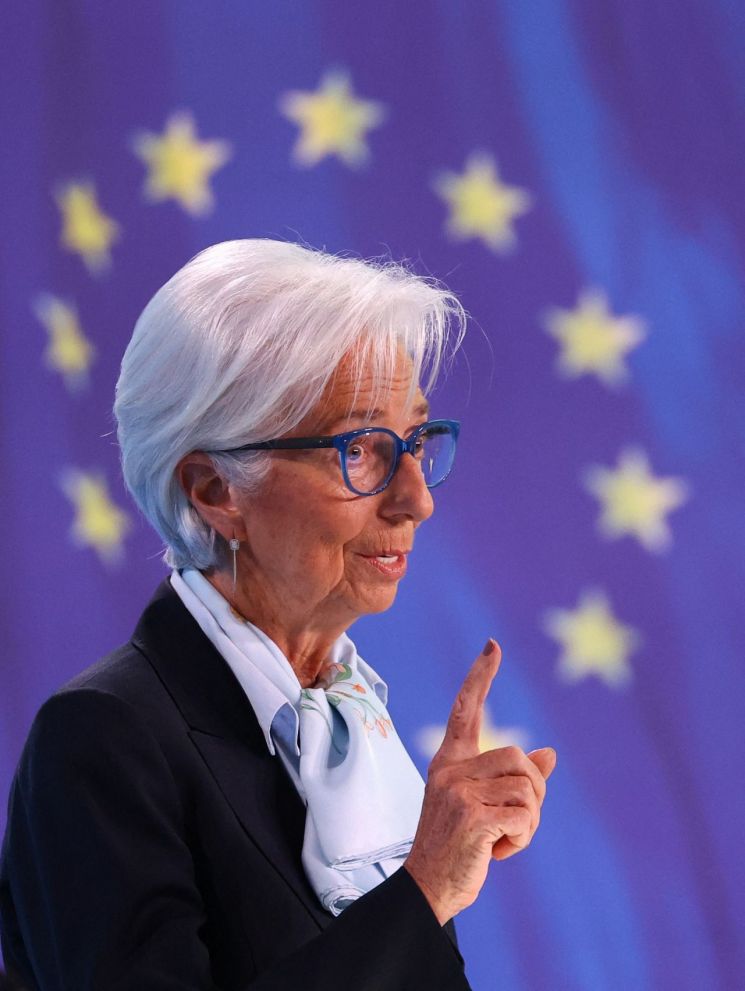
The European Central Bank (ECB) is also expected to pivot before the U.S. Federal Reserve (Fed). Despite ongoing uncertainties such as the Middle East conflict and inflationary pressures, it is anticipated that interest rate cuts will proceed unless there is a major economic shock. ECB President Christine Lagarde said in an interview with CNBC on the 16th (local time), “If there is no major shock to the economy, we will soon ease monetary tightening.” This effectively signals that the ECB will start cutting its benchmark interest rate around June or July this year.
On the other hand, the U.S. pivot is expected to be later than June. On the same day, Fed Chair Jerome Powell said at a Canadian economic forum held in Washington D.C., “Recent data has not given clear confidence that inflation is reaching the 2% target,” adding, “It suggests it will take longer than expected to gain that confidence.” Powell’s hawkish remarks have led the market to believe that a rate cut in June is unlikely.
Can the Bank of Korea Make a Proactive ‘Pivot’?
The common factor among countries that have pivoted ahead of the U.S. is confirmed indicators showing that inflation has sufficiently stabilized. The Swiss National Bank, which cut its interest rate by 0.25 percentage points to 1.5% annually on the 21st of last month, stated in a release that “the consumer price inflation rate is expected not to exceed 1.5% until 2026.” The Czech Republic and Hungary also cut rates by 0.5 and 2.5 percentage points respectively this year, with both countries confirming indicators that inflation has entered a stable zone. Ultimately, a proactive move is possible only with confidence that inflation will stabilize.
Additionally, if there is confidence that the won will not depreciate due to interest rate differentials with the U.S., South Korea can cut rates before the U.S. Yoon Yeo-sam, a researcher at Meritz Securities, said, “Assuming Europe cuts rates around June, we need to check whether the euro will not weaken significantly,” adding, “Then, a rate cut could be possible around August, a step ahead of the U.S. potential cut in September.”
Economic conditions are also a variable. On the 16th, the International Monetary Fund (IMF) downgraded the economic growth forecasts for European countries such as Germany (0.2%) and France (0.7%) in its “April World Economic Outlook,” citing deteriorating consumer sentiment. These figures are 0.3 percentage points lower than the forecasts made in January. In contrast, the U.S. is expected to show strong growth of 2.7%, exceeding the previous forecast of 2.1%. This indicates that economic stimulus is more urgent in Europe than in the U.S.
Experts suggest that South Korea is likely to follow a monetary policy stance similar to Europe’s. Researcher Yoon said, “Although the recent high exchange rate increases uncertainty, if the euro’s depreciation remains limited after Europe cuts rates, the possibility of a rate cut in South Korea in the third quarter remains valid.” Jeong Kyu-chul, head of the KDI Economic Outlook Office, said, “The U.S. economy is quite strong and requires high interest rates, whereas South Korea’s domestic demand is sluggish but inflation remains high, so if inflation stabilizes further, South Korea can pivot independently of the U.S.”
However, some argue that a proactive rate cut is difficult because the economic situations in Europe and South Korea differ. Jo Young-moo, a research fellow at LG Economic Research Institute, said, “Europe’s economic growth was about 0.5% last year and is expected to be below 1% this year, making it difficult to ignore a recession,” adding, “Meanwhile, South Korea’s policymakers expect economic growth in the low 2% range this year, so they are unlikely to rush rate cuts.” In fact, unlike the IMF’s downward revision of Europe’s economic outlook on the 16th, South Korea’s growth forecast remained at 2.3%, the same as in January.
© The Asia Business Daily(www.asiae.co.kr). All rights reserved.

















