"Support Target Groups Focused on Socially Vulnerable People Now"
Choi Sang-mok, Deputy Prime Minister for Economic Affairs and Minister of Economy and Finance, expressed a negative stance on the opposition party's request for supplementary budget on the 18th (local time), stating, "Supplementary budgets are usually implemented when a recession occurs."
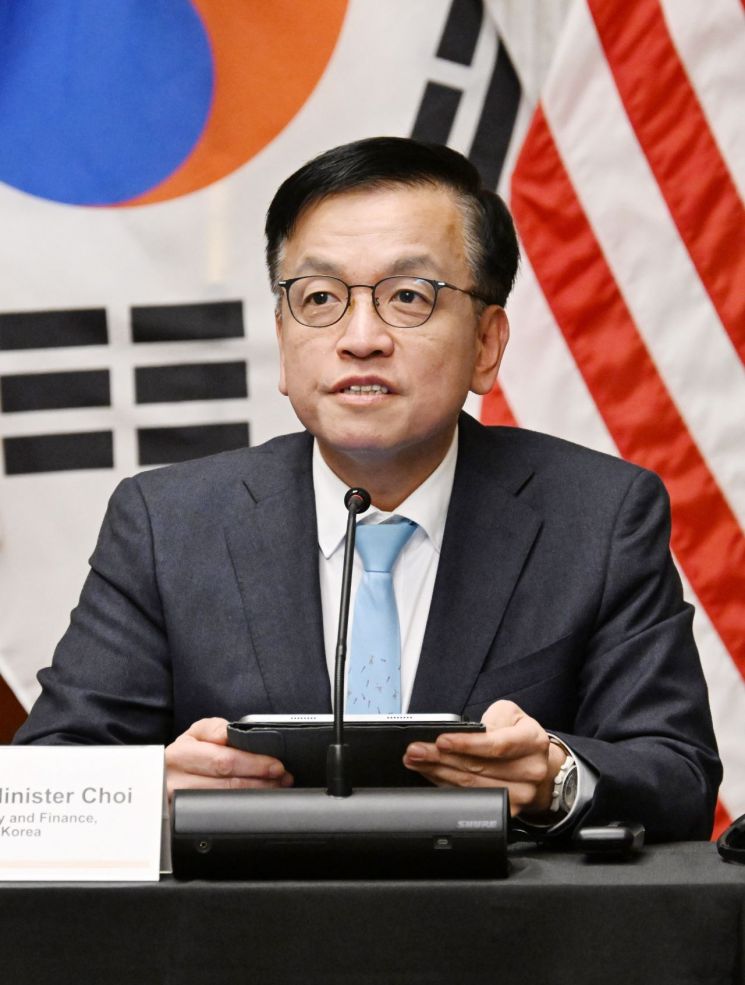 Choi Sang-mok, Deputy Prime Minister for Economic Affairs and Minister of Economy and Finance, visiting Washington, USA to attend the G20 Finance Ministers' Meeting
While visiting the United States to attend the International Monetary Fund (IMF) and World Bank (WB) annual meetings, Deputy Prime Minister Choi met with reporters at the IMF headquarters building in Washington D.C. and said, "Considering our country's growth rate forecast, now is the time to provide support through targeted groups, focusing on socially vulnerable populations."
He added, "The role of fiscal policy is more about people's livelihoods than economic recession," and said, "When setting this year's budget, we allocated a significant portion to welfare and livelihood budgets more than ever before." Regarding inflation, Deputy Prime Minister Choi said, "I always feel the weight of inflation," but also noted, "Our country's core inflation is more stable compared to other countries."
He continued, "Initially, we expected the consumer price index increase rate to stay below 3% in the first half of the year and stabilize around the low to mid 2% range in the second half," and stated, "Although there are many uncertainties, core inflation itself is moving steadily, so the forecast that inflation will stabilize downward in the second half remains valid."
Regarding the continuously rising KRW-USD exchange rate, he said, "We are closely monitoring the situation and have response plans for various scenarios," adding, "Issuing messages to the foreign exchange market through international cooperation, such as during the recent meeting with the Japanese Finance Minister or the Korea-U.S.-Japan Finance Ministers' meeting, is part of that effort."
On the 17th (local time), the finance ministers of Korea, the U.S., and Japan shared concerns about the recent sharp depreciation of the Korean won and Japanese yen. When asked whether this means the U.S. has approved Korea's active intervention in the foreign exchange market to raise the won's value, he replied, "You can understand it as the media interprets it," and added, "It is correct to take the wording as it is."
When asked if there were any measures to counter China at the Korea-U.S.-Japan Finance Ministers' meeting, he said, "The discussions at the Korea-U.S.-Japan Finance Ministers' meeting were not about excluding any specific country but about sharing awareness and responding to challenges common to the three countries." He also mentioned, "We are currently consulting for this year's Korea-China Economic Ministers' meeting."
© The Asia Business Daily(www.asiae.co.kr). All rights reserved.
![Clutching a Stolen Dior Bag, Saying "I Hate Being Poor but Real"... The Grotesque Con of a "Human Knockoff" [Slate]](https://cwcontent.asiae.co.kr/asiaresize/183/2026021902243444107_1771435474.jpg)
















