Growing Corporate Interest Ahead of Weekend Work on the 20th
Voluntary Participation Amid Internal and External Emergencies
Potential Image Damage, Work-Life Balance Setback
"Working Hours Do Not Equate to Performance"
Low Likelihood of Widespread Corporate Adoption
As the 'six-day workweek' involving some executives of Samsung Group affiliates expands starting this weekend, the business community's attention is focused on this development. Within the industry, voices of concern outweigh those of understanding.
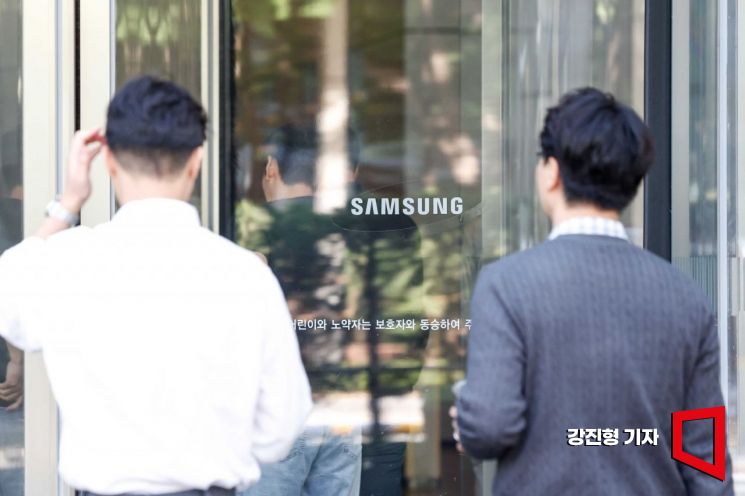
Executives from Samsung Electro-Mechanics, Samsung SDI, Samsung SDS, Samsung Display, and others will choose one day between Saturday and Sunday to work on weekends starting from the 20th. The six-day workweek practiced by executives of some affiliates like Samsung Electronics is spreading throughout the entire group. It is known that this participation is voluntary by executives, considering the recent difficult company circumstances, rather than a group-wide directive.
Samsung Group executives are keeping their comments brief. Some reportedly responded with "Do we really have to come to work?" but most seem to feel that not much will change. An executive from one affiliate said on the 19th, "We are already working on weekends," adding, "It’s actually good because it gives me time to calmly wrap up the week."
However, outside Samsung, while there is some understanding of executives deciding to work six days a week, doubts are raised about its effectiveness. When employees of other companies were asked about Samsung executives’ six-day workweek, many responded that "the drawbacks outweigh the benefits."
There is particular concern that this will lead to a ‘loss of talent.’ It is feared that Samsung, competing with rivals and globally, will suffer adverse effects in the talent war due to the negative external image caused by the six-day workweek. A public enterprise official emphasized, "The younger generation of talent today values ‘work-life balance (WLB)’ over any achievement, so they will not view a six-day workweek favorably," and predicted, "This could ultimately deal a significant blow to Samsung’s talent recruitment and development."

Why did Samsung, which was expanding flexible work, change course?
Just two years ago, under the leadership of Samsung Electronics, Samsung was expanding flexible work arrangements. In 2022, the minimum working hours (4 hours) were abolished, and the ‘fully selective working hours system’ was widely implemented. As a result, employees could work just one hour a day and leave early. They only needed to meet the total monthly working hours. External satellite offices were also established to allow autonomous work.
The biggest reason for the change in atmosphere over two years is attributed to intensified global competition and the resulting performance pressure. Among Samsung executives who experienced a sharp decline in performance last year due to the ‘semiconductor cold wave,’ there is reportedly a heightened sense of urgency that this year must be different. Some affiliates faced reduced bonuses, and in January, Kyung Kye-hyun, President of Samsung Electronics’ Semiconductor (DS) Division, along with heads of business units, froze their salaries, increasing the pressure. This internal atmosphere is widely believed to have driven executives to head to the office even on weekends.
Worries over expansion to regular employees
The biggest concern within Samsung Group is whether the six-day workweek for executives will also affect regular employees at the manager level and below. Inside and outside the company, there is much talk that if executives come to work, it will inevitably influence lower-level employees.
Executives have very limited tasks they can do alone on weekends. Since related institutions are all closed, it is difficult to start new work. If a culture of executives coming to work on weekends is established, cynical employees predict that regular workers will also come to work out of pressure. There is also potential for internal controversy over whether contacts from executives to regular employees on weekends should be considered an extension of work.
Industry insiders point out that the effectiveness of executives’ weekend work on company performance is unclear. Various workplace communities have flooded with questions like, "If this does not lead to results, who will be held responsible?" A large company executive said, "I understand the decision was made due to the recent difficult economic situation, but I question whether increasing working hours is the right method," adding, "Isn’t it already well known that working hours and performance are not proportional?"
There are also concerns that executives’ work will remain mere ‘armchair theorizing.’ It is said that this could even harm innovative ideas. This concern has grown following recent foreign media criticism of Samsung Electronics for a "lack of research and development (R&D) innovation." On the 17th, the Japanese media outlet Nikkei Asia analyzed that "Samsung Electronics is lagging behind competitors like TSMC (Taiwan) because it avoids risks and does not focus on R&D and technological innovation," adding, "Samsung Electronics’ organizational environment makes it difficult to attempt new initiatives in R&D."
Unlikely to spread across the entire business community
Some speculate that Samsung executives’ six-day workweek might spread throughout the business community. If it takes root at Samsung, other major companies might find it difficult not to follow. However, according to explanations from industry insiders, it seems more likely that it will not actually spread. Most companies have outright dismissed the possibility of considering or implementing a six-day workweek for their employees. They also show a strong will not to get involved in the six-day workweek debate.
Even SK Group, which revived its ‘Saturday CEO meetings’ in January, stated that its approach is "different in nature" from Samsung’s six-day workweek. SK holds its ‘Strategy Global Committee’ meetings, attended by executives of the SK Supreme Council and CEOs of major affiliates, once a month on weekdays but changed to every other Saturday. This is the first time since the introduction of the five-day workweek in July 2000 that SK has held Saturday meetings of this kind. An SK official emphasized, "Only CEO-level executives participate in Saturday meetings, and they truly just meet and hold the meeting. No actual work is done." Five companies contacted by Asia Economy all responded that "regardless of employee category, they are not considering a six-day workweek."
© The Asia Business Daily(www.asiae.co.kr). All rights reserved.


















