"Need to Monitor Consumer Prices for 1-2 More Months"
"Sufficient Measures Available to Stabilize Exchange Rates"
Lee Chang-yong, Governor of the Bank of Korea, stated on the 18th (local time) regarding the possibility of an interest rate cut, "We need to observe how the Consumer Price Index (CPI) will develop over the next one to two months," adding, "The biggest variable is oil prices."
Governor Lee, who is visiting Washington D.C., USA, to attend the G20 Finance Ministers and Central Bank Governors Meeting, made these remarks at a press conference on the same day.
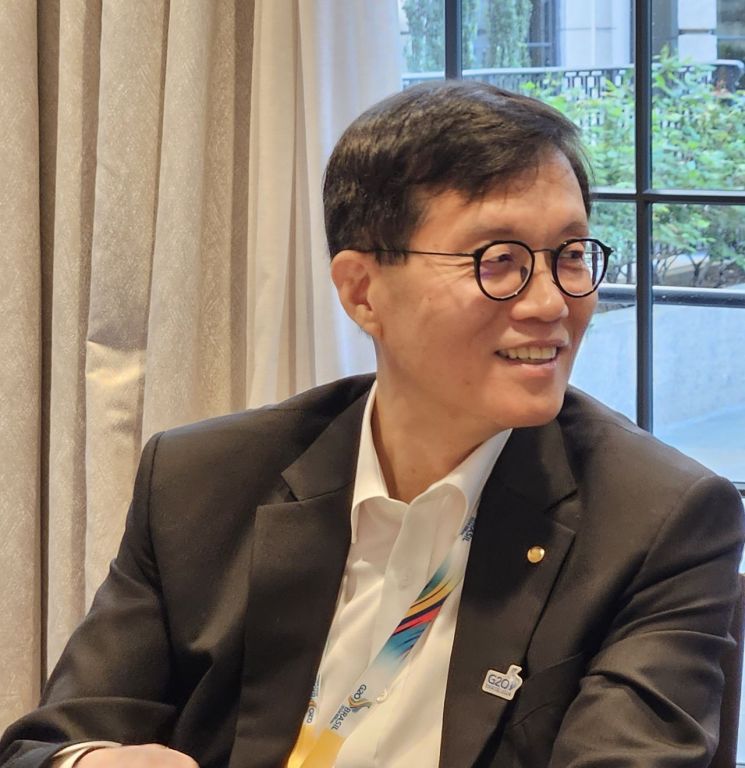 Lee Chang-yong, Governor of the Bank of Korea, is responding during a press conference held on the 18th (local time) in Washington D.C., USA. / Photo by Ministry of Economy and Finance
He explained, "Rather than the monetary policies of major countries, we see oil prices as the biggest premise for an interest rate cut," adding, "Oil prices are currently forming at a higher level than expected." He further noted, "The biggest issue is whether oil prices can stay below $90 per barrel (Dubai crude standard) or if they will rise further."
Governor Lee's concerns have deepened due to increasing uncertainty in international oil prices. The Bank of Korea had projected inflation rates assuming international oil prices would fluctuate in the $80 per barrel range this year. However, recent Middle East tensions, such as Iran's attack on Israel, have pushed oil prices above $90 per barrel, raising concerns about whether the expected inflation trajectory can be maintained.
He pointed out that the unpredictability of oil price trends has increased uncertainty in the consumer price forecast path. Governor Lee stated, "The Bank of Korea's forecast that consumer prices will reach 2.3% in the second half of the year was based on the assumption that oil prices would remain in the high $80s per barrel," adding, "We need to observe the broader impact of the Middle East situation on the global economy."
Regarding the timing of an interest rate cut, he said, "All five members of the Monetary Policy Committee, except for myself, believe it is premature to suggest the possibility of a rate cut," but added, "We need to observe the CPI trends for at least one or two months."
Governor Lee also emphasized that there are sufficient measures to stabilize the exchange rate. He reiterated that the foreign exchange authorities are well-prepared to intervene in the market to defend the exchange rate as the situation demands. In an interview with CNBC the previous day, he said regarding the recent sharp rise in the won-dollar exchange rate, "We consider the recent volatility somewhat excessive," and added, "If exchange rate volatility continues, we are prepared to take market stabilization measures and have sufficient means to do so."
The exchange rate has been soaring, surpassing the 1,400 won per dollar mark during trading on the 16th. However, after Choi Sang-mok, Deputy Prime Minister and Minister of Economy and Finance, Janet Yellen, U.S. Treasury Secretary, and Suzuki Shunichi, Japanese Finance Minister, issued a joint statement expressing concerns that the depreciation of the won and yen against the dollar was excessive, the exchange rate stabilized somewhat and fell to the 1,370 won range.
Governor Lee diagnosed, "We believe our exchange rate has deviated from its fundamentals," and said, "The recent movements in the exchange rate over the past few days are excessive by any measure." He also emphasized, "Basically, considering purchasing power parity and interest rate differentials, the speed at which the exchange rate is deviating from fundamentals is too fast."
He continued, "Due to the rise in oil prices caused by the Middle East situation and the increased growth rate in the U.S., expectations that the timing of an interest rate cut may be delayed have overlapped simultaneously, raising questions about whether the current pace is reasonable," adding, "Because we were certain that the speed of deviation from fundamentals was too fast, we can talk about intervention." However, he refrained from specifying how the foreign exchange authorities would intervene to defend the exchange rate, stating, "The authorities cannot reveal all their cards."
Regarding the possibility of concluding a currency swap agreement with the United States, he expressed that the necessity is not significant. South Korea and the U.S. signed a currency swap agreement in October 2008 when the global financial crisis began, but it ended in 2021 without renewal. Governor Lee said, "Every time the exchange rate fluctuates, there is talk about currency swaps, but we need to look at why the exchange rate is moving," adding, "Japan has a standing currency swap with the U.S., but its currency has depreciated more than Korea's." He further added, "Now is a time when signing a swap would not be effective."
© The Asia Business Daily(www.asiae.co.kr). All rights reserved.
![Clutching a Stolen Dior Bag, Saying "I Hate Being Poor but Real"... The Grotesque Con of a "Human Knockoff" [Slate]](https://cwcontent.asiae.co.kr/asiaresize/183/2026021902243444107_1771435474.jpg)
















