Grant 120% Maximum Floor Area Ratio for Public Notice Installation
Revamp Incentive Items Including UAM and Underground Power Lines
Abolish Reduced Floor Area Ratio Rules for Semi-Residential and Commercial Zones
Unify Zoning Change Reference Year to 2000
When constructing buildings in Seoul, if public open spaces accessible to citizens are created, an additional 120% floor area ratio (FAR) can be granted. The artificially lowered standard FAR regulations for quasi-residential and commercial areas will also be abolished. If items necessary for the public are introduced, an additional 110% FAR incentive will be provided.
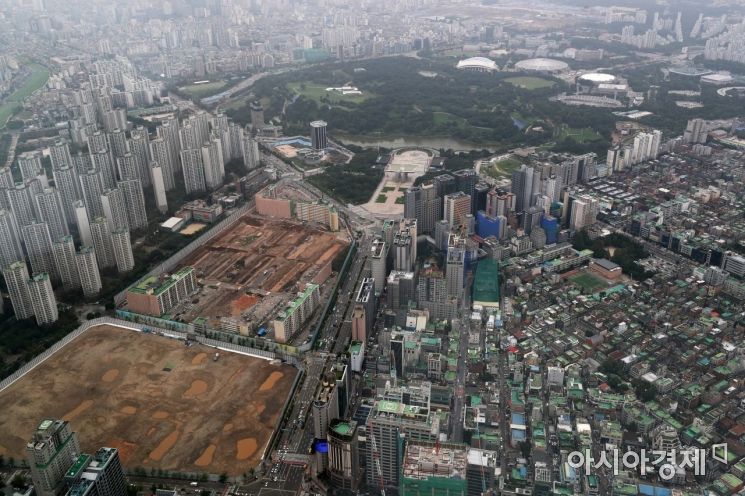 The government is introducing a public reconstruction system as part of expanding supply to stabilize the real estate market, and will significantly relax floor area ratio and height restrictions for reconstruction apartments in Seoul. Alongside this, land development will be pursued, including the site of Taereung Golf Course in Nowon-gu, Seoul, aiming to supply a total of 132,000 new housing units. The photo shows the city center view from Lotte World Tower in Songpa-gu, Seoul, on the 4th. Photo by Mun Ho-nam munonam@
On the 19th, the Seoul Metropolitan Government announced the "Seoul District Unit Plan FAR System Reform Plan," focusing on providing incentives and eliminating unnecessary regulations. This plan will be applied from the time district unit plans are decided or changed in the future. If there is a proposal from residents, it will be immediately reflected to expedite project implementation.
Seoul will reform the FAR system to further activate private development. The main points are ▲expansion of the target for maximum FAR ▲establishment of incentive items aligned with city policy directions ▲simplification and integration of the FAR operation system.
FAR is the ratio of the total floor area of a building to the site area; the higher it is, the higher the development density. The standard FAR is the basic FAR, the allowable FAR is the FAR provided when the conditions set in the district unit plan are met, and the maximum FAR is the highest limit that can be relaxed through donations or other means.
Application of Maximum FAR When Installing Public Open Spaces, Expanded to All District Unit Plan Areas
In the future, even if the area is not a semi-industrial zone, maximum FAR can be applied if public open spaces are created. This also applies to buildings constructed as intelligent buildings or designated as special architectural zones.
For example, in district unit plan areas designated as general commercial zones, the incentive for installing public open spaces, which was previously capped at 800%, can be expanded up to 960%. The incentives added through public open spaces, intelligent buildings, etc., can be up to 120% of the maximum FAR limit set by the enforcement ordinance.
Seoul's district unit plan areas are plans that establish building heights and scales for some urban planning target areas. They were created to use land rationally and induce planned development. They cover 35% of Seoul's total area (excluding green spaces).
District unit plan areas have been used as a means to manage building density and expand infrastructure. After 24 years since the system was introduced, regulations have accumulated, and it has sometimes acted as an obstacle to downtown development due to inability to respond to urban situations such as population decline.
Abolition of Standard FAR Reduction, 110% Incentive Provided Compared to Ordinance FAR
The regulation that artificially lowered the standard FAR in district unit plan areas will also be abolished. The standard FAR will be applied the same as the ordinance FAR. The standard FAR for quasi-residential areas will change from 300% to 400%. For general commercial areas, it will improve from 500-600% to 800%, and for central commercial areas, from 600-700% to 1000%.
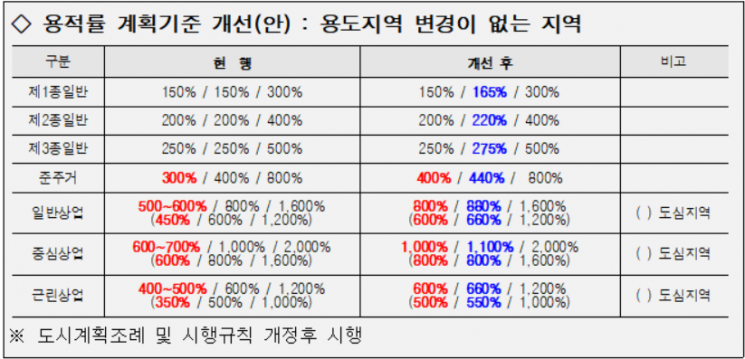
Currently, the standard FAR in quasi-residential and commercial areas within district unit plan areas has been set 100-300 percentage points lower than the FAR specified in the ordinance. Instead, incentives for allowable FAR were provided when existing incentive items such as public open spaces, building setback lines, and joint development were implemented. As a result, project owners often chose the easier incentives to implement, limiting the inducement of plans to achieve the purpose of each district unit plan.
Going forward, the city will provide up to an additional 110% allowable FAR incentive compared to the ordinance FAR when public interest items or those aligned with policy objectives are introduced. If project owners build buildings by introducing future city policies or public interest items, they will receive incentives increased up to 110%. With incentives, quasi-residential areas will have 440%, general commercial 880%, and central commercial 1100% FAR.
Incentives Provided for Introducing Underground Power Lines, UAM Facilities, etc.
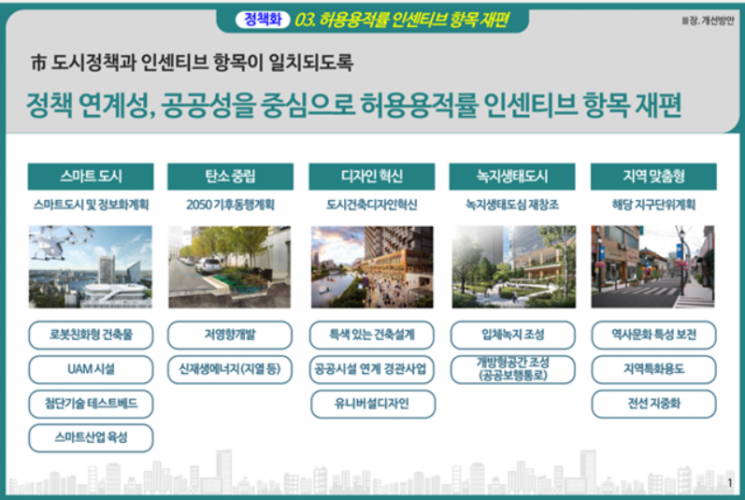
The FAR incentive items will also be reorganized to consider future urban space demand and secure public interest. It was judged that existing incentive items such as building setback lines, recommended uses, and joint development are difficult to respond to future changes.
Incentives will be provided when future industry uses such as robot-friendly buildings and UAM (Urban Air Mobility) facilities are introduced, or when items aligned with city policy directions such as carbon neutrality and green ecological cities are introduced. Items such as renewable energy, three-dimensional green space creation, open spaces (public pedestrian passages), and underground power lines are also included.
Unification of Zoning Calculation Standards to the Year 2000
The FAR system, which was operated differently depending on the timing of zoning changes even within the same area, will be unified based on the year 2000. For example, commercial zones changed before 1991 had an allowable FAR of 800%, but those changed after 1991 were applied at a lower 630%. The FAR system changed every time the Urban Planning Act was amended, causing confusion among citizens.
Seoul decided to simplify the zoning change timing criteria, which were applied differently, to the year 2000. The district unit plan system was introduced when the Urban Planning Act was enacted in 2000. Before 2000, when zoning was upgraded, the FAR system of the upgraded zoning had to be followed. Afterward, the law was amended so that even if zoning was upgraded, the maximum FAR could not be exceeded.
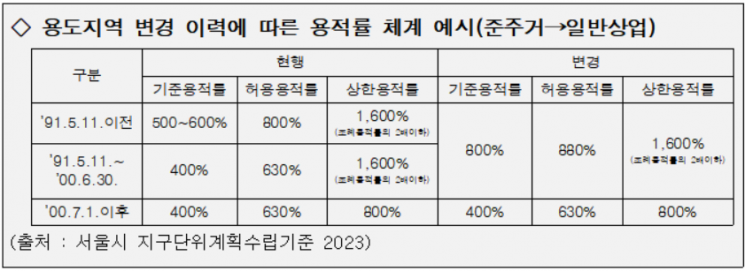
Areas changed to general commercial zones before 2000 will be adjusted to current standards. When changing from quasi-residential to general commercial zones, the standard FAR will be unified to 800%, allowable FAR to 880%, and maximum FAR to 1600%. Areas changed to general commercial zones after July 2000 will have a standard FAR of 400%, allowable FAR of 630%, and maximum FAR of 800%.
Seoul expects that this FAR system improvement will enable dense development without zoning upgrades, revitalizing projects for regional maintenance. Especially, most commercial areas where FAR increases due to the zoning standard timing adjustment are located in Gangbuk and Gangseo districts.
Namjun Cho, head of Seoul's Urban Space Headquarters, said, "At this time when various urban changes are expected, this system improvement will re-highlight district unit plan areas as regions that support private development and provide vitality. We will continue to promote system improvements to ensure balanced development with Seoul city policies."
© The Asia Business Daily(www.asiae.co.kr). All rights reserved.
![Clutching a Stolen Dior Bag, Saying "I Hate Being Poor but Real"... The Grotesque Con of a "Human Knockoff" [Slate]](https://cwcontent.asiae.co.kr/asiaresize/183/2026021902243444107_1771435474.jpg)













