Efforts to Revitalize the Northeast Asia Energy Hub Continue
Korea National Oil Corporation held a ceremony on the 18th at Ulsan North Port to commemorate the first cargo arrival of petroleum products at Korea Energy Terminal (KET).
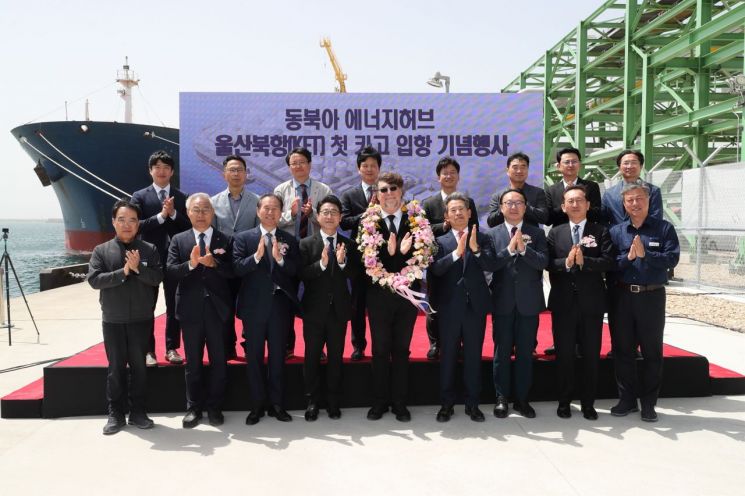 Northeast Asia Energy Hub Ulsan North Port (KET) First Cargo Arrival Commemoration Ceremony (front row from the left, 3rd: Kim Dong-seop, President of Korea National Oil Corporation; Lee Ho-yeon, Director of Energy Policy, Ministry of Trade, Industry and Energy; Captain Parenov Paul; Ahn Hyo-dae, Deputy Mayor for Economic Affairs of Ulsan; Lee Kyung-sik, Director of Ulsan Free Economic Zone Authority)
The 125,000 barrels of naphtha received that day were brought in under the ‘Korea Energy Terminal (KET)-T Company Oil Tank Lease Agreement’ signed in March. T Company plans to blend various additives into the naphtha upon future arrivals to manufacture gasoline that meets the quality standards of the final consumer countries and then export it.
To develop Korea as a Northeast Asia energy logistics hub, the Oil Corporation has established commercial energy storage facilities in Ulsan following Yeosu and has worked to improve institutional conditions to activate international oil trading.
In the mid-phase of the project, in 2015, there was a crisis when existing investors withdrew due to low oil prices causing reduced investment by oil companies and the financial burden of constructing large-scale storage facilities. However, by expanding the project scope from oil to LNG and attracting investors (SK Gas), the existing Korea Oil Terminal was reborn as Korea’s first Oil & LNG complex terminal, Korea Energy Terminal.
The Oil Corporation supported institutional improvements with related agencies such as the Ministry of Trade, Industry and Energy and the Korea Customs Service to enable oil traders to operate freely in Korea. As a result, in 2017, international oil trading was newly established under the Petroleum Business Act, and from January 2024, domestic petroleum products exported to bonded zones will be eligible for refunds on customs duties, value-added tax, and import charges, allowing international traders to utilize petroleum products produced by domestic refineries for blending.
As a result of these institutional improvements, Korea’s advanced refining and chemical industries and its geographical advantage close to the U.S. and Australia have become a reality, with expectations for the movement of blending volumes previously directly exported to Singapore to Korea.
The first cargo arrival by T Company is evaluated as a meaningful outcome of the Oil Corporation’s efforts so far.
In his commemorative speech, Kim Dong-seop, President of the Oil Corporation, expressed gratitude to related organizations including the Ministry of Trade, Industry and Energy, Ministry of Oceans and Fisheries, Ulsan City, and Ulsan Port Authority for their active support leading up to the first petroleum product cargo arrival. He added, “Starting transactions with T Company, we will continue to strive to make Korea Energy Terminal a hub of Northeast Asian energy through continuous exchanges with domestic and international energy companies.”
The Oil Corporation plans to attract additional customers to expand petroleum logistics (trading), drive the development of related industries such as shipping and ports, and revitalize the regional economy. It will also promote CCS, bioenergy, hydrogen, and ammonia projects on the remaining land at Ulsan North Port and Ulsan South Port to establish Ulsan as a carbon-neutral energy hub, supporting the government’s low-carbon and eco-friendly energy policies.
© The Asia Business Daily(www.asiae.co.kr). All rights reserved.
![Clutching a Stolen Dior Bag, Saying "I Hate Being Poor but Real"... The Grotesque Con of a "Human Knockoff" [Slate]](https://cwcontent.asiae.co.kr/asiaresize/183/2026021902243444107_1771435474.jpg)
















