The Bank of Korea Announces '2023 Exports and Imports by Settlement Currency'
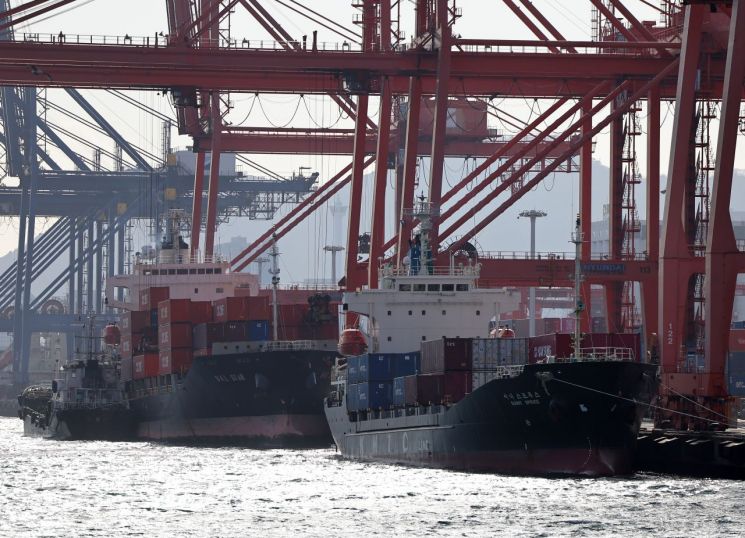
Last year, as exports of semiconductors and petroleum products declined, the share of the US dollar in total export settlement currencies fell by 2 percentage points from the previous year to 83.1%.
According to the '2023 Export and Import by Settlement Currency (Final)' released by the Bank of Korea on the 18th, the export share by settlement currency last year was recorded as follows: US dollar (83.1%), euro (6.8%), Korean won (2.8%), Japanese yen (2.3%), and Chinese yuan (1.7%). The top five currencies accounted for 96.7% of total exports.
Among these, the share of US dollar settlements decreased by 2 percentage points compared to the previous year, while the euro and Korean won increased by 1 percentage point and 0.5 percentage points, respectively.
The decline in the US dollar export settlement share was due to decreased exports of semiconductors, petroleum products, and chemical products, which have a high proportion of US dollar settlements. Semiconductors accounted for 98.3%, petroleum products 98.9%, and chemical products 87.7% of US dollar settlement exports.
Moon Hye-jung, team leader of the International Balance of Payments Team at the Bank of Korea’s Economic Statistics Bureau, stated, “This year, with exports showing a clear improvement compared to last year, the share of US dollar export settlements is expected to increase.”
On the other hand, the share of euro export settlements rose. This was driven by a 7.7% year-on-year increase in euro-settled exports centered on passenger cars and machinery & precision instruments.
The share of the Korean won increased as exports rose by 14.3%, mainly in items with a high won settlement share such as passenger cars and machinery & precision instruments.
The shares of Japanese yen and Chinese yuan export settlements remained steady compared to the previous year. The yen share held steady as the decline in yen-settled exports of electrical and electronic products (-4.8%) was less than the overall export decline rate (-7.5%). The yuan share also remained steady as the decrease in yuan-settled exports, mainly steel products and electrical & electronic products (-5.4%), was less than the overall export decline rate (-7.5%).
Last year, the share of import settlement currencies was also highest for the US dollar (80.6%), followed by the Korean won (6.7%), euro (5.8%), Japanese yen (3.8%), and Chinese yuan (2.4%). The top five currencies accounted for 99.2% of total imports.
The share of US dollar import settlements fell by 2.3 percentage points from the previous year. Team leader Moon explained, “This decline was due to a decrease (-14.5%) in imports of raw materials such as crude oil and gas, which are usually settled in US dollars.” The average annual import price of crude oil dropped 16.7% from $102.8 per barrel in 2022 to $85.7 last year.
The share of Japanese yen import settlements also slightly decreased by 0.1% as yen-settled imports, mainly machinery & precision instruments and chemical products, declined (-15.2%).
Conversely, the share of Chinese yuan import settlements rose by 0.7 percentage points from the previous year to a record high of 2.4%. This was driven by a 21.9% increase in yuan-settled imports centered on secondary batteries and accumulators. Team leader Moon explained, “The increase was due to Chinese companies raising the share of yuan-settled exports, especially for secondary batteries.”
The share of euro imports also increased as euro-settled imports of machinery & precision instruments and electrical & electronic devices rose by 6.0%.
The share of Korean won imports increased by 0.6 percentage points despite a 3.0% decrease in won-settled imports mainly in chemical products, as increases in passenger cars and other items outpaced the overall import decline rate (-12.1%).
© The Asia Business Daily(www.asiae.co.kr). All rights reserved.

















